What a room energy system has to get right
Most hotel energy saving schemes fail in the same place: the system decides a room is empty while a guest is still inside. Lights switch off while someone is reading, air conditioning drops to an unoccupied setpoint while someone is asleep, and the guest calls the front desk.
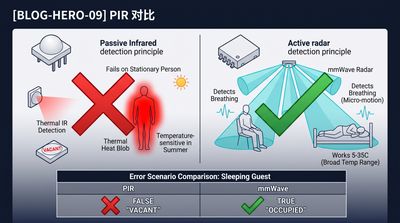
The cause is usually the sensor, not the control logic. A passive infrared (PIR) sensor reacts to movement and to the contrast between a warm body and the background. A guest who is asleep, reading or working at a desk produces almost neither. Once the room has been still for a few minutes, the system reports it vacant.
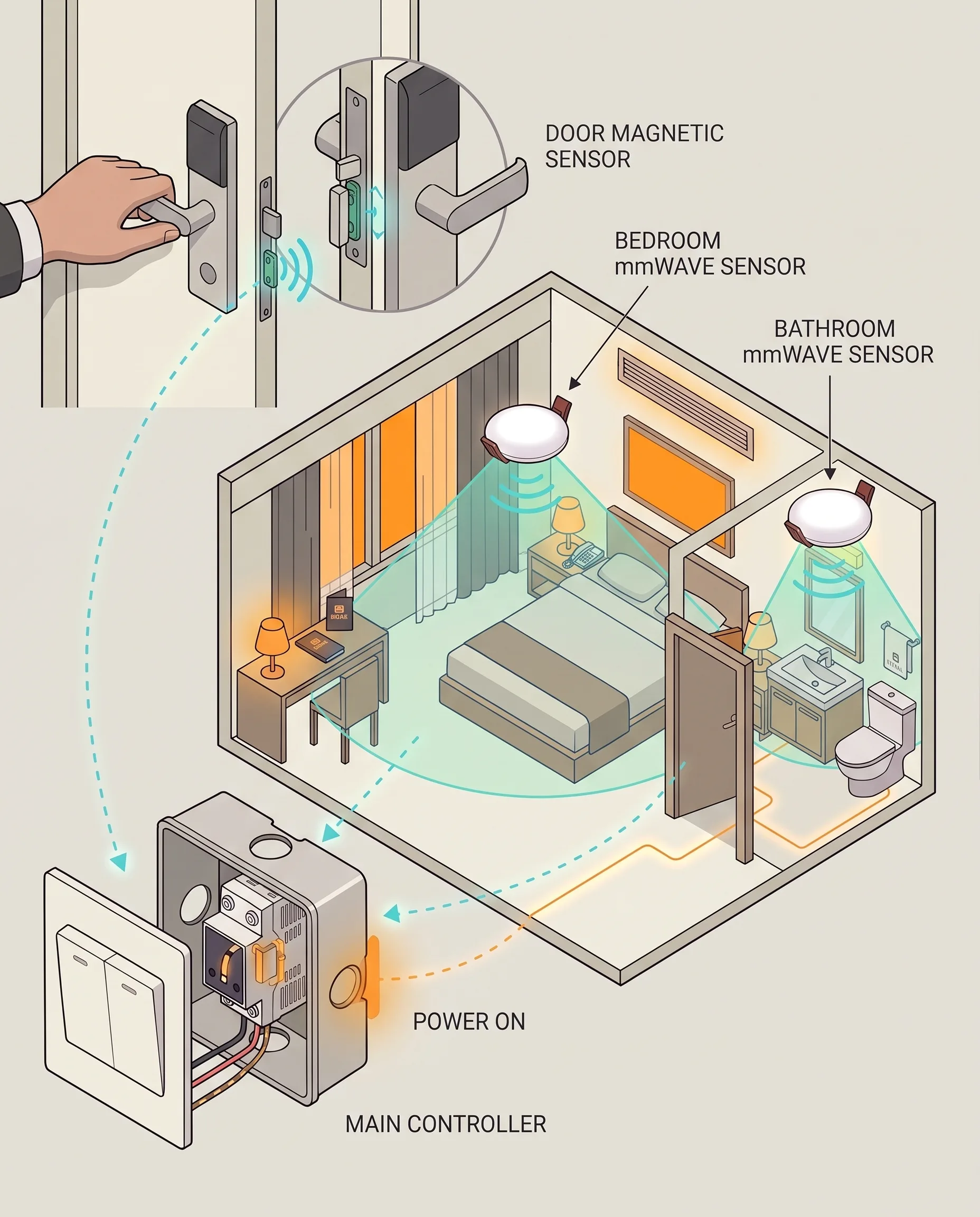
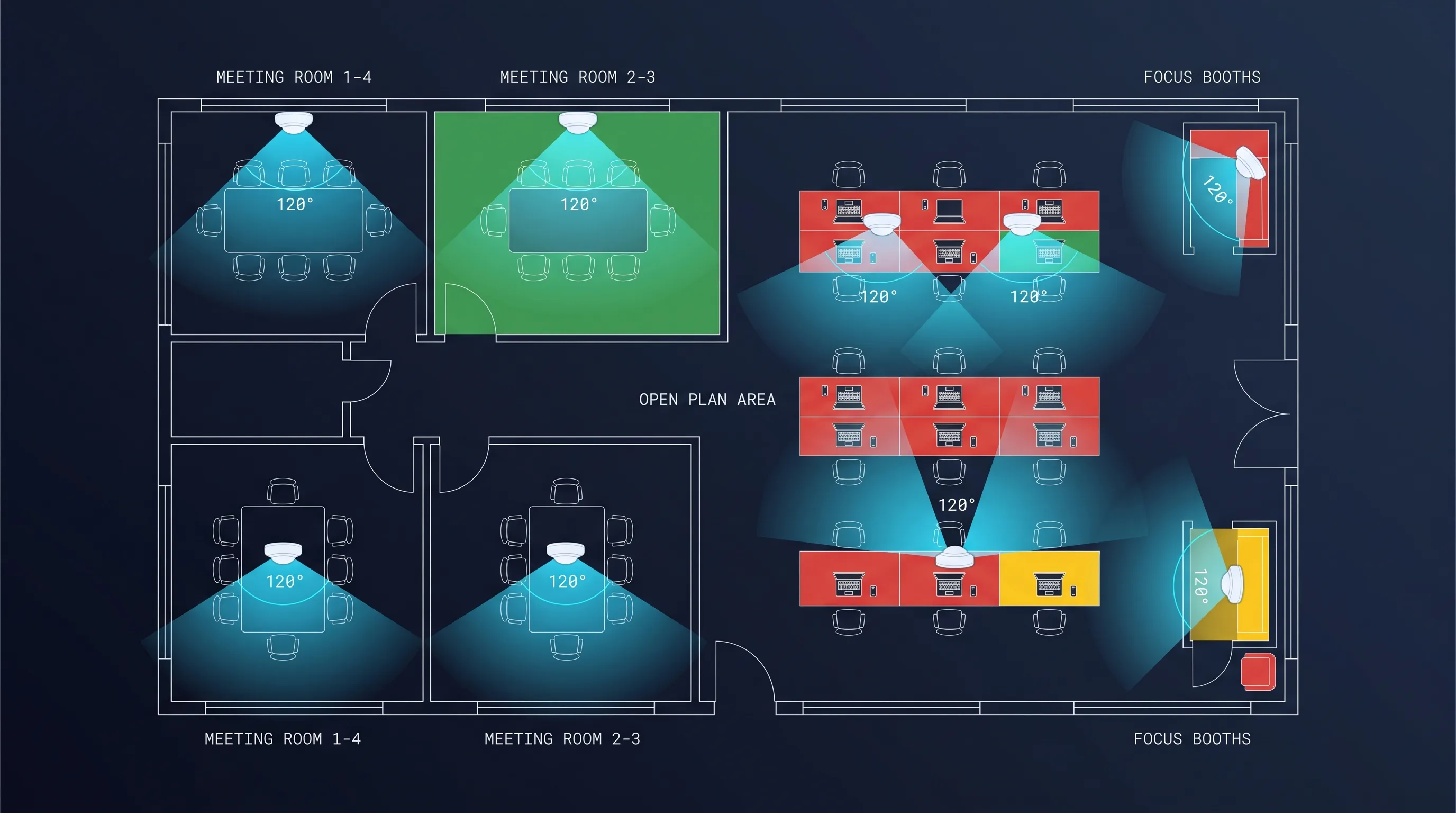
This system uses a different input. Two ceiling-mounted mmWave radar sensors measure the micro-motion of a person — including breathing — so a sleeping or seated guest keeps the room in the occupied state. Power is only cut when the sensors agree that nobody is left.
The parts, and where they go
| Component |
Location |
What it does |
Power |
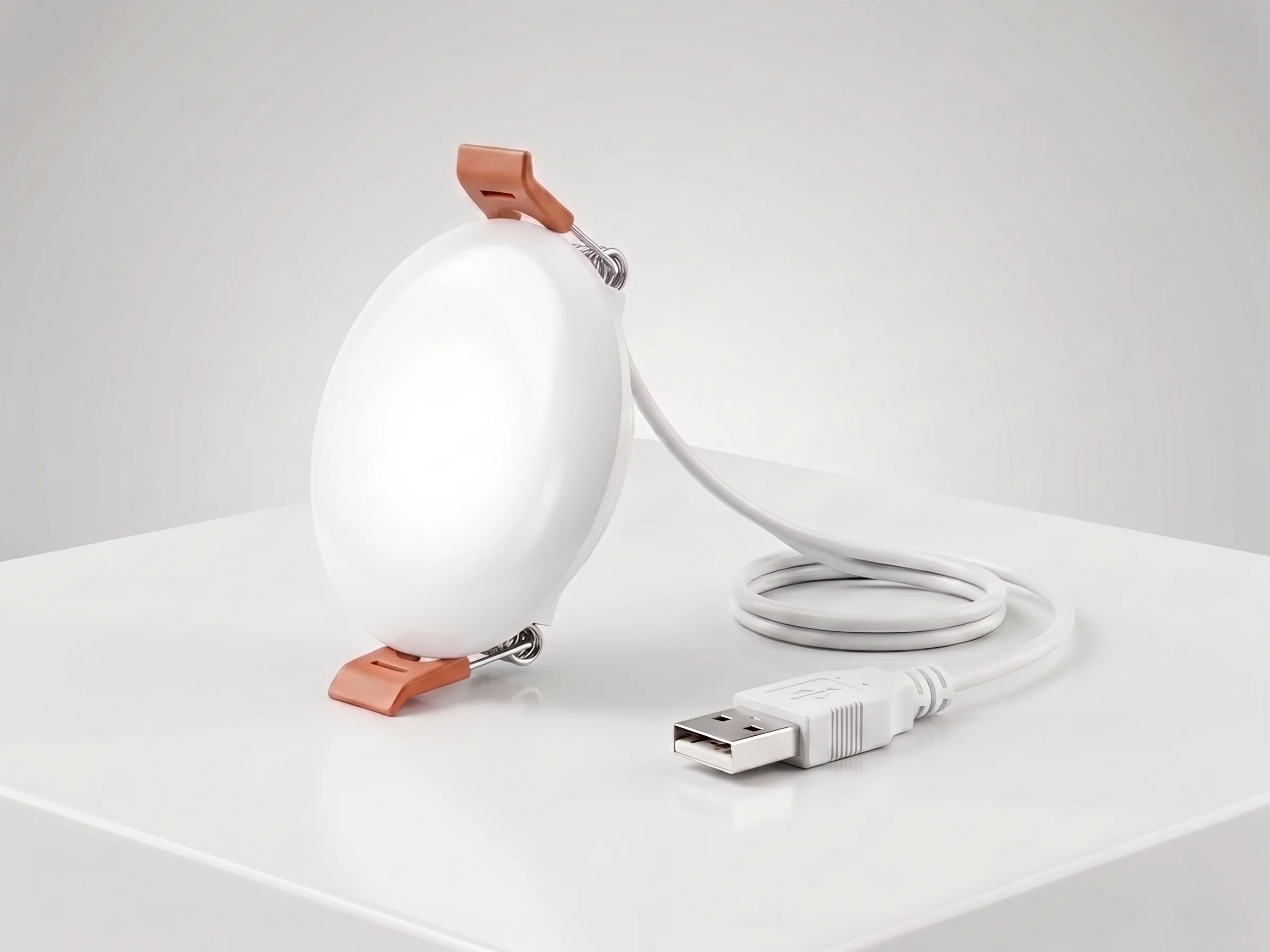
| Bedroom mmWave sensor |
Bedroom ceiling, above the sleeping area |
Detects motion to 10 m, micro-motion and breathing to 2.5 m, 120° field |
DC 5 V |
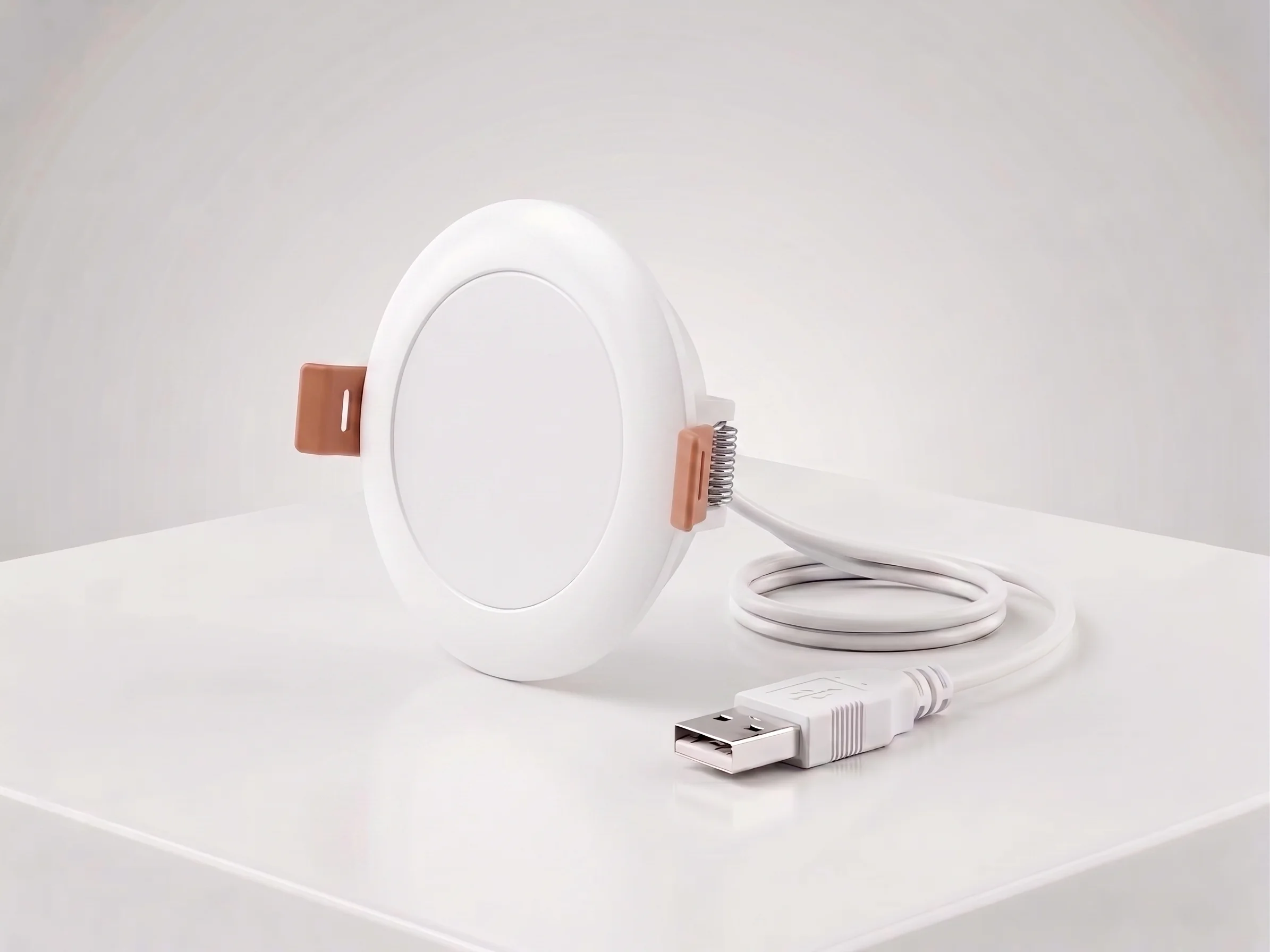
| Bathroom mmWave sensor |
Bathroom ceiling |
Covers the room the bedroom sensor cannot see |
DC 5 V |
| Door magnetic contact |
Inside the gap in the door lock body |
Reports every door open and close within a second |
Door lock battery |
| Central controller |
Inside the existing switch box |
Receives the sensor and door signals, switches room power |
Mains at the switch |
The door contact is a magnetic contact, 2 × 4 cm, fitted into the space that already exists inside the lock body. Because it takes its power from the lock battery, there is no extra supply to pull to the door and no battery to replace on a separate schedule. It works with any lock brand, needs no drilling and no configuration, and is live as soon as it is powered.
The guest journey, step by step
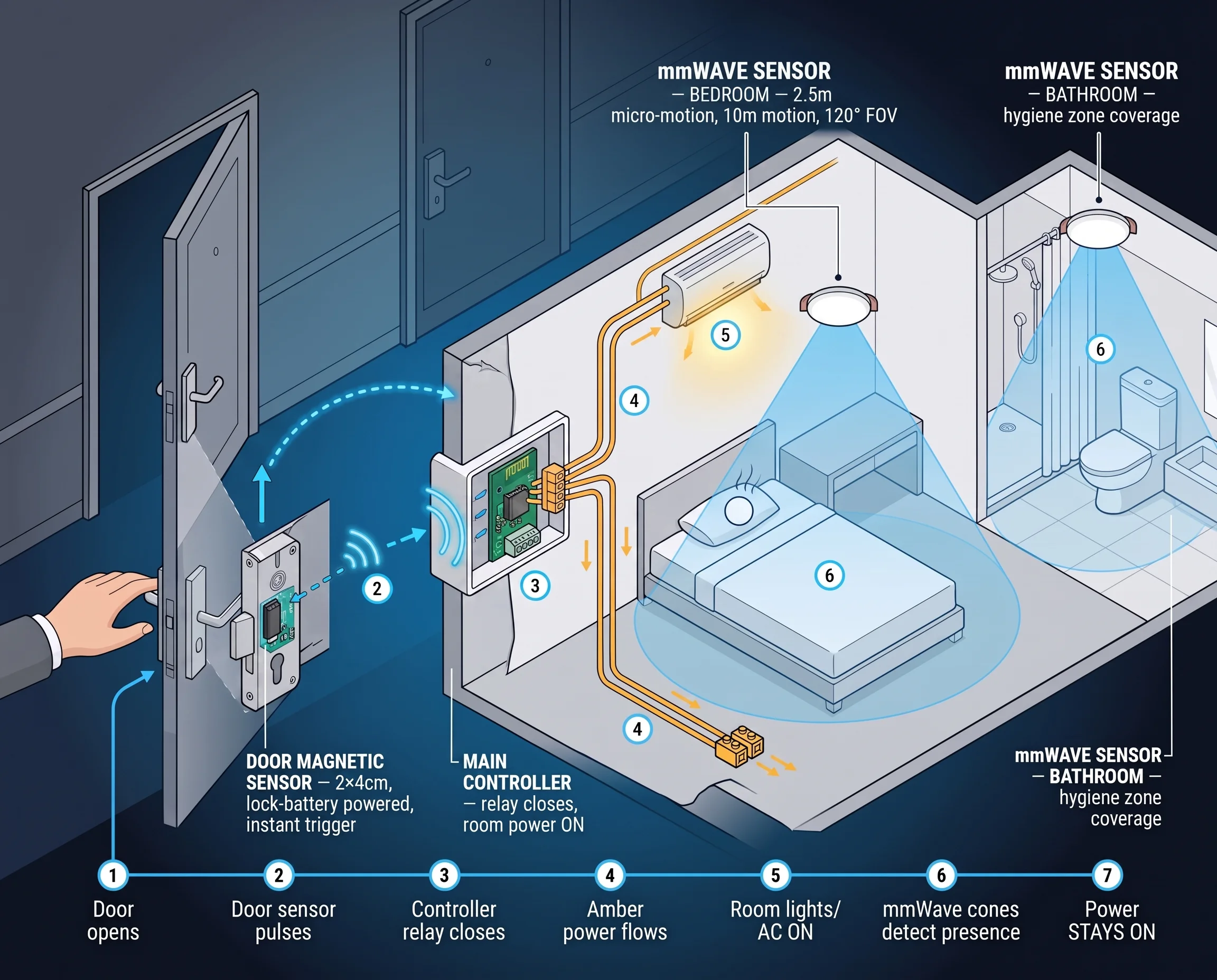
- The guest opens the door. The door contact reports the opening immediately and the controller energises the room. The guest walks into a lit room instead of reaching for a switch in the dark.
- The guest is in the bedroom. The bedroom sensor detects micro-motion and breathing, and the room stays powered. A sleeping guest is still an occupied guest.
- The guest uses the bathroom. The bathroom sensor holds the room occupied for as long as someone is in there, and can drive bathroom lighting and the exhaust fan on its own.
- The guest leaves. Both sensors report clear. After a configurable delay — five minutes is a common setting — the controller cuts room power. Lights, air conditioning and socket circuits go off together.
The door contact matters in step one because radar alone reacts a moment late: a person walking in is detected quickly, but the light should already be on. The sensors matter in step four because the door only tells you someone came in or went out, never whether the room is still occupied.
Why a card-key switch is not the same thing
A card-key switch asks the guest to do the sensing. The usual outcomes are familiar to every hotel operator:
|
Card-key switch |
Presence + door contact |
| What triggers power |
A card in a slot |
Actual presence in the room |
| Air conditioning before arrival |
Not possible — the room is cold or hot until the guest arrives |
Can be started on room assignment or on door opening |
| Spare card left in the slot |
Room runs empty for the whole stay |
Room powers down when the guest leaves |
| Guest forgets the card inside |
Room goes dark while the guest is still there |
Room stays powered |
| Housekeeping signal |
None |
Room status derived from real occupancy |
A card switch is a good fit where the goal is simply "no card, no power". It is a poor fit where the goal is knowing whether a room is actually occupied.
Why the bathroom needs its own sensor
mmWave radar does not pass through walls. A single sensor in the bedroom cannot see into an enclosed bathroom, and a guest taking a shower or sitting still in the bathroom produces little for a motion-based device to detect. That is how rooms get reported empty while a guest is in the bathroom — the classic false-vacancy case, and the one that generates complaints.
The second sensor removes it. It also gives the bathroom its own control loop: light and exhaust fan on presence, off on vacancy, independent of the bedroom.
What a retrofit needs
- Door lock: any brand. Send the model and a photo of the lock body so we can confirm the 2 × 4 cm space for the contact.
- Switch box: the in-room switch box must have line and neutral available to power the controller. A photo of the wiring is enough for us to check.
- Ceiling: sensor positions in the bedroom and the bathroom, normally a standard flush cutout.
- Room count and layout: standard rooms, suites and accessible rooms use different quantities.
Where this fits, and where it does not
✅ Existing hotels, serviced apartments and resorts that want room-level power control without replacing the lock or the wiring.
✅ Properties that want the saving to depend on real occupancy rather than on guest behaviour.
✅ Projects where the room must keep working if the network or the internet is down.
❌ Rooms where the switch box has no accessible line and neutral.
❌ New-build projects that require every device to be native to a central building management protocol. This system is deliberately self-contained inside the room and does not speak those protocols.
Estimating the saving without invented numbers
We do not publish a headline percentage, because the number depends on your climate, your tariff, your room mix and how the property is run today. The calculation that matters is straightforward:
- Take the annual energy used by in-room air conditioning, lighting and socket circuits per room, from your own metering or from the utility bills for a representative floor.
- Establish how many hours per day those loads run while the room is actually empty. This is the addressable share, and it is usually far larger than operators expect.
- Apply your tariff to the addressable share. That is the annual ceiling for any occupancy-based system.
- Subtract installation and hardware amortised over the number of rooms.
A pilot floor gives you steps 1 and 2 with your own data in two to four weeks. We will build the model with you rather than hand you a percentage.
From survey to rollout
- Survey — door lock model, switch box photo, room count and room types.
- Sample room — one full set installed and observed across a normal stay cycle.
- Floor pilot — 20 to 40 rooms for two to four weeks, measured against your baseline.
- Rollout — production and shipment in batches aligned with your installation schedule, with wiring diagrams and a commissioning checklist for the property team.
What we need to quote
Send five things and we will return a bill of materials, a per-room count and a pilot plan:
- Door lock brand and model, plus a photo of the lock body.
- A photo of the in-room switch box with the cover off.
- Room count, split by standard room, suite and accessible room.
- Whether bathroom lighting and exhaust should be controlled by the system.
- Destination country and required delivery window.
If you are still at specification stage, send the same information and we will mark up the rooms that need a second sensor.