mmWave Sensors Wholesaler: Complete OEM Bulk Procurement Guide 2026
Learn how to source mmWave sensors in bulk from wholesalers. Covers OEM pricing, tiered pricing structures, MOQs, and supplier evaluation for commercial deployments.
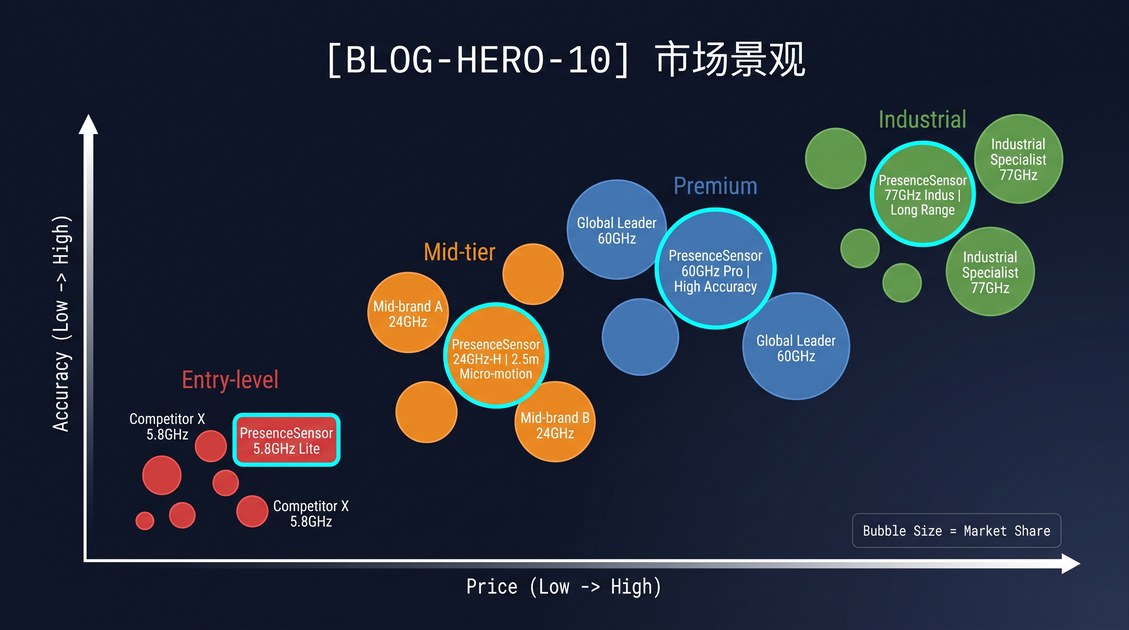
An mmWave sensors wholesaler is a business entity that supplies millimeter-wave radar components, modules, or finished presence detection products to OEMs, system integrators, and commercial procurement teams at volume-based wholesale prices typically structured across three tiers: 1,000-unit lots at $6–18 per module for a 60 GHz presence sensor, 10,000-unit lots at $4–12 per module, and 100,000-unit lots at $3–8 per module, with the specific price point within each band determined by frequency (24 GHz being cheapest, 77 GHz most expensive), antenna configuration (2×2 MIMO vs 3×3 MIMO vs 4×4 MIMO), certification scope (FCC/CE only vs automotive qualification), and bundling (standalone module vs module with pre-certified reference design). The wholesale pricing structure reflects the bill of materials cost (where the mmWave chipset represents 40–60% of the module cost), the factory calibration and testing overhead (5–8% of module cost), and the supplier's profit and overhead (10–15% of module cost). A reliable mmWave sensors wholesaler provides transparent volume-based pricing, clear MOQ terms, regional warehousing options, and technical support for integration, with a commitment to quality that includes ISO 9001 certification, FCC/CE regulatory compliance, and a documented quality system that ensures consistent performance across volume production runs.
Procuring mmWave sensors in bulk from a wholesaler is a strategic sourcing decision that goes beyond finding the lowest per-unit cost. The procurement team must evaluate the wholesaler's technical capability (can they deliver sensors that meet the application requirements for detection range, accuracy, and field of view), manufacturing quality and reliability (what certifications do they hold, what is the field failure rate), supply chain resilience (what is the lead time, is the chipset dual-sourced, what is the geographic risk), and commercial terms (what are the payment terms, what is the warranty policy). This guide provides a structured framework for evaluating mmWave sensors wholesalers, explains the pricing structure across volume tiers, identifies the cost drivers that can be negotiated, and offers a decision framework for selecting the right wholesaler for a specific deployment.
mmWave Sensors Wholesaler: Understanding the Wholesale Pricing Structure
The wholesale pricing of mmWave sensors is not a single price point but a volume-based curve that reflects the economies of scale in semiconductor manufacturing and in sensor assembly. The pricing structure is standardized across the industry, but the specific price points vary by vendor and by the technical configuration of the sensor.
mmWave Sensors Wholesaler: Tier 1 Pricing — Prototyping and Pilot Deployments (1K–2,500 Units)
The first volume tier, typically covering orders of 1,000 to 2,500 units, represents the highest per-unit cost because the supplier must recover the setup and overhead costs of a small production run. For a 60 GHz mmWave presence sensor with a 3×3 MIMO antenna array and Zigbee connectivity, the typical wholesale price range in this tier is $6–18 per module.
The upper end of this price band ($12–18) typically includes:
- A 3×3 or 4×4 MIMO antenna array with fine angular resolution
- Integrated machine learning for presence classification
- Full certification suite (FCC, CE, IC, MIC, SRRC, KC, NCC, RCM)
- Extended warranty (24 months)
- Priority support
The lower end of this price band ($6–10) typically includes:
- A 2×2 MIMO antenna array with basic angular resolution
- Rule-based presence classification
- Basic certification (FCC, CE only)
- Standard warranty (12 months)
- Standard support
The MOQ in this tier is typically 500–1,000 units. For an OEM evaluating a new mmWave sensor design, this tier is used for building engineering samples and for conducting a limited pilot deployment (e.g., 50 sensors in 10 hotel rooms) before committing to higher volume.
mmWave Sensors Wholesaler: Tier 2 Pricing — Production Deployments (2,500–25,000 Units)
The second volume tier, typically covering orders of 2,500 to 25,000 units, represents a 20–40% discount compared to the Tier 1 pricing. For the same 60 GHz sensor described above, the typical wholesale price range in this tier is $4–12 per module.
The discount comes from several factors: the supplier can amortize the setup costs across a larger run, the supplier benefits from component-level volume discounts (especially on the mmWave chipset), and the supplier can optimize the production line for the specific SKU. For a hotel chain deployment of 200 rooms or an office building deployment of 1,000 sensors, this tier is typically where the procurement lands.
The MOQ in this tier is typically 2,500–5,000 units. A procurement team can often negotiate additional concessions in this tier, including extended payment terms (net 60 days instead of net 30), price protection clauses (if the supplier reduces the price for another customer within 6 months, the price is retroactively reduced), and a right of first refusal on capacity reservations.
mmWave Sensors Wholesaler: Tier 3 Pricing — High-Volume Production (25,000+ Units)
The third volume tier, typically covering orders of 25,000 units and above, represents a 30–50% discount compared to the Tier 2 pricing. For the same 60 GHz sensor, the typical wholesale price range in this tier is $3–8 per module.
This tier is where large hotel chains (1,000+ rooms), commercial real estate portfolios (2,000+ sensors), and OEMs shipping millions of units per year land. The discount comes from the supplier's ability to optimize the production line for high volume, to qualify second-source components to reduce BOM cost, and to pass through significant component-level volume discounts from the chipset vendors.
The MOQ in this tier is typically 10,000–25,000 units. A procurement team in this tier has significant leverage and can negotiate custom engineering (custom antenna pattern, custom RF front-end, custom firmware features), dedicated production lines, and multi-year supply agreements with scheduled price reductions.
| Volume tier | Unit range | Price range (60 GHz sensor) | MOQ | Typical customers |
|---|---|---|---|---|
| Tier 1 | 1K–2,500 | $6–18 | 500–1,000 | Prototyping, pilots |
| Tier 2 | 2.5K–25K | $4–12 | 2,500–5,000 | Hotel chains, offices |
| Tier 3 | 25K+ | $3–8 | 10K–25K | Large OEMs, portfolios |
mmWave Sensors Wholesaler: Cost Breakdown and Negotiable Components
Understanding the cost breakdown of an mmWave sensor module is essential for effective negotiation with a wholesaler. The cost is not a single number but a combination of hardware costs, manufacturing overhead, and supplier margin.
mmWave Sensors Wholesaler: Hardware Cost Breakdown
For a 60 GHz mmWave presence sensor module at 10,000-unit volume, the typical cost breakdown is:
- mmWave chipset (transceiver): 35–45% of module cost
- Antenna array and RF front-end: 20–30% of module cost
- Baseband processor: 10–15% of module cost
- Power management: 5–8% of module cost
- PCB and mechanical: 5–8% of module cost
- Factory calibration and testing: 5–8% of module cost
The chipset is the single largest cost component and is also where volume discounts are most significant. A 60 GHz chipset at 1,000-unit volume might cost $4–8, but at 100,000-unit volume it might cost $2–4. A procurement team can leverage this by negotiating volume-based chipset pricing with the wholesaler, or by qualifying a second chipset vendor to introduce competition.
mmWave Sensors Wholesaler: Manufacturing Overhead and Profit
Beyond the hardware cost, the wholesale price includes manufacturing overhead (labor, facility costs, equipment amortization) and supplier profit and overhead. These typically represent 20–25% of the total module cost.
A procurement team can sometimes negotiate these components by:
- Agreeing to a longer warranty period in exchange for a lower unit price (the supplier's quality cost is lower when the warranty is longer because they invest more in upfront testing)
- Accepting longer lead times in exchange for a lower unit price (the supplier can optimize production scheduling and reduce overtime costs)
- Committing to a multi-year supply agreement with scheduled price reductions (the supplier benefits from predictable volume and can plan capacity accordingly)
mmWave Sensors Wholesaler: Supplier Evaluation Framework
Selecting an mmWave sensors wholesaler requires evaluating the supplier across four dimensions: technical capability, manufacturing quality, supply chain resilience, and commercial terms.
mmWave Sensors Wholesaler: Technical Capability Evaluation
The technical capability evaluation should confirm that the wholesaler's sensors meet the application requirements. Key criteria include:
- Stationary-occupant true positive rate: above 99% in controlled testing, above 95% in real-world deployment
- False positive rate: below 1% over a 24-hour period
- Detection range: 6–8 m for a ceiling-mounted 60 GHz sensor
- Field of view: ±60° azimuth, ±40° elevation for a typical ceiling-mounted sensor
- Power consumption: 0.5–1.0 W active for a ceiling-mounted sensor
The wholesaler should provide independent test data for these metrics, not just marketing claims. The procurement team should request the test methodology and a redacted version of the test report.
mmWave Sensors Wholesaler: Manufacturing Quality Evaluation
The manufacturing quality evaluation should confirm that the wholesaler has robust quality systems in place. Key criteria include:
- Certifications: ISO 9001 for quality management, and any industry-specific certifications (IATF 16949 for automotive, ISO 13485 for healthcare)
- Yield rate: above 95%
- Field failure rate: below 0.5% per year
- Warranty period: 12–24 months standard, with longer warranties available at additional cost
The wholesaler should be willing to share these metrics and to provide references from existing customers in the target vertical.
mmWave Sensors Wholesaler: Supply Chain Resilience Evaluation
The supply chain resilience evaluation should confirm that the wholesaler can meet volume commitments and can mitigate disruptions. Key criteria include:
- Chipset sourcing: dual-sourced on mmWave chipsets for 60 GHz; single-sourced is acceptable for 77 GHz but is higher risk
- Lead time: 8–12 weeks at 10K volume for 60 GHz; longer lead times should be questioned
- Capacity headroom: supplier running at 60–80% capacity is preferred over 95%+ capacity
- Geographic risk: manufacturing in multiple countries is preferred over manufacturing in a single country
The wholesaler should be transparent about their capacity utilization and their future capacity expansion plans.
mmWave Sensors Wholesaler: Commercial Terms Evaluation
The commercial terms evaluation should confirm that the wholesaler offers fair and flexible terms. Key criteria include:
- Pricing transparency: clear volume-based pricing across three tiers
- Payment terms: net 30 to net 90 days, with early payment discounts available
- Warranty: 12–24 months, with a clear return process
- MOQ: reasonable for the procurement team's volume requirements
The procurement team should negotiate the best possible terms while recognizing that the wholesaler needs a reasonable margin to maintain quality and reliability.
mmWave Sensors Wholesaler: Common Procurement Mistakes
Several common procurement mistakes can undermine the success of a bulk order. The most frequent failure modes are:
- Focusing only on unit price: choosing the cheapest supplier without considering quality, reliability, or support
- Not evaluating chipset sourcing: failing to ask whether the chipset is dual-sourced or single-sourced
- Not requesting independent test data: accepting marketing claims without verification
- Not conducting a pilot order: committing to a full bulk order without first verifying the sensor's performance in the actual deployment environment
- Not understanding the landed cost: failing to account for shipping, customs, and duties in the total cost calculation
A disciplined procurement process that avoids these mistakes is more likely to result in a successful deployment with a reliable wholesaler.
mmWave Sensors Wholesaler: Final Recommendation
Selecting an mmWave sensors wholesaler is a strategic sourcing decision that should be approached with a structured evaluation framework. The procurement team should start by defining the application requirements (detection range, stationary-occupant detection, field of view, connectivity), then identify a shortlist of 3–5 wholesalers, then evaluate each wholesaler across the four dimensions (technical capability, manufacturing quality, supply chain resilience, commercial terms), and then select the wholesaler that scores best across all dimensions.
For a procurement team planning a bulk order, the right approach is to request quotes from multiple wholesalers, to negotiate the price volume curve and the commercial terms, and to execute a pilot order (50–500 units) before committing to the full bulk order. With this structured approach, a procurement team can secure competitive pricing, ensure quality and reliability, and establish a long-term relationship with a wholesaler that can support the organization's presence detection deployments for years to come.
Part of this article content is generated by AI and optimized for professional accuracy and readability.
Not sure which sensor fits your project?
Talk to our mmWave application engineers for a free consultation.
Find the right presence sensor for your hotel project
Compare the 3 protocols, check hotel-specific case studies, and download the installation guide
Related products
2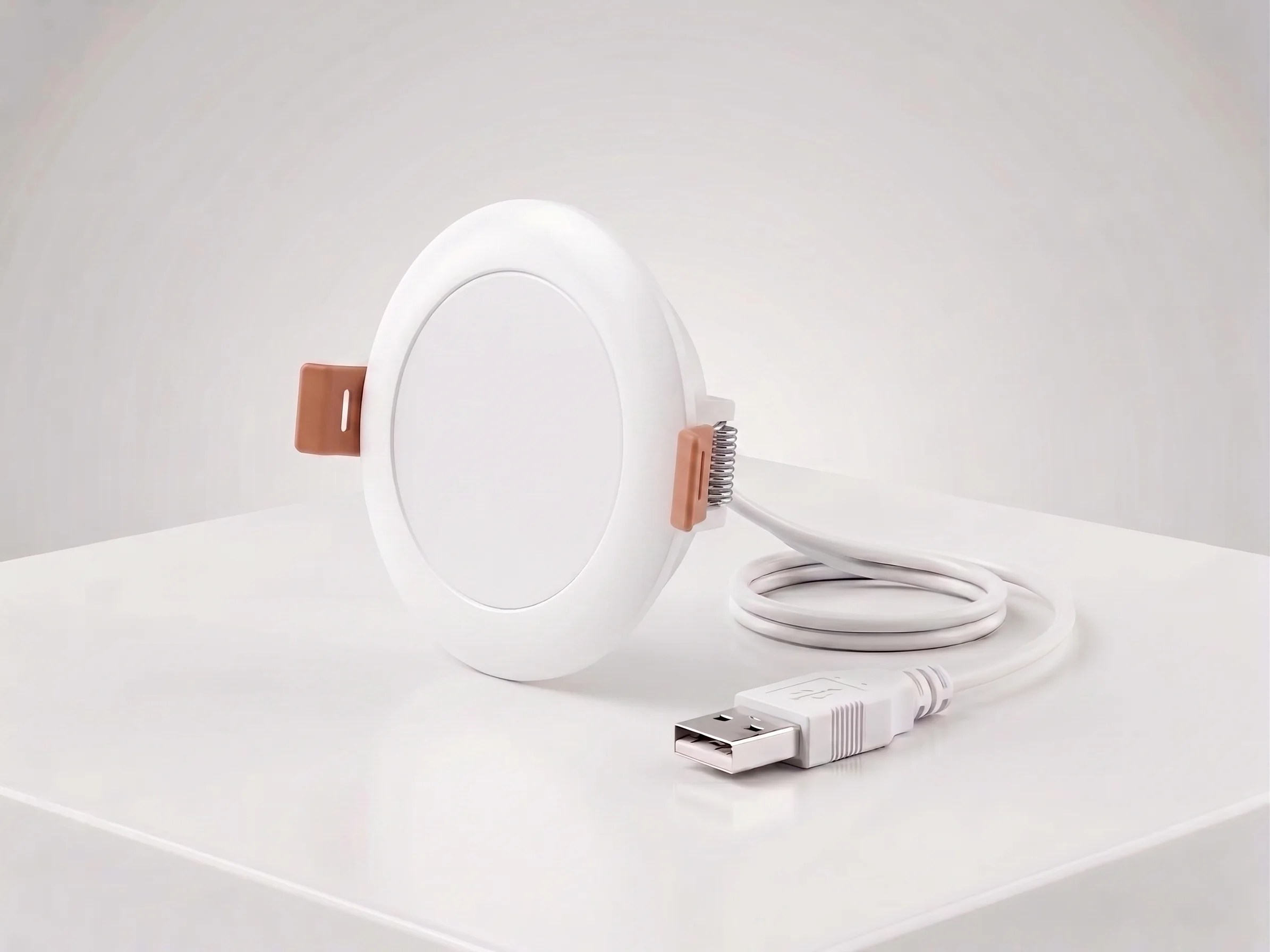
Ceiling Mount mmWave Human Presence Sensor — Zigbee
24GHz wideband mmWave ceiling presence sensor with 10m motion detection, 2.5m micro-motion, and breathing detection. 120° field, DC5V, Zigbee 3.0. For hotel room occupancy and commercial automation.
This page already points to it as the next recommended reference.
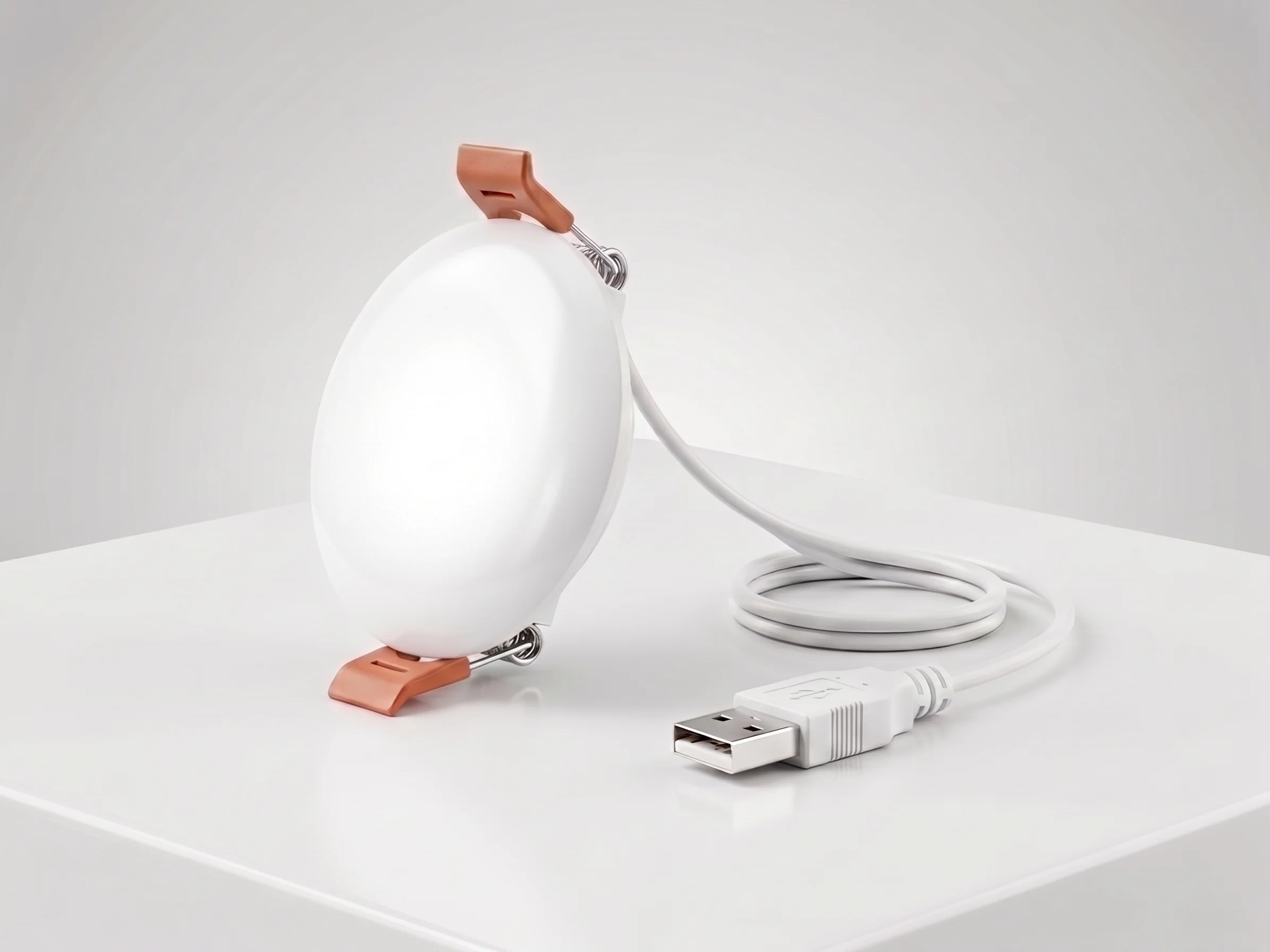
Ceiling Mount mmWave Human Presence Sensor — WiFi
24GHz wideband mmWave ceiling presence sensor with 10m motion detection, 2.5m micro-motion, and breathing detection. 120° field, DC5V, WiFi 2.4GHz. No gateway required for retrofit hotel and apartment projects.
This page already points to it as the next recommended reference.
Related solutions
1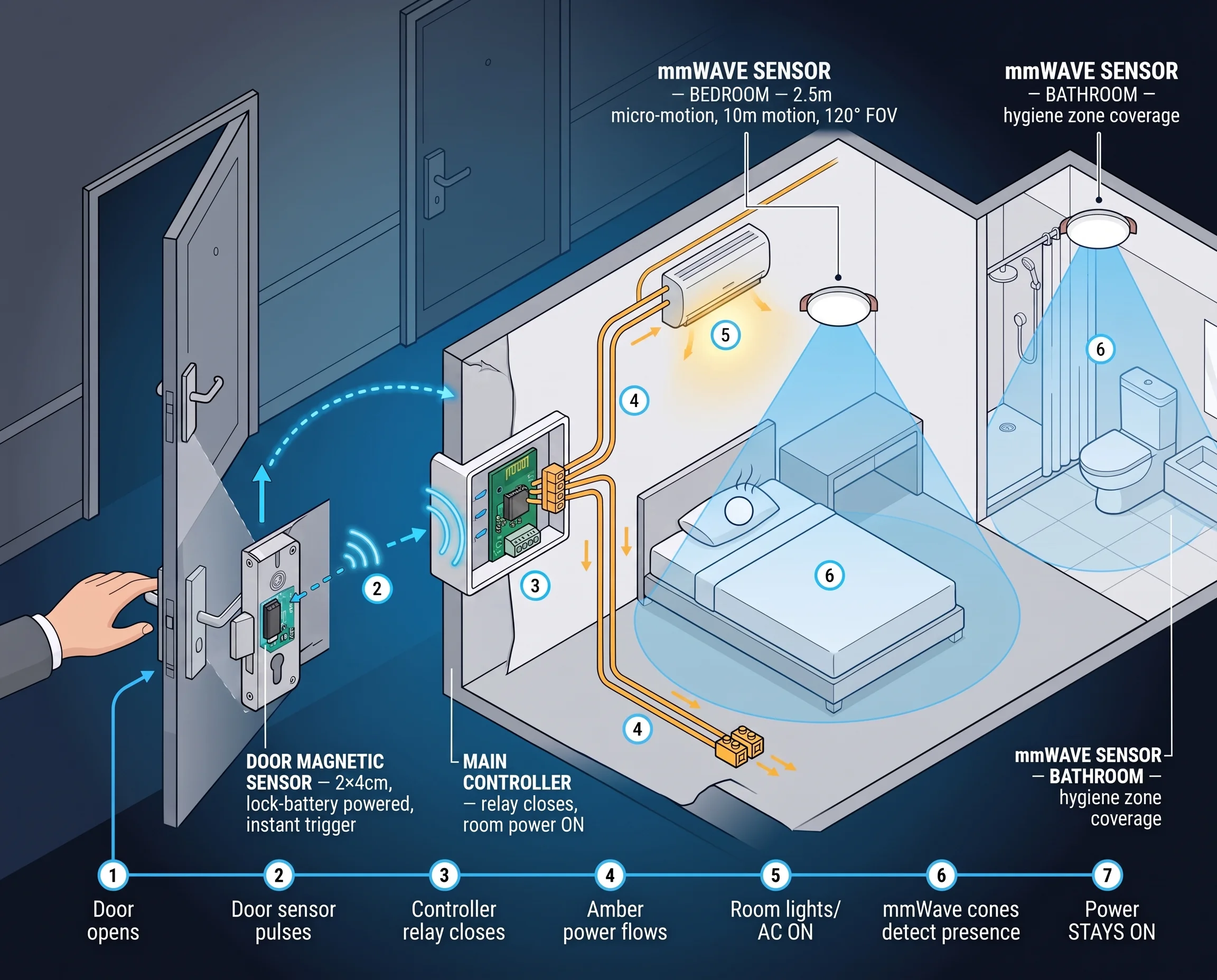
Hotel Room Occupancy & Motion Sensor Solution
mmWave radar presence sensors for hotel room occupancy, housekeeping scheduling, and HVAC energy saving. Detect true occupancy — even when the guest is asleep — with our ceiling-mount hotel room motion sensor.
It supports the same product context: Ceiling Mount mmWave Human Presence Sensor — Zigbee, Ceiling Mount mmWave Human Presence Sensor — WiFi.
Related blog posts
3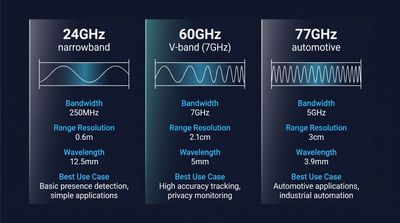
60GHz vs 24GHz vs 77GHz mmWave Sensors: Choosing the Right Frequency for Commercial Presence Detection
Compare 60GHz, 24GHz, and 77GHz mmWave sensors for commercial presence detection. Technical specs, detection range, privacy, and OEM sourcing guidance.
It supports the same product context: Ceiling Mount mmWave Human Presence Sensor — Zigbee, Ceiling Mount mmWave Human Presence Sensor — WiFi.
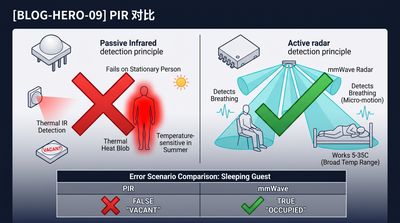
What Is an Electronic Presence Sensor? Technology, Accuracy, and How It Differs From a Motion Sensor
Learn what an electronic presence sensor is, how it detects stationary humans, and how it differs from a PIR motion sensor. Covers mmWave, accuracy, and use cases.
It supports the same product context: Ceiling Mount mmWave Human Presence Sensor — Zigbee, Ceiling Mount mmWave Human Presence Sensor — WiFi.
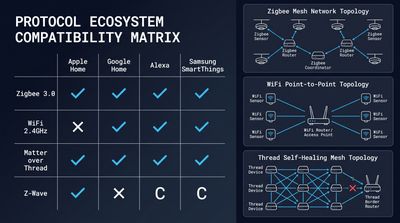
How to Integrate mmWave Presence Sensors With Home Assistant (Local Control Guide)
Step-by-step local control setup guide for mmWave devices, covering MQTT/Matter config, automation scripts, calibration and OEM ceiling presence sensor integration tips.
It supports the same product context: Ceiling Mount mmWave Human Presence Sensor — WiFi, Ceiling Mount mmWave Human Presence Sensor — Zigbee.
Specify your hotel project with our engineers
Send your room count, ceiling type, and protocol preference. We will return a sample plan and quote within 24 business hours.
- Move from general guidance into a product or application discussion.
- Use RFQ when pricing, drawings, MOQ, or launch timing needs structure.
- Keep a direct contact path visible for fast clarifications and handoff.