Microwave Presence Detector: Technology, Accuracy, and How It Compares to Other Occupancy Sensors
A complete guide to microwave presence detectors. Learn how they work, compare with PIR and mmWave sensors, and find the right detector for your application.
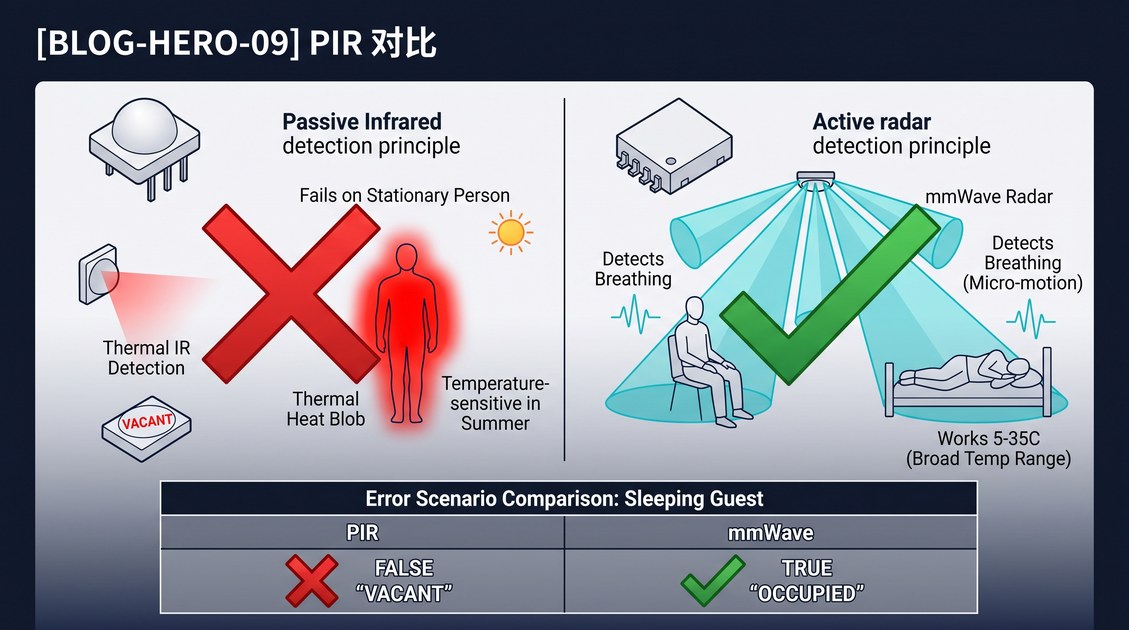
A microwave presence detector is an active radio frequency occupancy sensor that emits a microwave signal — most commonly in the 2.4 GHz, 5.8 GHz, 10.5 GHz, or 24 GHz industrial-scientific-medical (ISM) band — and analyzes the reflected signal to determine whether a human is present within the detection zone, using the Doppler effect to detect motion and, in more advanced designs, micro-motion of breathing to detect stationary occupants. Unlike a passive infrared (PIR) sensor that only reacts to changes in thermal radiation, a microwave presence detector emits its own electromagnetic signal and can therefore detect motion through non-metallic materials (glass, drywall, thin wood), operates reliably in all lighting conditions including complete darkness, and is insensitive to ambient temperature. The historical limitation of a microwave presence detector — the inability to detect stationary occupants — has been overcome in modern 24 GHz and 60 GHz designs, which use wideband FMCW (frequency-modulated continuous wave) radar to extract the micro-Doppler signature of human breathing at 0.2–0.5 Hz, achieving stationary-occupant true positive rates above 99% in controlled testing. A microwave presence detector is deployed in hotel rooms, offices, healthcare facilities, restrooms, stairwells, and industrial spaces for occupancy-based lighting control, HVAC management, security monitoring, and building automation, and it is the oldest and most widely deployed active occupancy sensing technology, with a history dating back to the 1970s in commercial building applications.
Understanding the microwave presence detector — its history, its operating principles, its strengths and weaknesses relative to other occupancy sensing technologies, and its current role in the building automation market — is valuable for engineers designing occupancy sensing systems, for procurement teams evaluating sensor products, and for solutions architects selecting technologies for specific applications. This article provides a comprehensive technical and practical guide to the microwave presence detector, explains how it differs from PIR sensors and from modern mmWave radar sensors, identifies the use cases where it remains the right choice, and provides a structured framework for selecting the right occupancy sensor for a specific application.
Microwave Presence Detector: Operating Principles
The operating principle of a microwave presence detector is based on the Doppler effect — the change in frequency of a wave when the source and the observer are in relative motion. In a Doppler-based microwave presence detector, the transmitter emits a continuous microwave signal at a fixed frequency (e.g., 5.8 GHz or 10.5 GHz), and the receiver detects the reflected signal from objects in the detection zone. If an object is moving toward or away from the detector, the reflected signal has a slightly different frequency from the transmitted signal, with the frequency difference (the Doppler shift) proportional to the velocity of the object. By analyzing the Doppler shift, the detector can determine that an object is moving and can estimate its velocity.
Microwave Presence Detector: Continuous Wave Doppler Sensing
The simplest and oldest form of the microwave presence detector is the continuous wave (CW) Doppler sensor. In a CW Doppler detector, the transmitter emits a continuous microwave signal at a fixed frequency, and the receiver detects the reflected signal. The reflected signal is mixed with a copy of the transmitted signal, producing a beat signal whose frequency is the Doppler shift. By analyzing the beat signal (typically with a simple FFT or a bandpass filter), the detector can determine that an object is moving and can estimate its velocity.
The CW Doppler detector is inexpensive and simple, but it has a fundamental limitation: it can only detect moving objects. A stationary person does not produce a Doppler shift, so the CW Doppler detector reports no motion. This is why the traditional microwave presence detector is often called a "motion detector" rather than a "presence detector" — it can detect that someone is moving, but it cannot confirm that someone is present if they are stationary.
The CW Doppler detector is widely used in applications where motion detection is sufficient: automatic door openers, security motion sensors, stairwell lighting control, and basic occupancy-based lighting control. For these applications, the simplicity and low cost of the CW Doppler detector make it a popular choice, and the limitation (no stationary occupant detection) is acceptable because the application only requires motion-based control.
Microwave Presence Detector: FMCW Radar Sensing
A more advanced form of the microwave presence detector is the frequency-modulated continuous wave (FMCW) radar sensor. In an FMCW detector, the transmitter emits a signal whose frequency sweeps linearly across a defined bandwidth over a short period (the chirp). The reflected signal from objects in the detection zone is mixed with a copy of the transmitted chirp, producing a beat signal whose frequency is proportional to the range of the object. By performing an FFT on the beat signal, the detector can determine the range of every object in the detection zone with a resolution of c / (2 × B), where c is the speed of light and B is the bandwidth.
The FMCW detector has two key advantages over the CW Doppler detector: it can determine the range of objects (not just their velocity), and it can detect stationary objects (because the range measurement does not require motion). However, a basic FMCW detector can detect the presence of a stationary object but cannot distinguish a stationary human from a stationary chair or a wall — all produce a range return, and without additional analysis, the detector cannot tell which is a human.
The key to true presence detection in an FMCW detector is the analysis of the phase of the beat signal across successive chirps. A stationary human produces a beat signal with a slowly varying phase (due to the micro-motion of breathing), while a stationary chair produces a beat signal with a constant phase. By analyzing the phase variation (the micro-Doppler signature), the FMCW detector can distinguish a stationary human from a stationary object, enabling true presence detection.
Microwave Presence Detector: Micro-Doppler and Breathing Detection
The micro-Doppler effect is the phenomenon where the micro-motion of parts of a target produces distinctive Doppler signatures. In human presence detection, the most important micro-Doppler signature is the breathing signature: the periodic chest wall motion at 0.2–0.5 Hz produces a Doppler modulation that is distinct from the background noise and from the Doppler signatures of inanimate objects.
A modern microwave presence detector with FMCW radar and micro-Doppler analysis can detect the breathing signature of a sleeping human at ranges of 6–8 meters, achieving a stationary-occupant true positive rate above 99% in controlled testing. This is the capability that has transformed the microwave presence detector from a simple motion detector into a true presence detector, and it is the foundation of the modern 60 GHz mmWave presence sensor market.
Microwave Presence Detector: Frequency Bands and Their Characteristics
The microwave presence detector market uses several frequency bands, each with different characteristics in terms of range, resolution, penetration, and regulatory status. The major bands are 2.4 GHz, 5.8 GHz, 10.5 GHz, 24 GHz, and 60 GHz.
Microwave Presence Detector: 2.4 GHz and 5.8 GHz Bands
The 2.4 GHz and 5.8 GHz ISM bands are the lowest frequency bands used for microwave presence detection. The 12.5 cm wavelength at 2.4 GHz and the 5.2 cm wavelength at 5.8 GHz allow for simple antenna designs and good penetration of non-metallic materials. The 2.4 GHz band is heavily congested (WiFi, Bluetooth, Zigbee, microwave ovens), which can cause interference, while the 5.8 GHz band is less congested and is often preferred for presence detection.
A 2.4 GHz or 5.8 GHz microwave presence detector is typically a CW Doppler detector used for motion-based lighting control, automatic door openers, and security motion sensing. These detectors are inexpensive ($1–5 at the component level), consume very little power, and can detect motion through glass and thin walls. They cannot detect stationary occupants and are therefore not suitable for true presence detection applications.
Microwave Presence Detector: 10.5 GHz Band
The 10.5 GHz band (with a 2.8 cm wavelength) is less commonly used than 2.4 GHz or 5.8 GHz, but it appears in some specialized presence detection applications. The shorter wavelength provides slightly better angular resolution than 2.4 GHz or 5.8 GHz, and the band is less congested. A 10.5 GHz microwave presence detector is typically a CW Doppler detector used for motion-based lighting control and security.
Microwave Presence Detector: 24 GHz Band
The 24 GHz band (24.0–24.25 GHz narrowband ISM or 24.05–24.25 GHz UWB) is the most widely deployed band for commercial microwave presence detection. The 12.5 mm wavelength allows for compact antenna designs and good penetration of non-metallic materials, and the band is regulated under FCC Part 15.249 (in the US) and EN 300 440 (in the EU) for unlicensed use.
A 24 GHz microwave presence detector can be either a CW Doppler detector (for motion-only applications) or an FMCW radar detector (for range and micro-motion detection). The narrowband ISM allocation provides 250 MHz of bandwidth, which is sufficient for basic FMCW range resolution (0.6 m) but is too coarse for fine micro-motion detection. The UWB allocation provides up to 5 GHz of bandwidth, which enables fine range resolution (3 cm) and micro-motion detection, but the UWB allocation is being phased out for new automotive designs in Europe and is increasingly restricted for other applications.
The 24 GHz microwave presence detector is the workhorse of the commercial occupancy sensing market, used in automatic door openers, security motion sensors, stairwell lighting control, and basic occupancy-based lighting control. For applications that require true stationary-occupant detection (hotel rooms, offices, healthcare), the 24 GHz narrowband detector is less suitable due to the limited bandwidth.
Microwave Presence Detector: 60 GHz Band
The 60 GHz band (57–64 GHz) is the newest and most advanced band for microwave presence detection, and it is the band used in the modern mmWave presence sensor. The 5 mm wavelength allows for very compact antenna arrays (a 3×3 MIMO array fits in a 20×20 mm PCB area), and the 7 GHz of bandwidth enables 2.1 cm range resolution and micro-Doppler detection of human breathing.
The 60 GHz microwave presence detector is the default choice for new presence detection deployments that require stationary-occupant detection. It is more expensive than the 24 GHz detector (due to the more complex chipset and antenna design), but it delivers the micro-motion sensitivity that is essential for true presence detection in hotel rooms, offices, and healthcare facilities. The 60 GHz band is regulated under FCC Part 15.255 (in the US) and EN 305 550 (in the EU), with clear technical rules for unlicensed use.
| Band | Frequency | Wavelength | Bandwidth | Stationary occupant | Penetration | Primary use |
|---|---|---|---|---|---|---|
| 2.4 GHz | 2.4–2.4835 GHz | 12.5 cm | 20 MHz (typical) | No | Good (through walls) | Motion, lighting control |
| 5.8 GHz | 5.725–5.875 GHz | 5.2 cm | 150 MHz (typical) | No | Good (through glass) | Motion, lighting control |
| 10.5 GHz | 10.5 GHz | 2.8 cm | 50 MHz (typical) | No | Fair | Motion, specialized |
| 24 GHz narrowband | 24.0–24.25 GHz | 12.5 mm | 250 MHz | Limited | Fair (through thin walls) | Motion, basic FMCW |
| 24 GHz UWB | 24.05–24.25 GHz | 12.5 mm | 5 GHz | Yes (with FMCW) | Fair | High-precision (phase-out) |
| 60 GHz | 57–64 GHz | 5.0 mm | 7 GHz | Yes (breathing detection) | Poor (absorbed by drywall) | True presence detection |
Microwave Presence Detector vs PIR Sensor: A Detailed Comparison
The most common comparison in the occupancy sensing market is between the microwave presence detector and the passive infrared (PIR) sensor. These two technologies represent different physical principles (active radio vs passive thermal) and have different strengths and weaknesses. Understanding this comparison is essential for selecting the right technology for a specific application.
Microwave Presence Detector vs PIR: Detection Principle
The fundamental difference between a microwave presence detector and a PIR sensor is the detection principle. A microwave presence detector emits an active radio signal and analyzes the reflected signal to detect motion (and, in advanced designs, micro-motion). A PIR sensor detects the infrared radiation emitted by warm bodies and triggers when the radiation pattern changes as the body moves across the sensor's field of view.
The practical consequence of this difference is that a microwave presence detector can detect motion through non-metallic materials (glass, drywall, thin wood), while a PIR sensor requires a direct line of sight to the occupant. A microwave presence detector mounted behind a glass partition can detect motion in the room beyond, while a PIR sensor mounted behind the same partition cannot. This can be an advantage (the microwave detector can be hidden from view) or a disadvantage (the microwave detector may detect motion in adjacent rooms, causing false triggers).
Microwave Presence Detector vs PIR: Sensitivity to Environmental Conditions
A microwave presence detector is insensitive to ambient temperature and operates reliably in all lighting conditions, including complete darkness. A PIR sensor is sensitive to ambient temperature (the sensitivity decreases as the ambient temperature approaches the body temperature) and can be triggered by sunlight reflections, HVAC airflow, and other sources of infrared radiation.
The practical consequence is that a microwave presence detector is more reliable in environments with variable lighting and temperature (e.g., a corridor with large windows, a warehouse with variable HVAC), while a PIR sensor may be more suitable for environments with stable lighting and temperature (e.g., a residential bathroom, a small office).
Microwave Presence Detector vs PIR: Detection of Stationary Occupants
Neither a traditional CW Doppler microwave presence detector nor a PIR sensor can detect stationary occupants. The CW Doppler detector requires motion to produce a Doppler shift, and the PIR sensor requires motion to change the infrared radiation pattern. For applications where stationary-occupant detection is required, only an FMCW radar detector with micro-Doppler analysis (typically at 60 GHz) can reliably detect a stationary human.
Microwave Presence Detector vs PIR: Power Consumption and Cost
A traditional CW Doppler microwave presence detector is inexpensive ($1–5 at the component level, $10–30 at retail) and consumes very little power (a few milliwatts in standby, a few tens of milliwatts when active). A PIR sensor is even less expensive ($0.5–2 at the component level, $5–20 at retail) and consumes even less power (essentially zero in standby, a few milliwatts when active).
For battery-powered applications, the PIR sensor has a significant advantage in battery life (3–5 years on a coin cell, compared to 1–2 years for a CW Doppler microwave detector). For mains-powered applications, the power consumption difference is negligible.
Microwave Presence Detector vs PIR: Field of View
A microwave presence detector has a relatively wide field of view (typically ±60° to ±120°, depending on the antenna design), and the field of view can be shaped by the antenna design. A PIR sensor has a field of view that is determined by the Fresnel lens, with typical fields of view of ±45° to ±120°, and the field of view can be shaped by the lens design.
The practical difference is that the microwave detector's field of view is less precisely defined than the PIR sensor's field of view (the microwave signal can leak beyond the intended detection zone), which can be a problem in applications where the detector needs to be confined to a specific zone (e.g., a corridor sensor that should not detect motion in adjacent rooms).
| Attribute | Microwave presence detector (CW Doppler) | PIR sensor |
|---|---|---|
| Detection principle | Active radio wave | Passive thermal |
| Stationary occupant | No | No |
| Penetration | Good (through glass, thin walls) | None (requires line of sight) |
| Sensitivity to temperature | Low | High |
| Sensitivity to lighting | None | High |
| Field of view | Wide, less precisely defined | Wide, precisely defined by lens |
| Power consumption | Low (a few mW) | Very low (near zero in standby) |
| Cost (component) | $1–5 | $0.5–2 |
| Battery life (coin cell) | 1–2 years | 3–5 years |
| Best for | Motion through barriers, variable lighting | Budget, line-of-sight motion |
Microwave Presence Detector vs mmWave Radar Sensor
The distinction between a "microwave presence detector" and an "mmWave radar sensor" is often unclear in the market, because both are active radio frequency sensors and the term "microwave" technically includes the millimeter wave range (30–300 GHz). In practice, the term "microwave presence detector" is most commonly used to refer to sensors operating at 2.4 GHz, 5.8 GHz, 10.5 GHz, or 24 GHz, while "mmWave radar sensor" is used to refer to sensors operating at 60 GHz or 77 GHz.
Microwave Presence Detector vs mmWave: Frequency and Wavelength
The primary difference between a traditional microwave presence detector (2.4–24 GHz) and an mmWave radar sensor (60–77 GHz) is the frequency and wavelength. The shorter wavelength at 60 GHz and 77 GHz allows for smaller antennas, finer angular resolution, and — critically — wider bandwidth, which enables the micro-Doppler detection of human breathing.
A 24 GHz narrowband microwave presence detector with 250 MHz of bandwidth cannot reliably detect the micro-motion of breathing (the range resolution of 0.6 m is too coarse). A 60 GHz mmWave radar sensor with 7 GHz of bandwidth can reliably detect the micro-motion of breathing (the range resolution of 2.1 cm and the fine phase resolution enable the detection of the 5–20 mm chest wall motion at 0.2–0.5 Hz).
Microwave Presence Detector vs mmWave: Stationary Occupant Detection
The key difference between a traditional microwave presence detector and a modern mmWave radar sensor is the ability to detect stationary occupants. A traditional CW Doppler microwave presence detector cannot detect stationary occupants (it requires motion). A 24 GHz narrowband FMCW microwave presence detector can detect the range of stationary objects but cannot reliably distinguish a stationary human from a stationary object. A 60 GHz mmWave radar sensor with micro-Doppler analysis can reliably detect a stationary human by detecting the breathing signature.
For applications that require stationary-occupant detection (hotel rooms, offices, healthcare, residential), the 60 GHz mmWave radar sensor is the right choice. For applications where motion detection is sufficient (stairwells, corridors, security), the traditional microwave presence detector is a cost-effective choice.
Microwave Presence Detector vs mmWave: Cost and Complexity
A traditional microwave presence detector (CW Doppler at 2.4 GHz or 5.8 GHz) is significantly less expensive and less complex than a 60 GHz mmWave radar sensor. The component cost of a CW Doppler detector is $1–5, while the component cost of a 60 GHz mmWave module is $6–18. The complexity of the signal processing is also different: a CW Doppler detector requires only a simple FFT or bandpass filter, while a 60 GHz mmWave sensor requires a full FMCW signal processing pipeline (range FFT, Doppler FFT, micro-motion extraction, classification).
For budget-sensitive applications where motion detection is sufficient, the traditional microwave presence detector is the right choice. For applications where stationary-occupant detection is required, the 60 GHz mmWave radar sensor is the right choice despite the higher cost.
Microwave Presence Detector: Applications
The microwave presence detector is deployed in a wide range of applications, each with different requirements and constraints. The following sections describe the major application categories.
Microwave Presence Detector: Automatic Door Openers
Automatic door openers are one of the oldest and most common applications of the microwave presence detector. A CW Doppler detector mounted above the door detects approaching people and triggers the door to open. The microwave detector is preferred over a PIR sensor for this application because it can detect motion through glass (allowing the detector to be mounted inside the building, behind the glass door) and because it is insensitive to ambient temperature (which can vary significantly at the entrance to a building).
Microwave Presence Detector: Security Motion Sensing
Security motion sensors use microwave presence detectors (often combined with PIR sensors in a "dual-technology" configuration) to detect intruders. The microwave detector is preferred for this application because it can detect motion through barriers (allowing the detector to monitor a larger area than a PIR sensor alone) and because it is less prone to false triggers from pets, sunlight, and HVAC airflow (when combined with a PIR sensor in a dual-technology configuration).
Microwave Presence Detector: Stairwell and Corridor Lighting Control
Stairwell and corridor lighting control is a common application for the microwave presence detector. A CW Doppler detector mounted in the ceiling of a stairwell or corridor detects motion and turns on the lights, and turns off the lights after a preset period of no motion. The microwave detector is preferred for this application because it can detect motion around corners (the microwave signal can reflect off walls) and because it is insensitive to ambient temperature.
Microwave Presence Detector: Occupancy-Based Lighting Control
Occupancy-based lighting control in offices, restrooms, and other commercial spaces is another common application. A microwave presence detector mounted in the ceiling detects motion and turns on the lights, and turns off the lights after a preset period of no motion. For applications where the occupant may be stationary for extended periods (e.g., an office worker sitting at their desk), a 60 GHz mmWave radar sensor is preferred over a traditional CW Doppler detector, because the mmWave sensor can detect the stationary occupant and prevent the lights from turning off unexpectedly.
Microwave Presence Detector: Hotel Room Presence Detection
Hotel room presence detection is an application where the 60 GHz mmWave radar sensor (a modern microwave presence detector) has displaced the traditional CW Doppler detector. A 60 GHz sensor can reliably detect a sleeping guest throughout the night, which a CW Doppler detector cannot. The 60 GHz sensor is now the default choice for hotel room presence detection, integrated with the building management system for housekeeping coordination and energy management.
Microwave Presence Detector: Limitations and Challenges
Despite its many advantages, the microwave presence detector has several limitations and challenges that should be considered when selecting a technology.
Microwave Presence Detector: False Triggers from Adjacent Rooms
A traditional microwave presence detector (especially at 2.4 GHz or 5.8 GHz) can detect motion through walls, which can cause false triggers from motion in adjacent rooms. This is a significant problem in applications where the detector needs to be confined to a specific zone (e.g., a corridor sensor that should not detect motion in adjacent offices). The mitigation is to use a higher frequency band (24 GHz or 60 GHz), which has less wall penetration, or to use a detector with a more precisely defined field of view.
Microwave Presence Detector: Sensitivity to HVAC Airflow
A microwave presence detector can be sensitive to HVAC airflow, especially when the airflow is turbulent or when it interacts with lightweight objects (curtains, blinds, plants). The airflow can produce a Doppler signature that looks similar to human motion, causing false triggers. The mitigation is to use a detector with environmental filtering (to distinguish human motion from airflow) and to mount the detector away from HVAC diffusers.
Microwave Presence Detector: Inability to Detect Stationary Occupants
The fundamental limitation of a traditional CW Doppler microwave presence detector is the inability to detect stationary occupants. For applications where the occupant may be stationary for extended periods, a 60 GHz mmWave radar sensor is required. The traditional microwave presence detector should not be used for these applications, despite the cost advantage.
Microwave Presence Detector: Interference from Other Wireless Devices
A microwave presence detector operating in the 2.4 GHz band can experience interference from WiFi, Bluetooth, and other wireless devices operating in the same band. The mitigation is to use a higher frequency band (5.8 GHz, 10.5 GHz, 24 GHz, or 60 GHz), which is less congested.
Microwave Presence Detector: Procurement Considerations
For a procurement team evaluating microwave presence detectors, the following considerations should guide the selection:
- Application requirements: determine whether stationary-occupant detection is required. If yes, select a 60 GHz mmWave radar sensor. If no, a traditional CW Doppler detector at 2.4 GHz, 5.8 GHz, or 24 GHz may be sufficient.
- Frequency band: select the band that is appropriate for the application. 2.4 GHz and 5.8 GHz for motion through barriers, 24 GHz for basic FMCW range resolution, 60 GHz for true presence detection.
- Detection range: confirm that the detector's detection range is sufficient for the application (typically 5–12 m for a ceiling-mounted detector).
- Field of view: confirm that the detector's field of view is appropriate for the application (typically ±60° to ±120° for a ceiling-mounted detector).
- Power consumption: confirm that the detector's power consumption is compatible with the available power source (mains, battery, PoE).
- Connectivity: confirm that the detector's connectivity (Zigbee, WiFi, BACnet, dry contact) is compatible with the downstream automation system.
- Certifications: confirm that the detector carries the required certifications (FCC, CE, RoHS, and any regional certifications).
- Environmental robustness: confirm that the detector is robust to the environmental conditions in the deployment (HVAC airflow, temperature variations, humidity).
Microwave Presence Detector: Future Trends
The microwave presence detector market is evolving, driven by the increasing demand for accurate occupancy data and the maturing of the mmWave chipset ecosystem. Several trends are shaping the future of the market.
Microwave Presence Detector: Migration to 60 GHz
The most significant trend is the migration of presence detection applications from the traditional 2.4 GHz, 5.8 GHz, and 24 GHz bands to the 60 GHz band. As the cost of 60 GHz mmWave chipsets has fallen (from $30–50 in 2020 to $2–4 in 2026 at high volume), the 60 GHz band has become economically viable for a wider range of applications, and the superior micro-motion sensitivity of 60 GHz has made it the default choice for any application that requires stationary-occupant detection.
Microwave Presence Detector: Convergence with Other Sensing Modalities
The convergence of the microwave presence detector with other sensing modalities (PIR, ultrasonic, CO₂, light, temperature/humidity) is reducing the per-room cost of a comprehensive sensing stack and enabling new applications. A multi-sensor ceiling device that combines a 60 GHz microwave presence detector with a CO₂ sensor, a light sensor, and a temperature/humidity sensor can provide a comprehensive view of the room's environment, enabling more sophisticated automation and better analytics.
Microwave Presence Detector: On-Device Machine Learning
The increasing use of on-device machine learning inference is improving the accuracy and capabilities of the microwave presence detector. A modern detector can run a small neural network locally to classify occupancy events, to detect falls, and to recognize activities, all within the power budget of a battery-powered device. This trend is reducing the data transmitted to the cloud (improving privacy) and is improving the robustness of the detector to environmental variations.
Microwave Presence Detector: Final Recommendation
The microwave presence detector is a mature, reliable, and widely deployed occupancy sensing technology, with a history dating back to the 1970s in commercial building applications. The traditional CW Doppler detector at 2.4 GHz, 5.8 GHz, or 24 GHz remains the right choice for motion-based applications (automatic door openers, security motion sensing, stairwell lighting control) where stationary-occupant detection is not required and where the low cost and simplicity of the CW Doppler detector are advantageous.
For applications that require stationary-occupant detection (hotel rooms, offices, healthcare facilities, residential smart homes), the 60 GHz mmWave radar sensor — a modern form of the microwave presence detector with FMCW processing and micro-Doppler analysis — is the right choice. The 60 GHz sensor can reliably detect a sleeping human by detecting the breathing signature, achieving a stationary-occupant true positive rate above 99% in controlled testing, with a form factor that fits in a ceiling puck and a cost that is competitive with high-end PIR sensors when the total cost of ownership is considered.
For a procurement team, the right approach is to start with a clear definition of the application requirements (does the application require stationary-occupant detection?), then select the technology (traditional CW Doppler for motion-only, 60 GHz mmWave for true presence detection), then evaluate vendors based on technical capability, certifications, supply chain resilience, and commercial terms. With the right technology and the right vendor, a microwave presence detector deployment can deliver reliable occupancy data for decades, making it one of the highest-ROI investments in building automation and smart home technology.
Not sure which sensor fits your project?
Talk to our mmWave application engineers for a free consultation.
Find the right presence sensor for your hotel project
Compare the 3 protocols, check hotel-specific case studies, and download the installation guide
Related products
3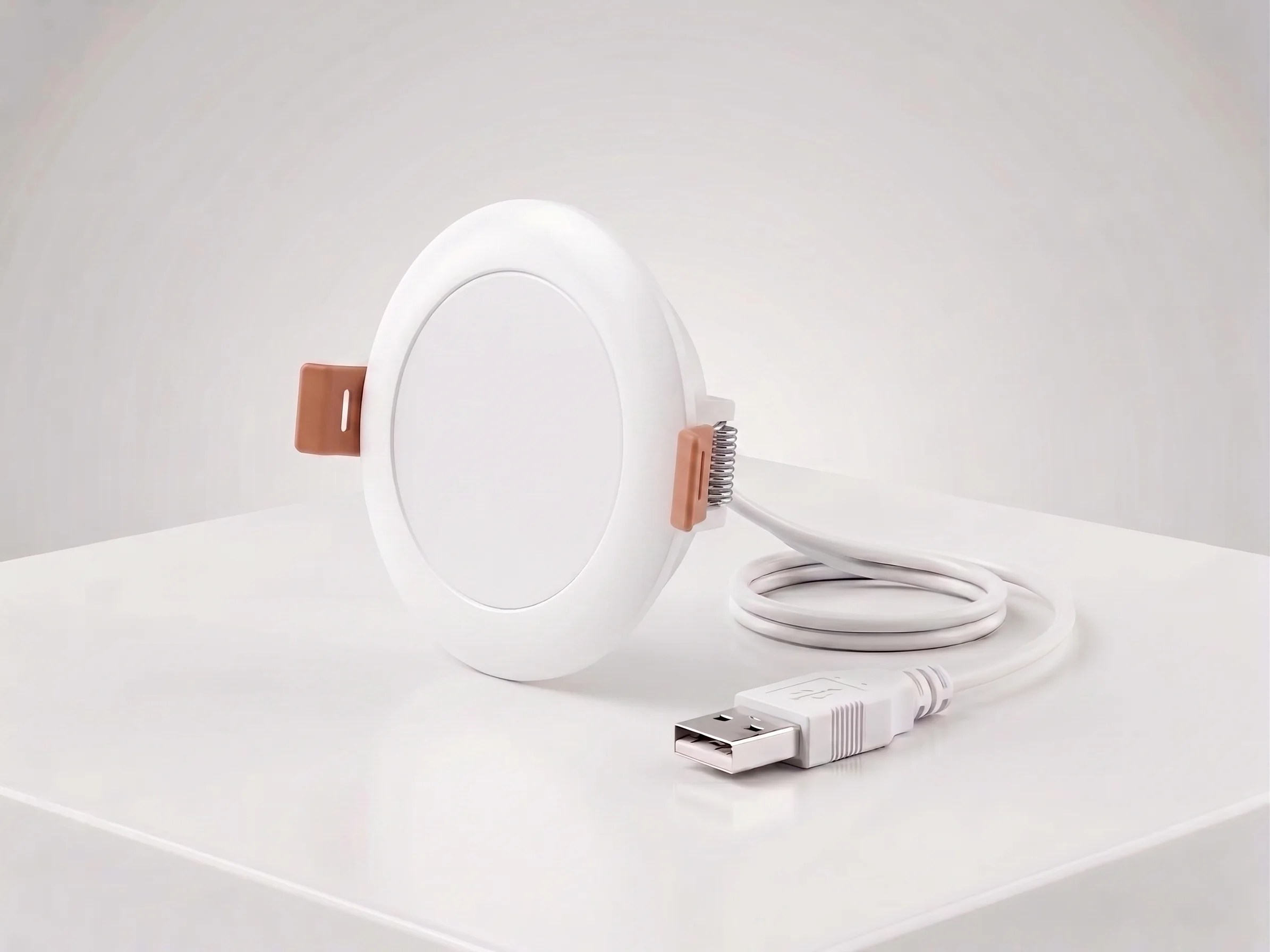
Ceiling Mount mmWave Human Presence Sensor — Zigbee
24GHz wideband mmWave ceiling presence sensor with 10m motion detection, 2.5m micro-motion, and breathing detection. 120° field, DC5V, Zigbee 3.0. For hotel room occupancy and commercial automation.
This page already points to it as the next recommended reference.
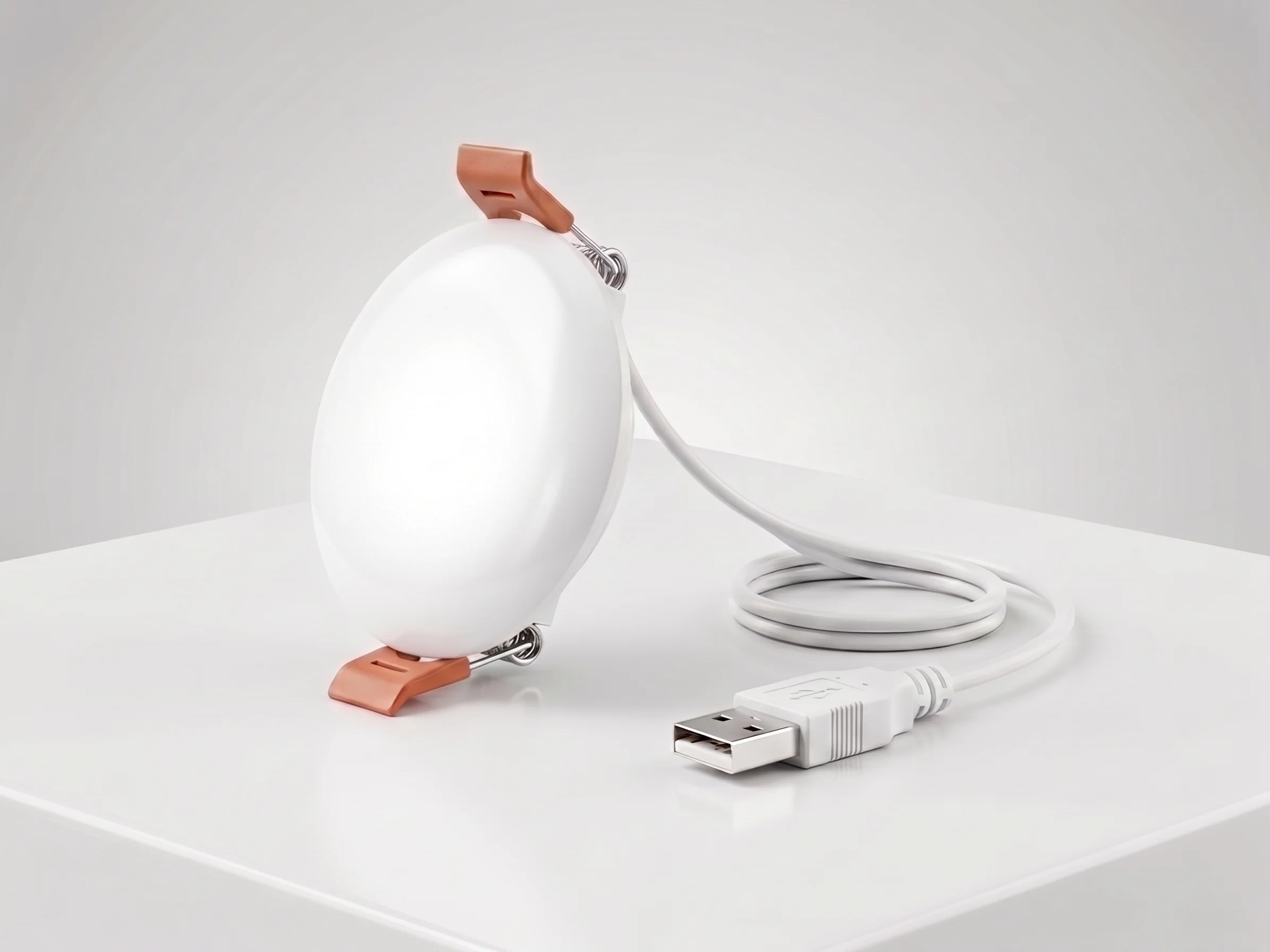
Ceiling Mount mmWave Human Presence Sensor — WiFi
24GHz wideband mmWave ceiling presence sensor with 10m motion detection, 2.5m micro-motion, and breathing detection. 120° field, DC5V, WiFi 2.4GHz. No gateway required for retrofit hotel and apartment projects.
This page already points to it as the next recommended reference.
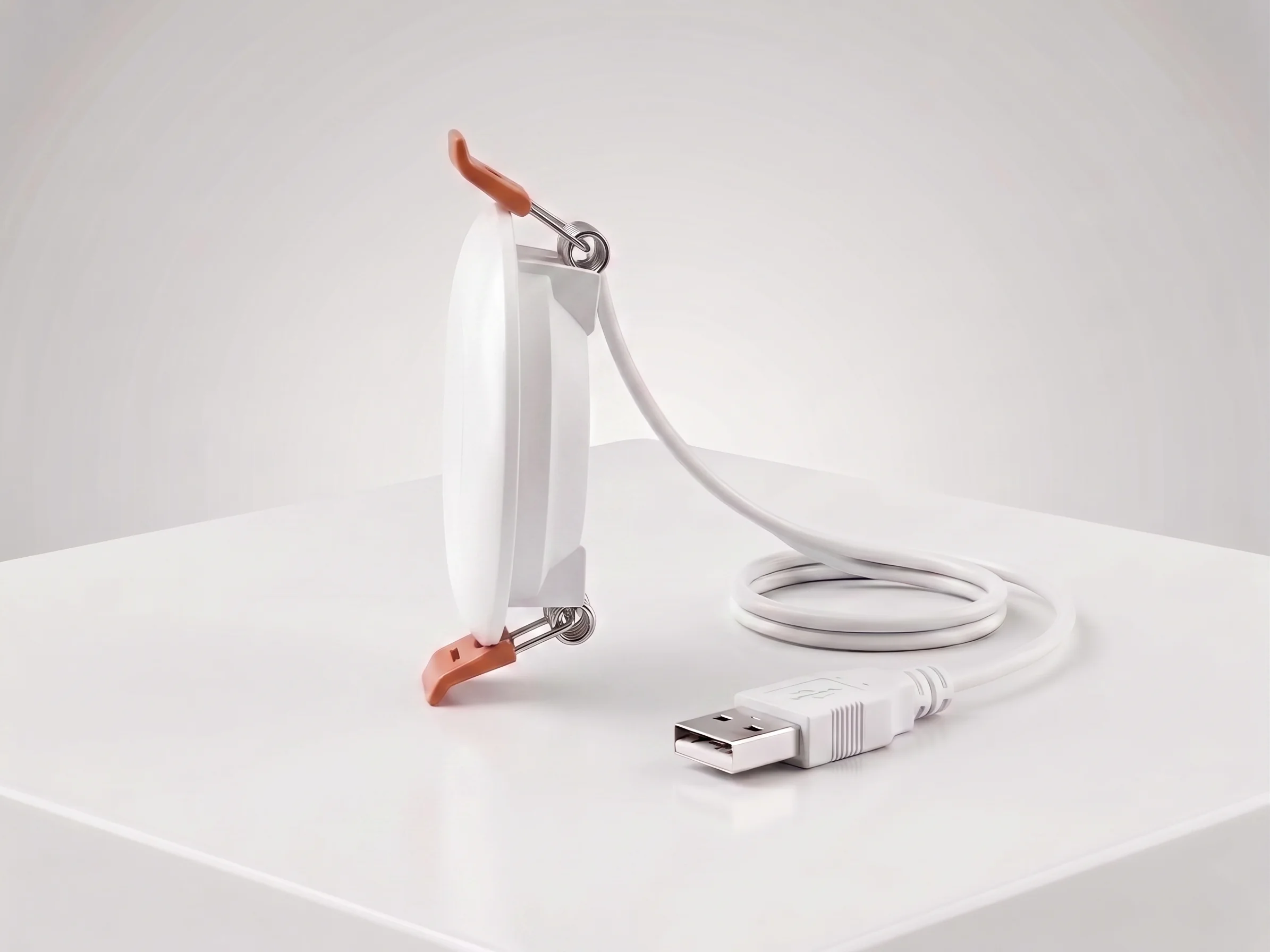
Wall Mount mmWave Human Presence Sensor
24GHz wideband mmWave presence sensor in a standard 86mm wall form factor. 10m motion, 2.5m micro-motion, breathing detection, 120° field, DC5V. Zigbee + WiFi dual mode for office and residential presence automation.
This page already points to it as the next recommended reference.
Related solutions
1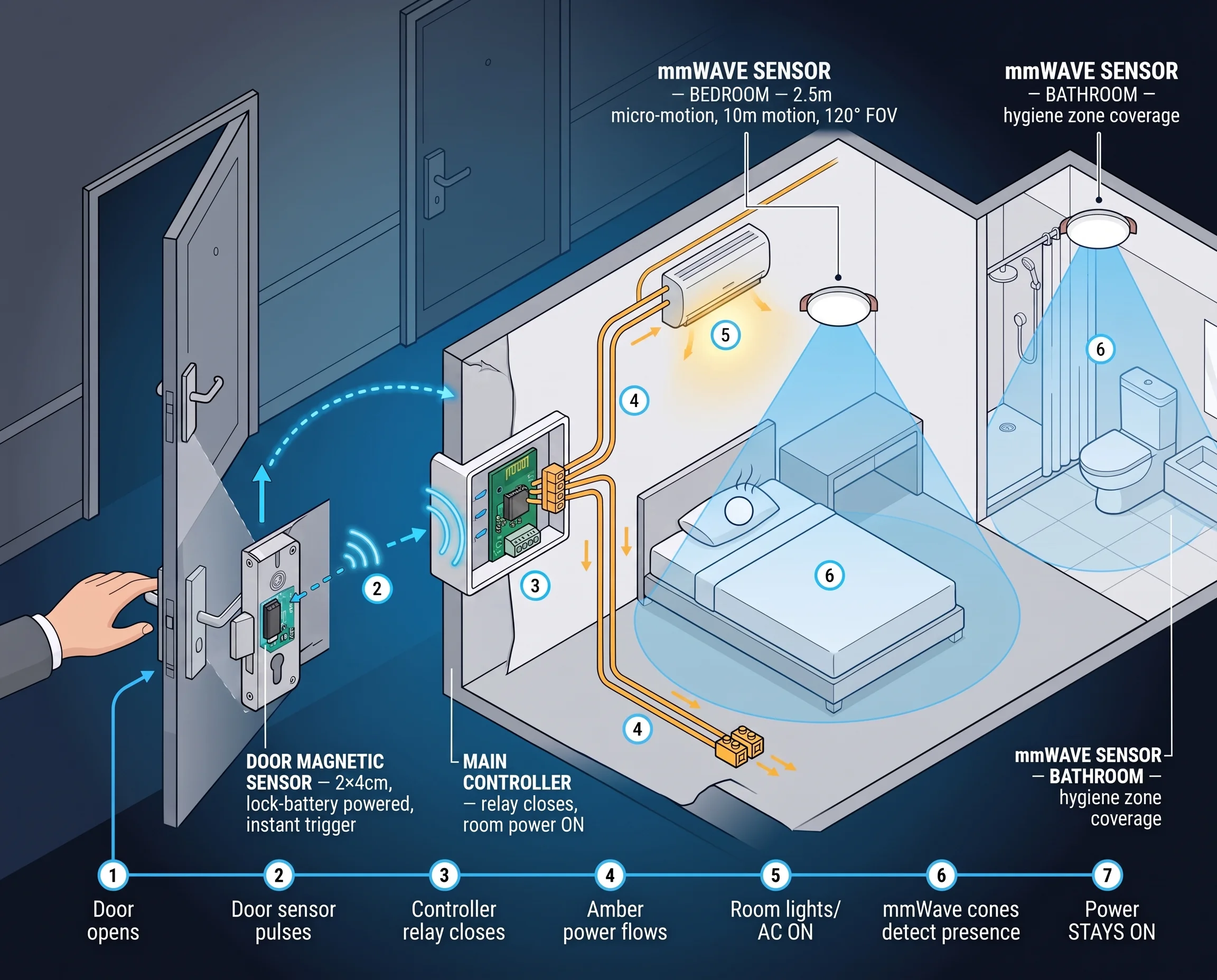
Hotel Room Occupancy & Motion Sensor Solution
mmWave radar presence sensors for hotel room occupancy, housekeeping scheduling, and HVAC energy saving. Detect true occupancy — even when the guest is asleep — with our ceiling-mount hotel room motion sensor.
It supports the same product context: Ceiling Mount mmWave Human Presence Sensor — Zigbee, Ceiling Mount mmWave Human Presence Sensor — WiFi.
Related blog posts
3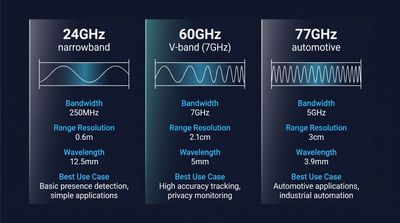
60GHz vs 24GHz vs 77GHz mmWave Sensors: Choosing the Right Frequency for Commercial Presence Detection
Compare 60GHz, 24GHz, and 77GHz mmWave sensors for commercial presence detection. Technical specs, detection range, privacy, and OEM sourcing guidance.
It supports the same product context: Ceiling Mount mmWave Human Presence Sensor — Zigbee, Ceiling Mount mmWave Human Presence Sensor — WiFi.
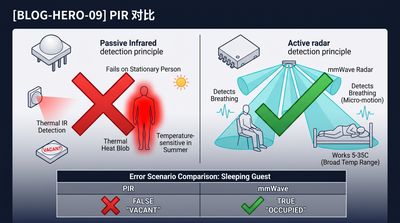
What Is an Electronic Presence Sensor? Technology, Accuracy, and How It Differs From a Motion Sensor
Learn what an electronic presence sensor is, how it detects stationary humans, and how it differs from a PIR motion sensor. Covers mmWave, accuracy, and use cases.
It supports the same product context: Ceiling Mount mmWave Human Presence Sensor — Zigbee, Ceiling Mount mmWave Human Presence Sensor — WiFi.
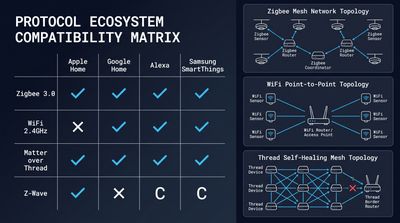
How to Integrate mmWave Presence Sensors With Home Assistant (Local Control Guide)
Step-by-step local control setup guide for mmWave devices, covering MQTT/Matter config, automation scripts, calibration and OEM ceiling presence sensor integration tips.
It supports the same product context: Ceiling Mount mmWave Human Presence Sensor — WiFi, Ceiling Mount mmWave Human Presence Sensor — Zigbee, Wall Mount mmWave Human Presence Sensor.
Specify your hotel project with our engineers
Send your room count, ceiling type, and protocol preference. We will return a sample plan and quote within 24 business hours.
- Move from general guidance into a product or application discussion.
- Use RFQ when pricing, drawings, MOQ, or launch timing needs structure.
- Keep a direct contact path visible for fast clarifications and handoff.