Overview
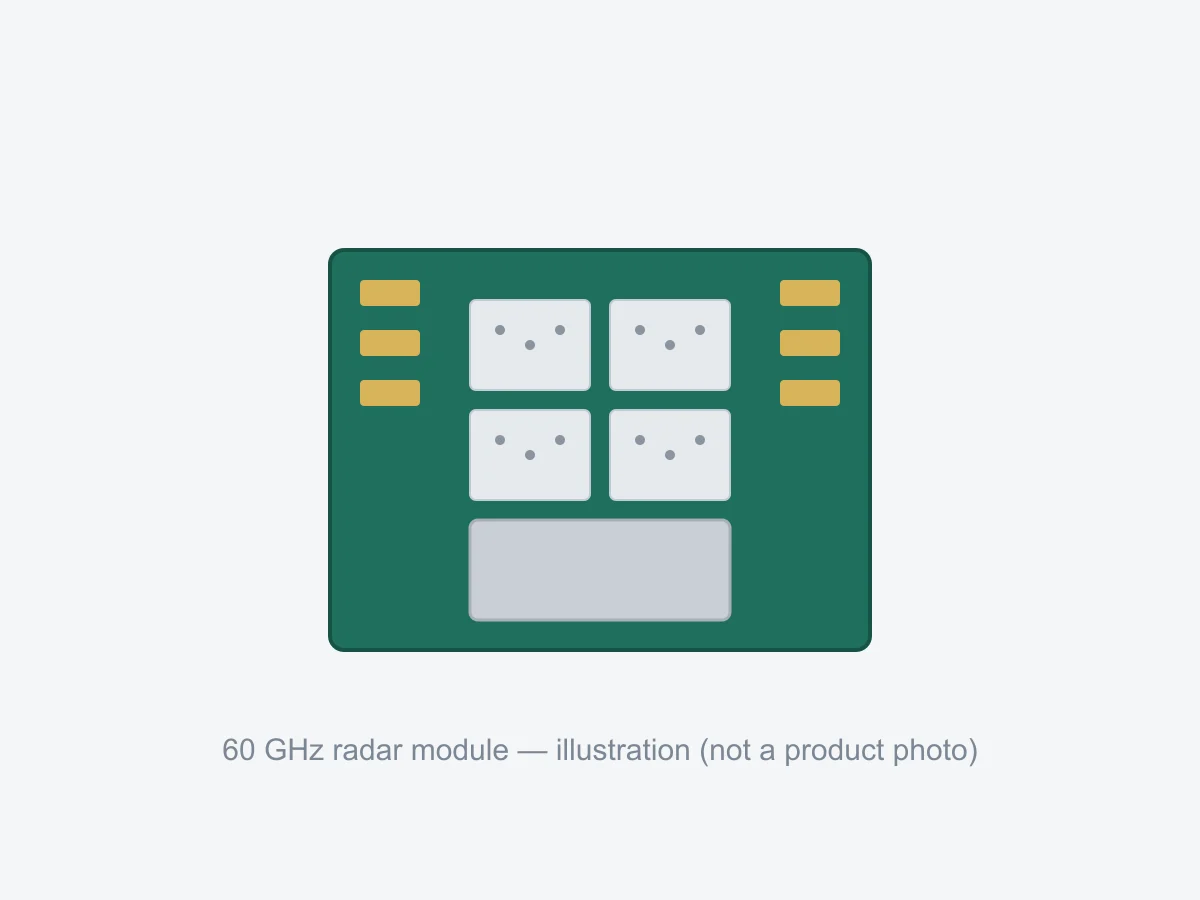
The 60GHz presence radar module is a 1T2R FMCW radar front end supplied for integration, not as a finished sensor. It measures 12 × 11 × 2mm and exposes target distance, speed and angle over UART or GPIO, so the product team writes the presence logic rather than accepting a vendor's fixed behaviour.
That distinction decides who this part is for. If the requirement is a finished ceiling sensor with a housing, a relay or a Zigbee radio, the finished presence sensor is the correct starting point. If the requirement is radar inside a luminaire, a switch plate or a proprietary device with its own firmware, the module is the part that ships.
Radar specifications
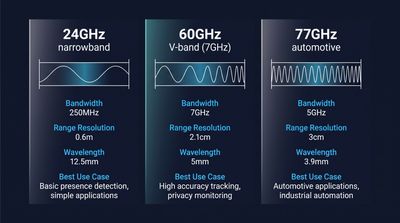
The front end runs at 59–64GHz with 5GHz of adjustable bandwidth and 11dBm transmit power. Bandwidth is what sets range resolution: a wider sweep separates two targets at close range that a narrow-band 24GHz sensor would merge. The 1T2R antenna configuration provides angle information alongside distance and speed, which is what allows the host to tell an approach from a pass-by.
Detection is quoted in two bands. Motion detection reaches ≤10m and is configurable between 0 and 10m. Micro-motion detection reaches up to 8m and is configurable independently. Both figures are set from the host, so a single part number covers both a bathroom-scale application and a larger room.
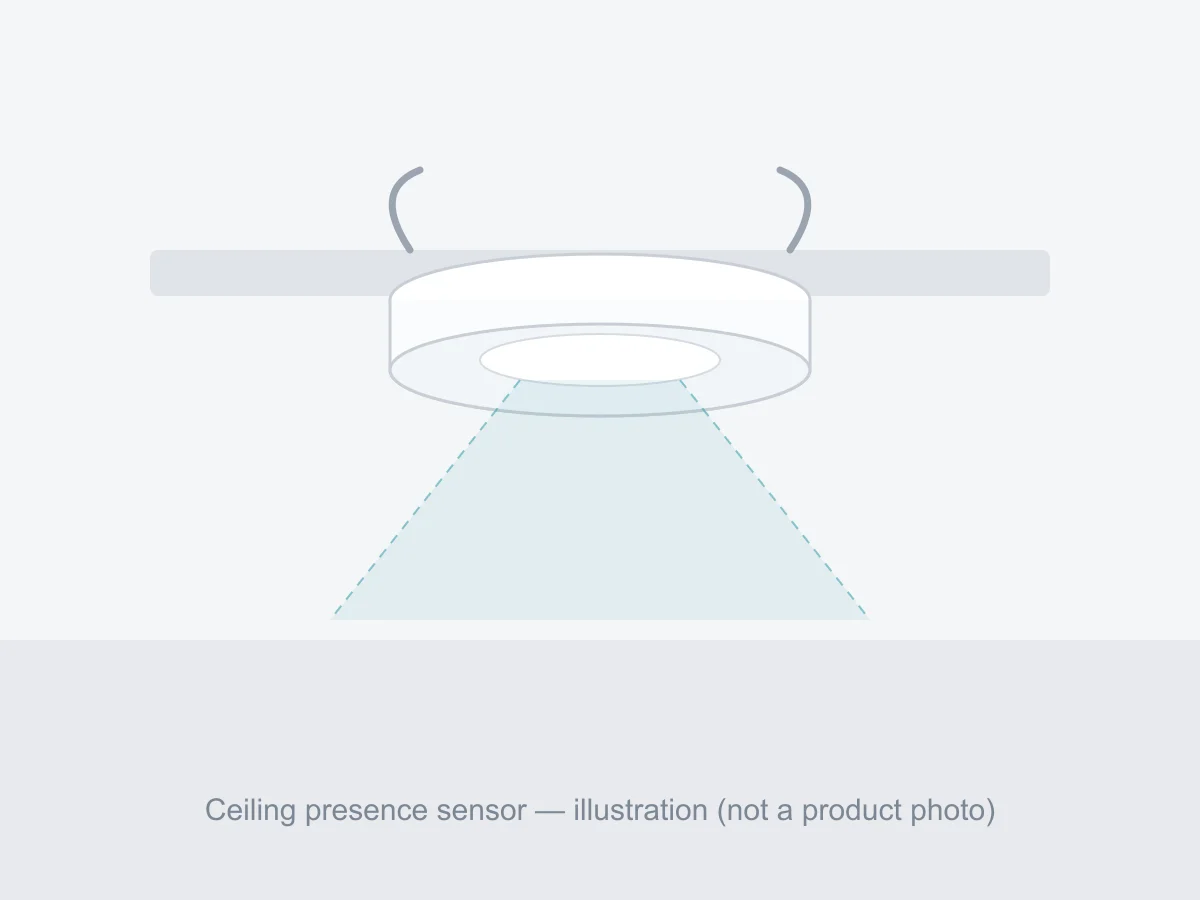
Field of view is ±60° horizontally and ±60° vertically. In practical terms the module covers a room-sized cone from a ceiling or wall position without any mechanical steering, which keeps enclosure design simple.
Interface and electrical integration
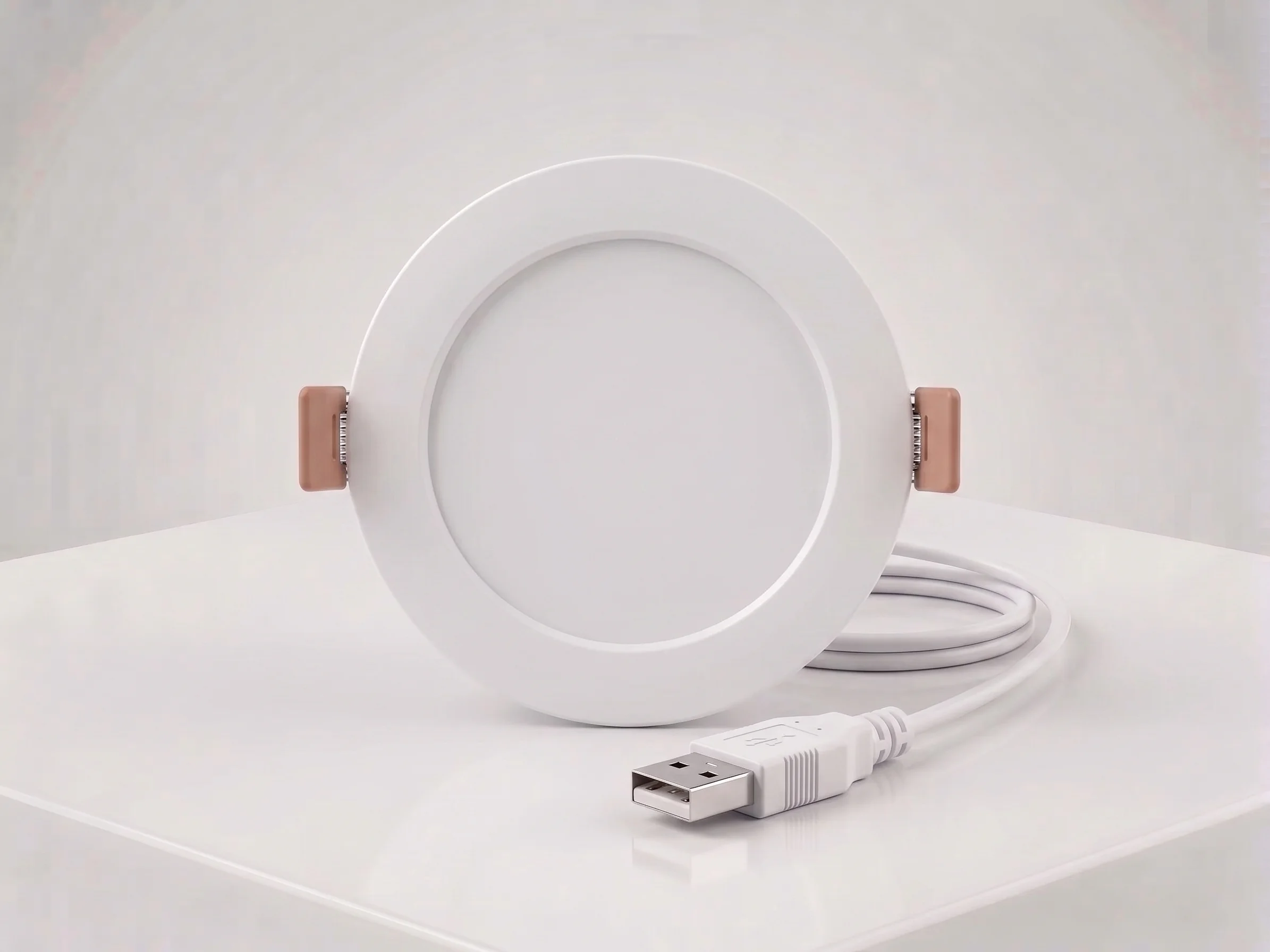
The module takes 3.0–5.5V and draws 80mA average, which lets it run directly from a 5V USB rail or from a 3.3V host supply without an extra regulator. Data goes out over UART; GPIO is available for simple presence indication where the host does not want to parse a protocol.
Operating temperature is −30 to +85°C and storage is −40 to +125°C, covering luminaire temperatures and unheated warehouse conditions. The module has no enclosure and no ingress protection of its own — the housing, gasket and lens are part of the product design the customer is building.
What the module reports
Per target, the host receives distance, speed and angle. That is enough to implement occupancy detection, zone-based triggering, approach direction and multi-target separation in firmware.
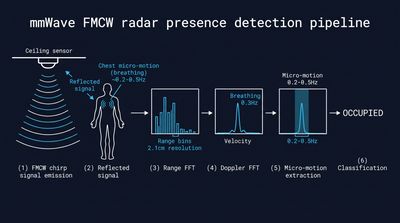
Stationary occupants are detected through chest micro-motion — the small displacement caused by breathing — which is the behaviour that separates a radar presence design from a PIR motion sensor. In a hotel room or a workstation context this is the difference between a light or HVAC staying on while someone sits still, and switching off under them.
Design-in checklist
Four items account for most integration problems.
Antenna keep-out. Metal within the radiating path distorts the pattern and shortens usable range. Leave the recommended clearance in front of the antenna face and keep ground planes and wiring out of that volume.
Housing material. Standard plastics are transparent to 60GHz, but metallised coatings, conductive paints and dense composite fills are not. Confirm the chosen housing with a sample measurement rather than a datasheet assumption.
Supply noise. The radar front end is sensitive to switching noise on the supply rail. Route the module's supply separately from LED drivers and relays, and place decoupling close to the module.
Firmware threshold ownership. Because the module reports raw target data, presence decisions belong to the customer's firmware. Budget time for tuning hold time and sensitivity against real rooms; this is the step most often skipped and most often responsible for a pilot that behaves inconsistently.
Typical applications
The module is used where the radar needs to disappear into an existing product: ceiling luminaires with integrated occupancy, wall switch plates, HVAC zone controllers, and product teams building a presence device under their own brand. It is also used where the output must be raw rather than interpreted — for example where an existing controller already owns the occupancy logic and cannot accept a protocol from a finished sensor.
OEM/ODM and customisation
Available from MOQ 500 pcs. Customisation covers firmware parameters exposed to the host, antenna and enclosure co-design support, and packaging. Samples ship in 3–5 days and mass production runs 7–10 days from confirmation.
FAQ
Is a finished sensor available on the same platform? Yes. The 60GHz ceiling presence sensor uses the same radar band in a flush housing with Zigbee output, for projects that do not need custom firmware.
Can it run from a coin cell? No. Average current is 80mA at 3.0–5.5V; the module suits USB, mains-derived or fixture-powered supplies, not battery-only designs.
What documentation ships with a sample? The UART protocol document covering command set, data framing and configurable parameters, plus the antenna keep-out guidance.