Probe Deteksi Kehadiran: Kunci Tersembunyi Sistem Deteksi Hunian
Pelajari probe deteksi kehadiran, perannya dalam sistem sensing mmWave, cara kerjanya, serta cara memilih dan mengonfigurasinya untuk deteksi hunian komersial.
Probe deteksi kehadiran adalah fungsi pemrosesan sinyal dan sensing internal di dalam sensor okupansi radar gelombang milimeter (mmWave) yang mengekstrak dan mengklasifikasikan kehadiran penghuni manusia dari sinyal radar pantulan mentah — secara spesifik, rangkaian pemrosesan chirp FMCW, pemetaan jarak-Doppler, ekstraksi mikro-gerak, dan klasifikasi okupansi yang bersama-sama menentukan apakah manusia yang diam atau bergerak berada dalam zona deteksi. Pada sensor kehadiran mmWave 60 GHz modern, probe deteksi kehadiran diimplementasikan sebagai kombinasi pemrosesan sinyal yang dipercepat perangkat keras (komputasi FFT pada chip transceiver radar) dan klasifikasi berbasis perangkat lunak (pada mikrokontroler atau mesin inferensi khusus), dan keduanya merupakan komponen fungsional yang membedakan sensor kehadiran sejati dari detektor gerak sederhana. Satu set probe deteksi kehadiran yang dirancang dengan baik dapat mengekstrak tanda tangan mikro-Doppler pernapasan manusia pada 0,2–0,5 Hz dari target pada jarak 6–8 meter, dapat membedakan tanda tangan tersebut dari derau lingkungan (aliran udara HVAC, getaran bangunan, gerak kipas), dan dapat melaporkan status okupansi dengan tingkat true positive penghuni diam di atas 99% dalam pengujian terkontrol. Memahami arsitektur dan konfigurasi probe deteksi kehadiran sangat penting bagi insinyur yang merancang sensor kehadiran mmWave, bagi tim pengadaan yang mengevaluasi produk sensor, dan bagi tim deployment yang mengoptimalkan kinerja sensor di lapangan.
Istilah "probe deteksi kehadiran" merujuk pada konsep teknis tertentu yang sering diabaikan dalam materi pemasaran dan bahkan dalam dokumentasi produk sensor kehadiran komersial. Sementara materi pemasaran berfokus pada spesifikasi utama (jarak deteksi, akurasi, konektivitas), kinerja aktual sebuah sensor kehadiran ditentukan oleh kualitas probe deteksi kehadirannya — fungsi pemrosesan sinyal yang mengubah pantulan radar mentah menjadi status okupansi yang andal. Artikel ini menjelaskan apa itu probe deteksi kehadiran, bagaimana probe tersebut diimplementasikan dalam sensor kehadiran mmWave modern, bagaimana konfigurasinya memengaruhi kinerja, dan cara mengevaluasi serta mengoptimalkannya untuk deployment tertentu.
Probe Deteksi Kehadiran: Arsitektur Fungsional
Arsitektur fungsional probe deteksi kehadiran pada sensor kehadiran mmWave modern dapat dipecah menjadi empat tahap: pemrosesan jarak, pemrosesan Doppler, ekstraksi mikro-gerak, dan klasifikasi okupansi. Setiap tahap mengubah sinyal radar mentah menjadi representasi zona deteksi yang lebih halus, dan kualitas setiap tahap secara langsung menentukan kinerja keseluruhan sensor.
Probe Deteksi Kehadiran: Pemrosesan Jarak
Tahap pertama probe deteksi kehadiran adalah pemrosesan jarak. Pada radar FMCW, sinyal yang dipancarkan adalah chirp yang frekuensinya menyapu secara linier melintasi bandwidth yang ditentukan (umumnya 7 GHz pada 60 GHz) dalam periode singkat (umumnya 50–200 mikrodetik). Sinyal pantulan dari target di zona deteksi dicampur dengan salinan chirp yang dipancarkan, menghasilkan sinyal beat yang frekuensinya proporsional dengan jarak target. Probe pemrosesan jarak melakukan Fast Fourier Transform (FFT) pada sinyal beat ini untuk menentukan jarak setiap target di zona deteksi, menghasilkan "profil jarak" yang menunjukkan distribusi energi pantulan di seluruh jarak.
Resolusi jarak probe ini ditentukan oleh bandwidth: c / (2 × B), dengan c adalah kecepatan cahaya dan B adalah bandwidth. Untuk sensor 60 GHz dengan bandwidth 7 GHz, resolusi jaraknya sekitar 2,1 cm, yang cukup untuk memisahkan orang dari tempat tidur, lantai, dan dinding di kamar hotel tipikal. Sensor 24 GHz dengan bandwidth 250 MHz hanya memiliki resolusi jarak 0,6 m, yang terlalu kasar untuk memisahkan target individual dan menjadi salah satu alasan 24 GHz kurang cocok untuk deteksi kehadiran.
Probe pemrosesan jarak umumnya diimplementasikan sebagai FFT yang dipercepat perangkat keras pada chip transceiver radar, dengan keluarannya (profil jarak) ditransfer ke mikrokontroler untuk pemrosesan lebih lanjut. Kualitas probe pemrosesan jarak — termasuk akurasi linearisasi chirp, efektivitas fungsi jendela (umumnya jendela Hann atau Hamming untuk mengurangi kebocoran spektral), dan rentang dinamis ADC — secara langsung menentukan kualitas tahap pemrosesan berikutnya.
Probe Deteksi Kehadiran: Pemrosesan Doppler
Tahap kedua probe deteksi kehadiran adalah pemrosesan Doppler. Pada radar FMCW, fase sinyal beat antar-chirp berturutan memuat informasi tentang kecepatan target. Target yang diam menghasilkan sinyal beat dengan fase konstan antar-chirp; target yang bergerak menghasilkan sinyal beat yang fasenya bergeser dari chirp ke chirp, dengan pergeseran fase proporsional terhadap kecepatan target. Probe pemrosesan Doppler melakukan FFT kedua antar-chirp pada setiap bin jarak untuk menentukan kecepatan setiap target pada setiap jarak, menghasilkan "peta jarak-Doppler" yang menunjukkan distribusi energi pantulan di seluruh kombinasi jarak-kecepatan.
Resolusi kecepatan probe ini ditentukan oleh panjang gelombang dan durasi frame (waktu akuisisi chirp). Untuk sistem 60 GHz dengan durasi frame 50 ms, resolusi kecepatannya sekitar 0,05 m/s, yang cukup untuk mendeteksi gerak lambat orang yang bernapas (0,01–0,05 m/s pada dinding dada). Sistem 24 GHz dengan durasi frame yang sama memiliki resolusi kecepatan sekitar 0,12 m/s, yang terlalu kasar untuk mendeteksi pernapasan secara andal.
Probe pemrosesan Doppler umumnya diimplementasikan sebagai FFT yang dipercepat perangkat keras (atau sebagai FFT perangkat lunak pada mikrokontroler, tergantung arsitektur chip). Kualitas probe pemrosesan Doppler — termasuk akurasi koherensi fase antar-chirp, efektivitas penghapusan clutter (pengurangan peta jarak-Doppler rata-rata untuk menghilangkan clutter statis), dan pilihan ukuran FFT — menentukan kemampuan sensor mendeteksi target bergerak lambat dan target diam.
Probe Deteksi Kehadiran: Ekstraksi Mikro-Gerak
Tahap ketiga probe deteksi kehadiran adalah ekstraksi mikro-gerak. Inilah probe yang membedakan sensor kehadiran sejati dari detektor gerak. Probe pemrosesan Doppler menghasilkan peta jarak-Doppler yang menunjukkan kecepatan target, tetapi orang yang tertidur menghasilkan tanda tangan Doppler yang sangat lambat (0,2–0,5 Hz pada dinding dada) dan termodulasi seiring waktu, bukan kecepatan konstan. Probe ekstraksi mikro-gerak menganalisis tanda tangan Doppler yang berubah terhadap waktu pada setiap bin jarak untuk mengidentifikasi komponen periodik (pernapasan, detak jantung) yang menandakan kehadiran manusia.
Probe ekstraksi mikro-gerak umumnya menggunakan satu atau lebih teknik berikut:
- Analisis waktu-frekuensi: melakukan short-time Fourier transform (STFT) atau transform wavelet pada tanda tangan Doppler yang berubah terhadap waktu pada setiap bin jarak, untuk mengidentifikasi komponen frekuensi mikro-gerak.
- Autokorelasi: menghitung autokorelasi tanda tangan Doppler yang berubah terhadap waktu pada setiap bin jarak, untuk mengidentifikasi komponen periodik (pernapasan menghasilkan puncak dalam autokorelasi pada periode pernapasan, umumnya 2–5 detik).
- Analisis spektral: menghitung kerapatan spektral daya dari tanda tangan Doppler yang berubah terhadap waktu pada setiap bin jarak, untuk mengidentifikasi komponen frekuensi dominan (pernapasan menghasilkan puncak dalam spektrum pada 0,2–0,5 Hz).
- Machine learning: menggunakan jaringan saraf terlatih atau support vector machine untuk mengklasifikasikan tanda tangan Doppler yang berubah terhadap waktu sebagai "pernapasan manusia", "derau lingkungan", atau "tanpa gerak".
Probe ekstraksi mikro-gerak adalah yang paling intensif secara komputasi di antara probe deteksi kehadiran, dan umumnya diimplementasikan sebagai fungsi perangkat lunak pada mikrokontroler (atau pada mesin inferensi khusus, jika sensor dilengkapi satu). Kualitas probe ekstraksi mikro-gerak — termasuk akurasi analisis waktu-frekuensi, ketahanan autokorelasi terhadap derau, dan kualitas model machine learning — menentukan kemampuan sensor mendeteksi penghuni yang diam.
Probe Deteksi Kehadiran: Klasifikasi Okupansi
Tahap keempat probe deteksi kehadiran adalah klasifikasi okupansi. Probe ini mengambil keluaran probe ekstraksi mikro-gerak (tanda tangan mikro-gerak yang terdeteksi pada setiap bin jarak) dan menghasilkan status okupansi akhir: "hadir", "tidak hadir", atau "ambigu". Probe klasifikasi juga dapat menghasilkan informasi tambahan, seperti jumlah penghuni, lokasi penghuni, dan aktivitas penghuni (tertidur, duduk, berjalan, terjatuh).
Probe klasifikasi okupansi umumnya menggunakan kombinasi logika berbasis aturan dan machine learning:
- Logika berbasis aturan: jika probe ekstraksi mikro-gerak mendeteksi komponen periodik pada 0,2–0,5 Hz di bin jarak mana pun, probe klasifikasi melaporkan "hadir". Jika tidak ada komponen periodik yang terdeteksi di bin jarak mana pun selama periode yang ditentukan (umumnya 10–30 detik), probe klasifikasi melaporkan "tidak hadir".
- Machine learning: jaringan saraf terlatih mengambil peta jarak-Doppler dan tanda tangan mikro-gerak sebagai masukan, dan menghasilkan probabilitas okupansi pada setiap bin jarak. Probe klasifikasi melaporkan "hadir" jika probabilitas melebihi ambang (umumnya 0,5–0,9, tergantung kompromi yang diinginkan antara false positive dan false negative).
Kualitas probe klasifikasi okupansi — termasuk akurasi model machine learning, ketahanan logika berbasis aturan terhadap kasus ekstrem, dan pengaturan ambang probabilitas yang tepat — menentukan kinerja akhir sensor kehadiran dalam hal tingkat true positive, tingkat false positive, dan latensi deteksi.
Probe Deteksi Kehadiran: Konfigurasi dan Tuning
Konfigurasi dan tuning probe deteksi kehadiran adalah bagian kritis dari proses desain sensor, dan juga menjadi pertimbangan bagi tim deployment yang perlu mengoptimalkan kinerja sensor untuk lingkungan tertentu. Parameter konfigurasi utamanya adalah:
Probe Deteksi Kehadiran: Konfigurasi Chirp
Konfigurasi chirp menentukan resolusi jarak dan kecepatan sensor. Parameter utamanya adalah:
- Bandwidth: rentang frekuensi yang disapu oleh chirp (umumnya 4–7 GHz pada 60 GHz). Bandwidth yang lebih lebar memberikan resolusi jarak lebih baik tetapi membutuhkan daya pemrosesan lebih besar.
- Durasi chirp: waktu penyapuan chirp (umumnya 50–200 mikrodetik). Durasi chirp lebih pendek memberikan frame rate lebih tinggi tetapi dapat menurunkan rasio sinyal-derau.
- Jumlah chirp per frame: jumlah chirp yang diakuisisi dalam satu frame (umumnya 16–256). Jumlah chirp lebih banyak memberikan resolusi kecepatan lebih baik tetapi memperpanjang durasi frame.
- Frame rate: jumlah frame yang diakuisisi per detik (umumnya 10–20 Hz). Frame rate lebih tinggi memberikan resolusi temporal lebih baik tetapi menambah beban pemrosesan.
Konfigurasi chirp merupakan kompromi antara resolusi jarak, resolusi kecepatan, frame rate, dan daya pemrosesan. Konfigurasi tipikal untuk sensor kehadiran 60 GHz adalah bandwidth 7 GHz, durasi chirp 100 mikrodetik, 64 chirp per frame, dan frame rate 20 Hz, yang memberikan resolusi jarak 2,1 cm, resolusi kecepatan 0,05 m/s, dan durasi frame 50 ms.
Probe Deteksi Kehadiran: Ambang Deteksi
Ambang deteksi menentukan sensitivitas probe deteksi kehadiran. Ambang utamanya adalah:
- Ambang jarak: energi pantulan minimum pada sebuah bin jarak agar bin tersebut dianggap target potensial. Ambang lebih rendah meningkatkan sensitivitas tetapi dapat menambah false positive.
- Ambang Doppler: energi Doppler minimum pada bin jarak-kecepatan agar bin tersebut dianggap target potensial. Ambang lebih rendah meningkatkan sensitivitas tetapi dapat menambah false positive.
- Ambang mikro-gerak: energi komponen periodik minimum pada sebuah bin jarak agar bin tersebut dianggap kehadiran manusia. Ambang lebih rendah meningkatkan sensitivitas tetapi dapat menambah false positive.
- Ambang klasifikasi: probabilitas okupansi minimum agar probe klasifikasi melaporkan "hadir". Ambang lebih rendah meningkatkan tingkat true positive tetapi dapat menambah tingkat false positive.
Ambang deteksi umumnya ditetapkan oleh produsen sensor untuk memberikan kinerja seimbang di berbagai lingkungan, tetapi dapat disesuaikan oleh tim deployment untuk mengoptimalkan kinerja pada lingkungan tertentu. Misalnya, di lingkungan dengan aliran udara HVAC yang kuat (yang dapat menghasilkan tanda tangan mikro-Doppler yang mirip pernapasan manusia), ambang mikro-gerak dapat dinaikkan untuk mengurangi false positive, dengan konsekuensi tingkat true positive sedikit lebih rendah.
Probe Deteksi Kehadiran: Penyaringan dan Reduksi Derau
Fungsi penyaringan dan reduksi derau pada probe deteksi kehadiran sangat penting untuk mencapai akurasi tinggi di lingkungan nyata. Penyaring utamanya adalah:
- Penghapusan clutter: mengurangi peta jarak-Doppler rata-rata dari setiap frame untuk menghilangkan clutter statis (dinding, perabot, objek tetap). Hal ini penting untuk mendeteksi target bergerak dan diam di latar belakang pantulan statis.
- Penyaringan spasial: menyaring peta jarak-Doppler untuk menghilangkan target di luar zona deteksi yang diharapkan (misalnya target melampaui jarak maksimum, atau target pada sudut di luar bidang pandang).
- Penyaringan temporal: menyaring status okupansi seiring waktu untuk meredam false positive dan false negative sesaat. Penyaring temporal tipikal mensyaratkan status okupansi stabil selama 2–5 detik sebelum melaporkan perubahan, yang menurunkan tingkat false positive dengan biaya latensi deteksi sedikit lebih tinggi.
- Penyaringan lingkungan: menyaring tanda tangan mikro-gerak untuk membedakan pernapasan manusia dari gerak lingkungan (aliran udara HVAC, gerak tirai, gerak kipas). Ini umumnya dilakukan menggunakan model machine learning yang telah dilatih pada dataset tanda tangan mikro-gerak manusia dan lingkungan.
Kualitas fungsi penyaringan dan reduksi derau sering kali menjadi pembeda antara sensor kehadiran yang bekerja baik di ruang uji terkontrol dan yang bekerja baik dalam deployment nyata. Sensor dengan penyaringan lingkungan yang buruk dapat mencapai tingkat true positive 99% di ruang uji, tetapi hanya 80% di kamar hotel nyata dengan HVAC aktif.
Probe Deteksi Kehadiran: Optimasi Kinerja
Mengoptimalkan kinerja probe deteksi kehadiran untuk deployment tertentu memerlukan pemahaman atas kompromi antara metrik kinerja utama: tingkat true positive, tingkat false positive, latensi deteksi, dan daya pemrosesan. Bagian berikut menjelaskan strategi optimasi untuk setiap metrik.
Probe Deteksi Kehadiran: Memaksimalkan Tingkat True Positive
Tingkat true positive (TPR) adalah persentase waktu penghuni manusia dilaporkan dengan benar sebagai hadir. Untuk memaksimalkan TPR:
- Gunakan konfigurasi chirp ber-bandwidth tinggi: sensor 60 GHz dengan bandwidth 7 GHz memberikan resolusi jarak dan sensitivitas mikro-Doppler terbaik.
- Gunakan ambang mikro-gerak yang sensitif: ambang lebih rendah meningkatkan probabilitas mendeteksi kehadiran manusia, dengan biaya potensi tingkat false positive lebih tinggi.
- Gunakan probe ekstraksi mikro-gerak yang tangguh: model machine learning yang dilatih pada dataset tanda tangan mikro-gerak manusia yang beragam akan lebih tahan terhadap variasi perilaku penghuni (kedalaman pernapasan berbeda, posisi tidur berbeda) dibandingkan klasifikator berbasis aturan.
- Gunakan penyaring temporal yang panjang: mensyaratkan status okupansi stabil selama 2–5 detik sebelum melaporkan perubahan mengurangi probabilitas melewatkan kehadiran sesaat, dengan biaya latensi deteksi sedikit lebih tinggi.
Probe Deteksi Kehadiran: Meminimalkan Tingkat False Positive
Tingkat false positive (FPR) adalah persentase waktu sensor melaporkan kehadiran saat ruangan sebenarnya kosong. Untuk meminimalkan FPR:
- Gunakan penghapusan clutter yang agresif: pengurangan peta jarak-Doppler rata-rata menghilangkan clutter statis yang dapat disalahartikan sebagai kehadiran manusia.
- Gunakan penyaring lingkungan yang tangguh: model machine learning yang dilatih pada dataset tanda tangan mikro-gerak lingkungan (aliran udara HVAC, gerak tirai, gerak kipas) akan lebih tahan terhadap false positive dibandingkan klasifikator berbasis ambang sederhana.
- Gunakan ambang mikro-gerak yang tinggi: ambang lebih tinggi mengurangi probabilitas melaporkan kehadiran manusia ketika mikro-gerak sebenarnya berasal dari lingkungan, dengan biaya potensi tingkat true positive lebih rendah.
- Gunakan penyaring temporal yang panjang: mensyaratkan status okupansi stabil selama 2–5 detik sebelum melaporkan perubahan mengurangi probabilitas melaporkan false positive sesaat.
Probe Deteksi Kehadiran: Meminimalkan Latensi Deteksi
Latensi deteksi adalah waktu antara penghuni memasuki zona deteksi dan sensor melaporkan perubahan. Untuk meminimalkan latensi deteksi:
- Gunakan frame rate tinggi: frame rate lebih tinggi (20 Hz atau lebih) memberikan resolusi temporal lebih baik dan mengurangi latensi ekstraksi mikro-gerak.
- Gunakan penyaring temporal yang pendek: mensyaratkan status okupansi stabil hanya selama 1–2 detik sebelum melaporkan perubahan mengurangi latensi, dengan biaya potensi tingkat false positive lebih tinggi.
- Gunakan probe klasifikasi yang cepat: probe klasifikasi yang dipercepat perangkat keras (atau model machine learning yang ringan) mengurangi waktu pemrosesan per frame.
Probe Deteksi Kehadiran: Meminimalkan Daya Pemrosesan
Daya pemrosesan yang dibutuhkan probe deteksi kehadiran menentukan konsumsi daya sensor, yang menjadi pertimbangan kritis untuk deployment berbasis baterai. Untuk meminimalkan daya pemrosesan:
- Gunakan konfigurasi duty-cycled: transceiver radar dan pipeline pemrosesan sinyal hanya aktif dalam burst singkat (umumnya 50–200 ms) setiap 1–5 detik, dan berada dalam mode tidur sepanjang waktu sisanya. Hal ini mengurangi daya pemrosesan rata-rata sebesar 80–95%, dengan biaya latensi deteksi lebih tinggi.
- Gunakan FFT yang dipercepat perangkat keras: FFT jarak dan Doppler dilakukan pada chip transceiver radar (yang memiliki akselerator perangkat keras FFT khusus) alih-alih pada mikrokontroler, sehingga mengurangi beban pemrosesan mikrokontroler.
- Gunakan probe klasifikasi yang ringan: klasifikator berbasis aturan atau jaringan saraf kecil membutuhkan daya pemrosesan lebih kecil dibandingkan jaringan saraf besar, dengan biaya potensi akurasi lebih rendah.
Probe Deteksi Kehadiran: Evaluasi dan Benchmarking
Mengevaluasi dan melakukan benchmarking kinerja probe deteksi kehadiran sangat penting baik bagi produsen sensor (yang perlu memvalidasi desainnya) maupun bagi tim deployment (yang perlu memilih sensor yang tepat untuk aplikasinya). Evaluasi harus didasarkan pada metodologi pengujian terstruktur yang mengukur metrik kinerja utama dalam kondisi terkontrol dan kondisi nyata.
Probe Deteksi Kehadiran: Pengujian Terkontrol
Pengujian terkontrol dilakukan di ruang uji dengan dimensi yang diketahui, kondisi lingkungan yang diketahui, dan perilaku penghuni yang diketahui. Metodologi pengujian umumnya meliputi:
- Uji penghuni diam: penghuni manusia duduk atau berbaring di zona deteksi selama periode yang ditentukan (umumnya 30–60 menit), dan status okupansi sensor direkam. Tingkat true positive dihitung sebagai persentase waktu sensor melaporkan "hadir" dengan benar.
- Uji ruangan kosong: zona deteksi dibiarkan kosong selama periode yang ditentukan (umumnya 24 jam), dan status okupansi sensor direkam. Tingkat false positive dihitung sebagai persentase waktu sensor melaporkan "hadir" secara keliru.
- Uji latensi: penghuni manusia memasuki zona deteksi, dan waktu antara masuk dan sensor melaporkan "hadir" diukur. Uji diulang beberapa kali untuk menghitung rata-rata dan distribusi latensi deteksi.
- Uji multi-penghuni: beberapa penghuni manusia berada di zona deteksi, dan jumlah okupansi sensor direkam. Akurasi penghitungan dihitung sebagai persentase waktu sensor melaporkan jumlah penghuni dengan benar.
Pengujian terkontrol memberikan baseline bagi kinerja sensor, tetapi tidak mencakup seluruh rentang kondisi nyata (aliran udara HVAC, perabot, variabilitas penghuni). Sensor yang berkinerja baik dalam pengujian terkontrol dapat berkinerja buruk dalam deployment nyata jika probe deteksi kehadirannya tidak tahan terhadap variasi lingkungan.
Probe Deteksi Kehadiran: Pengujian di Lapangan
Pengujian lapangan dilakukan di lingkungan deployment aktual (kamar hotel, kantor, fasilitas kesehatan) selama periode yang panjang (umumnya 1–4 minggu). Metodologi pengujian umumnya meliputi:
- Pengumpulan ground truth: status okupansi aktual ruangan direkam secara manual (oleh pengamat) atau otomatis (oleh sensor referensi, seperti kamera dengan pemrosesan di perangkat). Ground truth dibandingkan dengan status okupansi sensor untuk menghitung tingkat true positive, tingkat false positive, dan latensi deteksi.
- Pemantauan lingkungan: kondisi lingkungan di ruangan (aliran udara HVAC, suhu, kelembapan, pencahayaan) direkam untuk mengidentifikasi korelasi antara kondisi lingkungan dan kinerja sensor.
- Variabilitas penghuni: pengujian mencakup berbagai perilaku penghuni (tertidur, duduk, berjalan, membaca, menonton TV) untuk mengevaluasi ketahanan sensor terhadap variasi perilaku penghuni.
Pengujian lapangan adalah cara paling andal untuk mengevaluasi kinerja probe deteksi kehadiran, tetapi juga yang paling mahal dan memakan waktu. Pengujian lapangan tipikal untuk deployment kamar hotel meliputi pemasangan sensor di 5–10 kamar selama 2–4 minggu, pengumpulan data ground truth, dan analisis kinerja.
Probe Deteksi Kehadiran: Mode Kegagalan Umum
Meskipun teknologinya sudah matang, beberapa mode kegagalan umum dapat menurunkan kinerja probe deteksi kehadiran. Mode kegagalan yang paling sering adalah:
Probe Deteksi Kehadiran: False Positive Akibat HVAC
Aliran udara HVAC dapat menghasilkan tanda tangan mikro-Doppler yang tampak mirip pernapasan manusia, terutama saat aliran udara turbulen atau saat berinteraksi dengan tirai, kerai, atau objek ringan lainnya. Probe deteksi kehadiran yang tidak tahan terhadap mikro-gerak akibat HVAC dapat melaporkan false positive saat ruangan kosong tetapi HVAC sedang beroperasi. Mitigasinya adalah menggunakan penyaring lingkungan yang telah dilatih pada dataset tanda tangan mikro-gerak akibat HVAC, dan memasang sensor menjauh dari diffuser HVAC (minimum 0,5 m).
Probe Deteksi Kehadiran: Target Hantu Akibat Multipath
Multipath (pantulan sinyal radar dari dinding, lantai, dan perabot) dapat menghasilkan target hantu yang tidak nyata, yang dapat mengacaukan probe deteksi kehadiran. Mitigasinya adalah menggunakan array antena MIMO dengan penyaringan spasial untuk menolak multipath, dan memasang sensor di lokasi dengan garis pandang bebas ke zona deteksi.
Probe Deteksi Kehadiran: Variabilitas Penghuni
Setiap penghuni memiliki kedalaman pernapasan, posisi tidur, dan karakteristik mikro-gerak yang berbeda-beda, yang dapat memengaruhi kinerja probe deteksi kehadiran. Probe yang dilatih pada dataset terbatas mungkin bekerja baik untuk sebagian penghuni tetapi buruk untuk yang lain. Mitigasinya adalah menggunakan model machine learning yang dilatih pada dataset tanda tangan mikro-gerak penghuni yang beragam, dan memvalidasi model pada test set terpisah yang mencakup berbagai tipe penghuni.
Probe Deteksi Kehadiran: Pergeseran Lingkungan
Kinerja probe deteksi kehadiran dapat bergeser seiring waktu akibat perubahan lingkungan (penataan ulang perabot, objek baru di ruangan, perubahan konfigurasi HVAC). Probe yang dikalibrasi saat pemasangan mungkin berkinerja buruk berbulan-bulan atau bertahun-tahun kemudian jika lingkungan telah berubah. Mitigasinya adalah menggunakan probe adaptif yang terus-menerus mempelajari tanda tangan latar ruangan dan memperbarui baseline-nya, serta melakukan re-commissioning sensor secara berkala jika lingkungan berubah signifikan.
Probe Deteksi Kehadiran: Pertimbangan Pengadaan
Bagi tim pengadaan yang mengevaluasi produk sensor kehadiran, kualitas probe deteksi kehadiran adalah pertimbangan kritis yang sering diabaikan. Pertanyaan berikut harus diajukan kepada vendor sensor:
- Bagaimana konfigurasi chirp-nya? (bandwidth, durasi chirp, jumlah chirp per frame, frame rate). Sensor 60 GHz dengan bandwidth 7 GHz dan frame rate 20 Hz adalah baseline untuk deteksi kehadiran berkinerja tinggi.
- Bagaimana metodologi ekstraksi mikro-geraknya? (analisis waktu-frekuensi, autokorelasi, analisis spektral, machine learning). Probe berbasis machine learning umumnya lebih tangguh daripada probe berbasis aturan.
- Bagaimana metodologi klasifikasinya? (berbasis aturan, machine learning, hibrida). Pendekatan hibrida (berbasis aturan untuk status okupansi dasar, machine learning untuk klasifikasi aktivitas) umumnya paling akurat.
- Bagaimana metodologi penyaringan lingkungannya? (penghapusan clutter, penyaringan spasial, penyaringan temporal, penyaringan lingkungan). Probe dengan penyaringan lingkungan yang tangguh penting untuk deployment nyata.
- Bagaimana antarmuka konfigurasinya? (apakah ambang deteksi dapat disesuaikan oleh tim deployment?). Sensor dengan ambang yang dapat dikonfigurasi memungkinkan tim deployment mengoptimalkan kinerja untuk lingkungan tertentu.
- Bagaimana metodologi pengujian dan hasil pengujianya? (controlled testing, real-world testing, tingkat true positive, tingkat false positive, latensi deteksi). Vendor yang menyediakan data pengujian komprehensif lebih kredibel daripada yang hanya memberikan klaim pemasaran.
Probe Deteksi Kehadiran: Tren Masa Depan
Pasar probe deteksi kehadiran berevolusi dengan cepat, didorong oleh kemajuan teknologi chipset mmWave, machine learning, dan meningkatnya permintaan akan data okupansi yang akurat. Beberapa tren membentuk masa depan pasar ini.
Probe Deteksi Kehadiran: Edge AI dan Inferensi di Perangkat
Penggunaan edge AI dan inferensi di perangkat yang semakin meningkat memungkinkan probe deteksi kehadiran yang lebih canggih yang dapat berjalan pada sensor itu sendiri, tanpa memerlukan konektivitas cloud. Sensor kehadiran modern dapat menjalankan jaringan saraf secara lokal untuk mengklasifikasikan peristiwa okupansi, mendeteksi jatuh, dan mengenali aktivitas, semuanya dalam anggaran daya perangkat berbaterai. Tren ini mengurangi data yang dikirim ke cloud (meningkatkan privasi) dan meningkatkan akurasi serta daya respons probe deteksi kehadiran.
Probe Deteksi Kehadiran: Sensing Multi-Modal
Konvergensi radar mmWave dengan modalitas sensing lain (PIR, ultrasonik, akustik, CO₂) memungkinkan probe deteksi kehadiran multi-modal yang dapat memanfaatkan keunggulan setiap teknologi. Probe multi-modal dapat menggunakan radar mmWave untuk deteksi kehadiran utama, PIR untuk deteksi gerak cepat, dan CO₂ untuk estimasi okupansi jangka panjang, menggabungkan keluarannya untuk mencapai akurasi lebih tinggi daripada teknologi tunggal mana pun. Tren ini sangat relevan untuk aplikasi yang membutuhkan akurasi sangat tinggi (kesehatan, keamanan) atau yang beroperasi di lingkungan menantang (industri, luar ruangan).
Probe Deteksi Kehadiran: Probe Adaptif dan Pembelajaran Mandiri
Pengembangan probe deteksi kehadiran adaptif dan pembelajaran mandiri yang dapat terus mempelajari tanda tangan latar ruangan dan memperbarui baseline-nya menjawab masalah pergeseran lingkungan. Probe adaptif dapat mendeteksi perubahan lingkungan (penataan ulang perabot, objek baru, perubahan konfigurasi HVAC) dan menyesuaikan ambang deteksinya sesuai kebutuhan, mempertahankan akurasi tinggi sepanjang umur sensor tanpa memerlukan re-commissioning manual.
Probe Deteksi Kehadiran: Kesimpulan
Probe deteksi kehadiran adalah kunci tersembunyi di balik kinerja setiap sensor kehadiran mmWave, dan memahami arsitektur, konfigurasi, serta optimasinya sangat penting bagi insinyur, tim pengadaan, dan tim deployment. Satu set probe deteksi kehadiran yang dirancang dengan baik — dengan konfigurasi chirp ber-bandwidth tinggi, metodologi ekstraksi mikro-gerak yang tangguh, pendekatan klasifikasi hibrida, dan penyaringan lingkungan komprehensif — dapat mencapai tingkat true positive penghuni diam di atas 99% dalam pengujian terkontrol dan di atas 95% dalam deployment nyata, dengan tingkat false positive di bawah 1% dan latensi deteksi di bawah 3 detik.
Bagi tim pengadaan, kualitas probe deteksi kehadiran harus menjadi kriteria evaluasi utama, di samping spesifikasi utama (jarak deteksi, akurasi, konektivitas). Vendor yang mampu menyediakan deskripsi teknis rinci tentang probe deteksi kehadirannya, data pengujian komprehensif, dan antarmuka yang dapat dikonfigurasi untuk optimasi adalah kandidat yang lebih kuat daripada vendor yang hanya memberikan klaim pemasaran. Bagi tim deployment, kemampuan mengonfigurasi dan men-tuning probe deteksi kehadiran untuk lingkungan tertentu sangat penting untuk mencapai tingkat akurasi tinggi yang membenarkan biaya sensor kehadiran mmWave yang lebih mahal dibandingkan sensor gerak PIR. Dengan probe deteksi kehadiran yang tepat, konfigurasi yang tepat, dan optimasi yang tepat, sensor kehadiran mmWave dapat memberikan tingkat kesadaran okupansi yang mustahil dicapai oleh teknologi lain mana pun.
Sebagian konten artikel ini dihasilkan oleh AI dan dioptimalkan untuk akurasi profesional dan keterbacaan. Presence detection probes are the internal signal processing and sensing functions within a millimeter-wave (mmWave) radar occupancy sensor that extract and classify the presence of human occupants from the raw reflected radar signal — specifically, the sequence of FMCW chirp processing, range-Doppler mapping, micro-motion extraction, and occupancy classification that together determine whether a stationary or moving human is present within the detection zone. In a modern 60 GHz mmWave presence sensor, presence detection probes are implemented as a combination of hardware-accelerated signal processing (FFT computation on the radar transceiver chip) and software-based classification (on a microcontroller or a dedicated inference engine), and they are the functional components that distinguish a true presence sensor from a simple motion detector. A well-designed set of presence detection probes can extract the micro-Doppler signature of human breathing at 0.2–0.5 Hz from a target at 6–8 meters, can distinguish this signature from environmental noise (HVAC airflow, building vibration, fan motion), and can report the occupancy state with a stationary-occupant true positive rate above 99% in controlled testing. Understanding the architecture and configuration of presence detection probes is essential for engineers designing mmWave presence sensors, for procurement teams evaluating sensor products, and for deployment teams optimizing sensor performance in the field.
The term "presence detection probes" refers to a specific technical concept that is often overlooked in the marketing materials and even in the documentation of commercial presence sensor products. While the marketing materials focus on the headline specifications (detection range, accuracy, connectivity), the actual performance of a presence sensor is determined by the quality of its presence detection probes — the signal processing functions that turn raw radar reflections into a reliable occupancy state. This article explains what presence detection probes are, how they are implemented in modern mmWave presence sensors, how their configuration affects performance, and how to evaluate and optimize them for a specific deployment.
Presence Detection Probes: The Functional Architecture
The functional architecture of presence detection probes in a modern mmWave presence sensor can be broken down into four stages: range processing, Doppler processing, micro-motion extraction, and occupancy classification. Each stage transforms the raw radar signal into a more refined representation of the detection zone, and the quality of each stage directly determines the overall performance of the sensor.
Presence Detection Probes: Range Processing
The first stage of presence detection probes is range processing. In an FMCW radar, the transmitted signal is a chirp whose frequency sweeps linearly across a defined bandwidth (typically 7 GHz at 60 GHz) over a short period (typically 50–200 microseconds). The reflected signal from targets in the detection zone is mixed with a copy of the transmitted chirp, producing a beat signal whose frequency is proportional to the range of the target. The range processing probe performs a Fast Fourier Transform (FFT) on this beat signal to determine the range of every target in the detection zone, producing a "range profile" that shows the distribution of reflected energy across all ranges.
The range resolution of this probe is determined by the bandwidth: c / (2 × B), where c is the speed of light and B is the bandwidth. For a 60 GHz sensor with 7 GHz of bandwidth, the range resolution is approximately 2.1 cm, which is sufficient to resolve a person from the bed, the floor, and the walls in a typical hotel room. A 24 GHz sensor with 250 MHz of bandwidth has a range resolution of only 0.6 m, which is too coarse to resolve individual targets and is one of the reasons 24 GHz is less suitable for presence detection.
The range processing probe is typically implemented as a hardware-accelerated FFT on the radar transceiver chip, with the output (the range profile) transferred to the microcontroller for further processing. The quality of the range processing probe — including the accuracy of the chirp linearization, the effectiveness of the window function (typically a Hann or Hamming window to reduce spectral leakage), and the dynamic range of the ADC — directly determines the quality of the subsequent processing stages.
Presence Detection Probes: Doppler Processing
The second stage of presence detection probes is Doppler processing. In an FMCW radar, the phase of the beat signal across successive chirps contains information about the velocity of the targets. A stationary target produces a beat signal with a constant phase across chirps; a moving target produces a beat signal whose phase shifts from chirp to chirp, with the phase shift proportional to the target's velocity. The Doppler processing probe performs a second FFT across the chirps of each range bin to determine the velocity of every target at every range, producing a "range-Doppler map" that shows the distribution of reflected energy across all range-velocity combinations.
The velocity resolution of this probe is determined by the wavelength and the frame duration (the time over which the chirps are acquired). For a 60 GHz system with a 50 ms frame duration, the velocity resolution is approximately 0.05 m/s, which is sufficient to detect the slow motion of a person breathing (0.01–0.05 m/s at the chest wall). A 24 GHz system with the same frame duration has a velocity resolution of approximately 0.12 m/s, which is too coarse to reliably detect breathing.
The Doppler processing probe is typically implemented as a hardware-accelerated FFT (or as a software FFT on the microcontroller, depending on the chip architecture). The quality of the Doppler processing probe — including the accuracy of the chirp-to-chirp phase coherence, the effectiveness of the clutter removal (subtracting the average range-Doppler map to remove stationary clutter), and the choice of the FFT size — determines the sensor's ability to detect slow-moving and stationary targets.
Presence Detection Probes: Micro-Motion Extraction
The third stage of presence detection probes is micro-motion extraction. This is the probe that distinguishes a true presence sensor from a motion detector. The Doppler processing probe produces a range-Doppler map that shows the velocity of targets, but a sleeping person produces a Doppler signature that is very slow (0.2–0.5 Hz at the chest wall) and that is modulated over time rather than being a constant velocity. The micro-motion extraction probe analyzes the time-varying Doppler signature at each range bin to identify periodic components (breathing, heartbeat) that indicate a human presence.
The micro-motion extraction probe typically uses one or more of the following techniques:
- Time-frequency analysis: perform a short-time Fourier transform (STFT) or a wavelet transform on the time-varying Doppler signature at each range bin, to identify the frequency components of the micro-motion.
- Autocorrelation: compute the autocorrelation of the time-varying Doppler signature at each range bin, to identify periodic components (breathing produces a peak in the autocorrelation at the breathing period, typically 2–5 seconds).
- Spectral analysis: compute the power spectral density of the time-varying Doppler signature at each range bin, to identify the dominant frequency components (breathing produces a peak in the spectrum at 0.2–0.5 Hz).
- Machine learning: use a trained neural network or a support vector machine to classify the time-varying Doppler signature as "human breathing," "environmental noise," or "no motion."
The micro-motion extraction probe is the most computationally intensive of the presence detection probes, and it is typically implemented as a software function on the microcontroller (or on a dedicated inference engine, if the sensor includes one). The quality of the micro-motion extraction probe — including the accuracy of the time-frequency analysis, the robustness of the autocorrelation to noise, and the quality of the machine learning model — determines the sensor's ability to detect stationary occupants.
Presence Detection Probes: Occupancy Classification
The fourth stage of presence detection probes is occupancy classification. This probe takes the output of the micro-motion extraction probe (the detected micro-motion signatures at each range bin) and produces a final occupancy state: "present," "absent," or "ambiguous." The classification probe may also produce additional information, such as the number of occupants, the location of the occupants, and the activity of the occupants (sleeping, sitting, walking, falling).
The occupancy classification probe typically uses a combination of rule-based logic and machine learning:
- Rule-based logic: if the micro-motion extraction probe detects a periodic component at 0.2–0.5 Hz at any range bin, the classification probe reports "present." If no periodic component is detected at any range bin for a defined period (typically 10–30 seconds), the classification probe reports "absent."
- Machine learning: a trained neural network takes the range-Doppler map and the micro-motion signatures as input, and produces a probability of occupancy at each range bin. The classification probe reports "present" if the probability exceeds a threshold (typically 0.5–0.9, depending on the desired trade-off between false positives and false negatives).
The quality of the occupancy classification probe — including the accuracy of the machine learning model, the robustness of the rule-based logic to edge cases, and the appropriate setting of the probability threshold — determines the final performance of the presence sensor in terms of true positive rate, false positive rate, and detection latency.
Presence Detection Probes: Configuration and Tuning
The configuration and tuning of presence detection probes is a critical part of the sensor design process, and it is also a consideration for deployment teams that need to optimize sensor performance for a specific environment. The key configuration parameters are:
Presence Detection Probes: Chirp Configuration
The chirp configuration determines the range and velocity resolution of the sensor. The key parameters are:
- Bandwidth: the frequency range swept by the chirp (typically 4–7 GHz at 60 GHz). A wider bandwidth provides better range resolution but requires more processing power.
- Chirp duration: the time over which the chirp is swept (typically 50–200 microseconds). A shorter chirp duration provides faster frame rates but may reduce the signal-to-noise ratio.
- Number of chirps per frame: the number of chirps acquired in a single frame (typically 16–256). A larger number of chirps provides better velocity resolution but increases the frame duration.
- Frame rate: the number of frames acquired per second (typically 10–20 Hz). A higher frame rate provides better temporal resolution but increases the processing load.
The chirp configuration is a trade-off between range resolution, velocity resolution, frame rate, and processing power. A typical configuration for a 60 GHz presence sensor is 7 GHz bandwidth, 100 microsecond chirp duration, 64 chirps per frame, and 20 Hz frame rate, which provides 2.1 cm range resolution, 0.05 m/s velocity resolution, and 50 ms frame duration.
Presence Detection Probes: Detection Thresholds
The detection thresholds determine the sensitivity of the presence detection probes. The key thresholds are:
- Range threshold: the minimum reflected energy at a range bin for the bin to be considered a potential target. A lower threshold increases sensitivity but may increase false positives.
- Doppler threshold: the minimum Doppler energy at a range-velocity bin for the bin to be considered a potential target. A lower threshold increases sensitivity but may increase false positives.
- Micro-motion threshold: the minimum periodic component energy at a range bin for the bin to be considered a human presence. A lower threshold increases sensitivity but may increase false positives.
- Classification threshold: the minimum probability of occupancy for the classification probe to report "present." A lower threshold increases the true positive rate but may increase the false positive rate.
The detection thresholds are typically set by the sensor manufacturer to provide a balanced performance across a range of environments, but they can be adjusted by the deployment team to optimize performance for a specific environment. For example, in an environment with high HVAC airflow (which can produce micro-Doppler signatures that look similar to human breathing), the micro-motion threshold may be increased to reduce false positives, at the cost of a slightly lower true positive rate.
Presence Detection Probes: Filtering and Noise Reduction
The filtering and noise reduction functions in the presence detection probes are essential for achieving high accuracy in real-world environments. The key filters are:
- Clutter removal: subtracting the average range-Doppler map from each frame to remove stationary clutter (walls, furniture, fixed objects). This is essential for detecting moving and stationary targets against a background of static reflections.
- Spatial filtering: filtering the range-Doppler map to remove targets that are outside the expected detection zone (e.g., targets beyond the maximum range, or targets at angles outside the field of view).
- Temporal filtering: filtering the occupancy state over time to smooth out brief false positives and false negatives. A typical temporal filter requires the occupancy state to be stable for 2–5 seconds before reporting a change, which reduces the false positive rate at the cost of a slightly higher detection latency.
- Environmental filtering: filtering the micro-motion signatures to distinguish human breathing from environmental motion (HVAC airflow, curtain movement, fan motion). This is typically done using a machine learning model that has been trained on a dataset of human and environmental micro-motion signatures.
The quality of the filtering and noise reduction functions is often the difference between a presence sensor that works well in a controlled test room and one that works well in a real-world deployment. A sensor with poor environmental filtering may achieve 99% true positive rate in a test room but only 80% in a real hotel room with active HVAC.
Presence Detection Probes: Performance Optimization
Optimizing the performance of presence detection probes for a specific deployment requires understanding the trade-offs between the key performance metrics: true positive rate, false positive rate, detection latency, and processing power. The following sections describe the optimization strategies for each metric.
Presence Detection Probes: Maximizing True Positive Rate
The true positive rate (TPR) is the percentage of time that a human occupant is correctly reported as present. To maximize the TPR:
- Use a high-bandwidth chirp configuration: a 60 GHz sensor with 7 GHz of bandwidth provides the best range resolution and micro-Doppler sensitivity.
- Use a sensitive micro-motion threshold: a lower threshold increases the probability of detecting a human presence, at the cost of a potentially higher false positive rate.
- Use a robust micro-motion extraction probe: a machine learning model that has been trained on a diverse dataset of human micro-motion signatures will be more robust to variations in occupant behavior (different breathing depths, different sleep postures) than a rule-based classifier.
- Use a long temporal filter: requiring the occupancy state to be stable for 2–5 seconds before reporting a change reduces the probability of missing a brief presence, at the cost of a slightly higher detection latency.
Presence Detection Probes: Minimizing False Positive Rate
The false positive rate (FPR) is the percentage of time the sensor reports presence when the room is actually empty. To minimize the FPR:
- Use an aggressive clutter removal: subtracting the average range-Doppler map removes stationary clutter that could be misinterpreted as a human presence.
- Use a robust environmental filter: a machine learning model that has been trained on a dataset of environmental micro-motion signatures (HVAC airflow, curtain movement, fan motion) will be more robust to false positives than a simple threshold-based classifier.
- Use a high micro-motion threshold: a higher threshold reduces the probability of reporting a human presence when the micro-motion is actually environmental, at the cost of a potentially lower true positive rate.
- Use a long temporal filter: requiring the occupancy state to be stable for 2–5 seconds before reporting a change reduces the probability of reporting a brief false positive.
Presence Detection Probes: Minimizing Detection Latency
The detection latency is the time between an occupant entering the detection zone and the sensor reporting the change. To minimize the detection latency:
- Use a high frame rate: a higher frame rate (20 Hz or higher) provides better temporal resolution and reduces the latency of the micro-motion extraction.
- Use a short temporal filter: requiring the occupancy state to be stable for only 1–2 seconds before reporting a change reduces the latency, at the cost of a potentially higher false positive rate.
- Use a fast classification probe: a hardware-accelerated classification probe (or a lightweight machine learning model) reduces the processing time per frame.
Presence Detection Probes: Minimizing Processing Power
The processing power required by the presence detection probes determines the power consumption of the sensor, which is a critical consideration for battery-powered deployments. To minimize the processing power:
- Use a duty-cycled configuration: the radar transceiver and the signal processing pipeline are active only for a short burst (typically 50–200 ms) every 1–5 seconds, and are in sleep mode for the rest of the time. This reduces the average processing power by 80–95%, at the cost of a higher detection latency.
- Use a hardware-accelerated FFT: the range and Doppler FFTs are performed on the radar transceiver chip (which has a dedicated FFT hardware accelerator) rather than on the microcontroller, which reduces the processing load on the microcontroller.
- Use a lightweight classification probe: a rule-based classifier or a small neural network requires less processing power than a large neural network, at the cost of a potentially lower accuracy.
Presence Detection Probes: Evaluation and Benchmarking
Evaluating and benchmarking the performance of presence detection probes is essential for both sensor manufacturers (who need to validate their designs) and deployment teams (who need to select the right sensor for their application). The evaluation should be based on a structured test methodology that measures the key performance metrics under controlled and real-world conditions.
Presence Detection Probes: Controlled Testing
Controlled testing is conducted in a test room with known dimensions, known environmental conditions, and known occupant behavior. The test methodology typically involves:
- Stationary occupant test: a human occupant sits or lies in the detection zone for a defined period (typically 30–60 minutes), and the sensor's occupancy state is recorded. The true positive rate is calculated as the percentage of time the sensor correctly reports "present."
- Empty room test: the detection zone is empty for a defined period (typically 24 hours), and the sensor's occupancy state is recorded. The false positive rate is calculated as the percentage of time the sensor incorrectly reports "present."
- Latency test: a human occupant enters the detection zone, and the time between entry and the sensor reporting "present" is measured. The test is repeated multiple times to calculate the average and the distribution of the detection latency.
- Multi-occupant test: multiple human occupants are in the detection zone, and the sensor's occupancy count is recorded. The counting accuracy is calculated as the percentage of time the sensor correctly reports the number of occupants.
Controlled testing provides a baseline for the sensor's performance, but it does not capture the full range of real-world conditions (HVAC airflow, furniture, occupant variability). A sensor that performs well in controlled testing may perform poorly in real-world deployment if its presence detection probes are not robust to environmental variations.
Presence Detection Probes: Real-World Testing
Real-world testing is conducted in the actual deployment environment (a hotel room, an office, a healthcare facility) over an extended period (typically 1–4 weeks). The test methodology typically involves:
- Ground truth collection: the actual occupancy state of the room is recorded manually (by an observer) or automatically (by a reference sensor, such as a camera with on-device processing). The ground truth is compared to the sensor's occupancy state to calculate the true positive rate, false positive rate, and detection latency.
- Environmental monitoring: the environmental conditions in the room (HVAC airflow, temperature, humidity, lighting) are recorded to identify any correlations between environmental conditions and sensor performance.
- Occupant variability: the test includes a range of occupant behaviors (sleeping, sitting, walking, reading, watching TV) to evaluate the sensor's robustness to variations in occupant behavior.
Real-world testing is the most reliable way to evaluate the performance of presence detection probes, but it is also the most expensive and time-consuming. A typical real-world test for a hotel room deployment involves installing the sensor in 5–10 rooms for 2–4 weeks, collecting ground truth data, and analyzing the performance.
Presence Detection Probes: Common Failure Modes
Despite the maturity of the technology, several common failure modes can undermine the performance of presence detection probes. The most frequent failure modes are:
Presence Detection Probes: HVAC-Induced False Positives
HVAC airflow can produce micro-Doppler signatures that look similar to human breathing, especially when the airflow is turbulent or when it interacts with curtains, blinds, or other lightweight objects. A presence detection probe that is not robust to HVAC-induced micro-motion may report false positives when the room is empty but the HVAC is running. The mitigation is to use an environmental filter that has been trained on a dataset of HVAC-induced micro-motion signatures, and to mount the sensor away from HVAC diffusers (minimum 0.5 m).
Presence Detection Probes: Multipath-Induced Ghost Targets
Multipath (the reflection of the radar signal off walls, floors, and furniture) can produce ghost targets that are not real, which can confuse the presence detection probes. The mitigation is to use a MIMO antenna array with spatial filtering to reject multipath, and to mount the sensor in a location with a clear line of sight to the detection zone.
Presence Detection Probes: Occupant Variability
Different occupants have different breathing depths, different sleep postures, and different micro-motion characteristics, which can affect the performance of the presence detection probes. A probe that has been trained on a limited dataset may perform well for some occupants but poorly for others. The mitigation is to use a machine learning model that has been trained on a diverse dataset of occupant micro-motion signatures, and to validate the model on a separate test set that includes a range of occupant types.
Presence Detection Probes: Environmental Drift
The performance of presence detection probes can drift over time due to changes in the environment (furniture rearrangement, new objects in the room, changes in the HVAC configuration). A probe that was calibrated at installation may perform poorly months or years later if the environment has changed. The mitigation is to use an adaptive probe that continuously learns the background signature of the room and updates its baseline, and to periodically re-commission the sensor if the environment has changed significantly.
Presence Detection Probes: Procurement Considerations
For a procurement team evaluating presence sensor products, the quality of the presence detection probes is a critical but often overlooked consideration. The following questions should be asked of the sensor vendor:
- What is the chirp configuration? (bandwidth, chirp duration, number of chirps per frame, frame rate). A 60 GHz sensor with 7 GHz of bandwidth and a 20 Hz frame rate is the baseline for high-performance presence detection.
- What is the micro-motion extraction methodology? (time-frequency analysis, autocorrelation, spectral analysis, machine learning). A machine learning-based probe is typically more robust than a rule-based probe.
- What is the classification methodology? (rule-based, machine learning, hybrid). A hybrid approach (rule-based for the basic occupancy state, machine learning for the activity classification) is typically the most accurate.
- What is the environmental filtering methodology? (clutter removal, spatial filtering, temporal filtering, environmental filtering). A probe with robust environmental filtering is essential for real-world deployment.
- What is the configuration interface? (can the detection thresholds be adjusted by the deployment team?). A sensor with configurable thresholds allows the deployment team to optimize performance for a specific environment.
- What is the test methodology and the test results? (controlled testing, real-world testing, true positive rate, false positive rate, detection latency). A vendor that provides comprehensive test data is more credible than one that provides only marketing claims.
Presence Detection Probes: Future Trends
The presence detection probes market is evolving rapidly, driven by advances in mmWave chipset technology, machine learning, and the increasing demand for accurate occupancy data. Several trends are shaping the future of the market.
Presence Detection Probes: Edge AI and On-Device Inference
The increasing use of edge AI and on-device inference is enabling more sophisticated presence detection probes that can run on the sensor itself, without requiring cloud connectivity. A modern presence sensor can run a neural network locally to classify occupancy events, to detect falls, and to recognize activities, all within the power budget of a battery-powered device. This trend is reducing the data transmitted to the cloud (improving privacy) and is improving the accuracy and responsiveness of the presence detection probes.
Presence Detection Probes: Multi-Modal Sensing
The convergence of mmWave radar with other sensing modalities (PIR, ultrasonic, acoustic, CO₂) is enabling multi-modal presence detection probes that can leverage the strengths of each technology. A multi-modal probe can use mmWave radar for the primary presence detection, PIR for fast motion detection, and CO₂ for long-term occupancy estimation, combining the outputs to achieve higher accuracy than any single technology. This trend is particularly relevant for applications that require very high accuracy (healthcare, security) or that operate in challenging environments (industrial, outdoor).
Presence Detection Probes: Adaptive and Self-Learning Probes
The development of adaptive and self-learning presence detection probes that can continuously learn the background signature of the room and update their baseline is addressing the problem of environmental drift. An adaptive probe can detect changes in the environment (furniture rearrangement, new objects, changes in the HVAC configuration) and can adjust its detection thresholds accordingly, maintaining high accuracy over the lifetime of the sensor without requiring manual re-commissioning.
Presence Detection Probes: Conclusion
Presence detection probes are the hidden key to the performance of any mmWave presence sensor, and understanding their architecture, configuration, and optimization is essential for engineers, procurement teams, and deployment teams. A well-designed set of presence detection probes — with a high-bandwidth chirp configuration, a robust micro-motion extraction methodology, a hybrid classification approach, and comprehensive environmental filtering — can achieve a stationary-occupant true positive rate above 99% in controlled testing and above 95% in real-world deployment, with a false positive rate below 1% and a detection latency below 3 seconds.
For a procurement team, the quality of the presence detection probes should be a primary evaluation criterion, alongside the headline specifications (detection range, accuracy, connectivity). A vendor that can provide a detailed technical description of its presence detection probes, comprehensive test data, and a configurable interface for optimization is a stronger candidate than a vendor that provides only marketing claims. For a deployment team, the ability to configure and tune the presence detection probes for a specific environment is essential for achieving the high accuracy levels that justify the higher cost of a mmWave presence sensor compared to a PIR motion sensor. With the right presence detection probes, the right configuration, and the right optimization, a mmWave presence sensor can deliver a level of occupancy awareness that is impossible to achieve with any other technology.
Part of this article content is generated by AI and optimized for professional accuracy and readability.
blog.inArticleCta.title
blog.inArticleCta.description
contentGraph.title
contentGraph.description
contentGraph.sections.products
2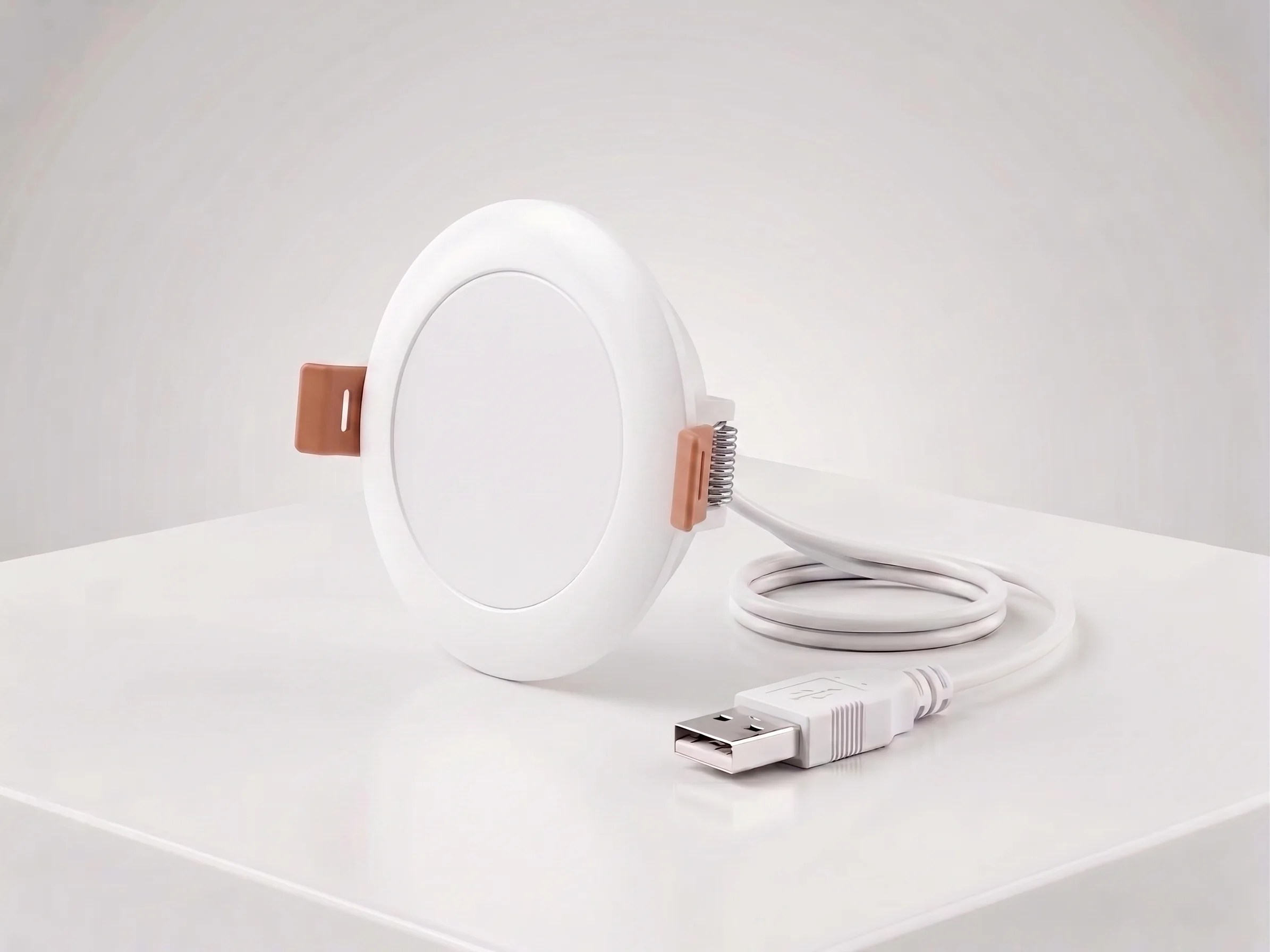
Sensor Kehadiran Manusia mmWave Pasang Plafon — Zigbee
Sensor kehadiran mmWave 24GHz pita lebar untuk plafon: deteksi gerak 10m, mikro-gerak 2,5m, deteksi napas. Sudut 120°, DC5V, Zigbee 3.0, untuk kamar hotel.
contentGraph.reasons.explicit
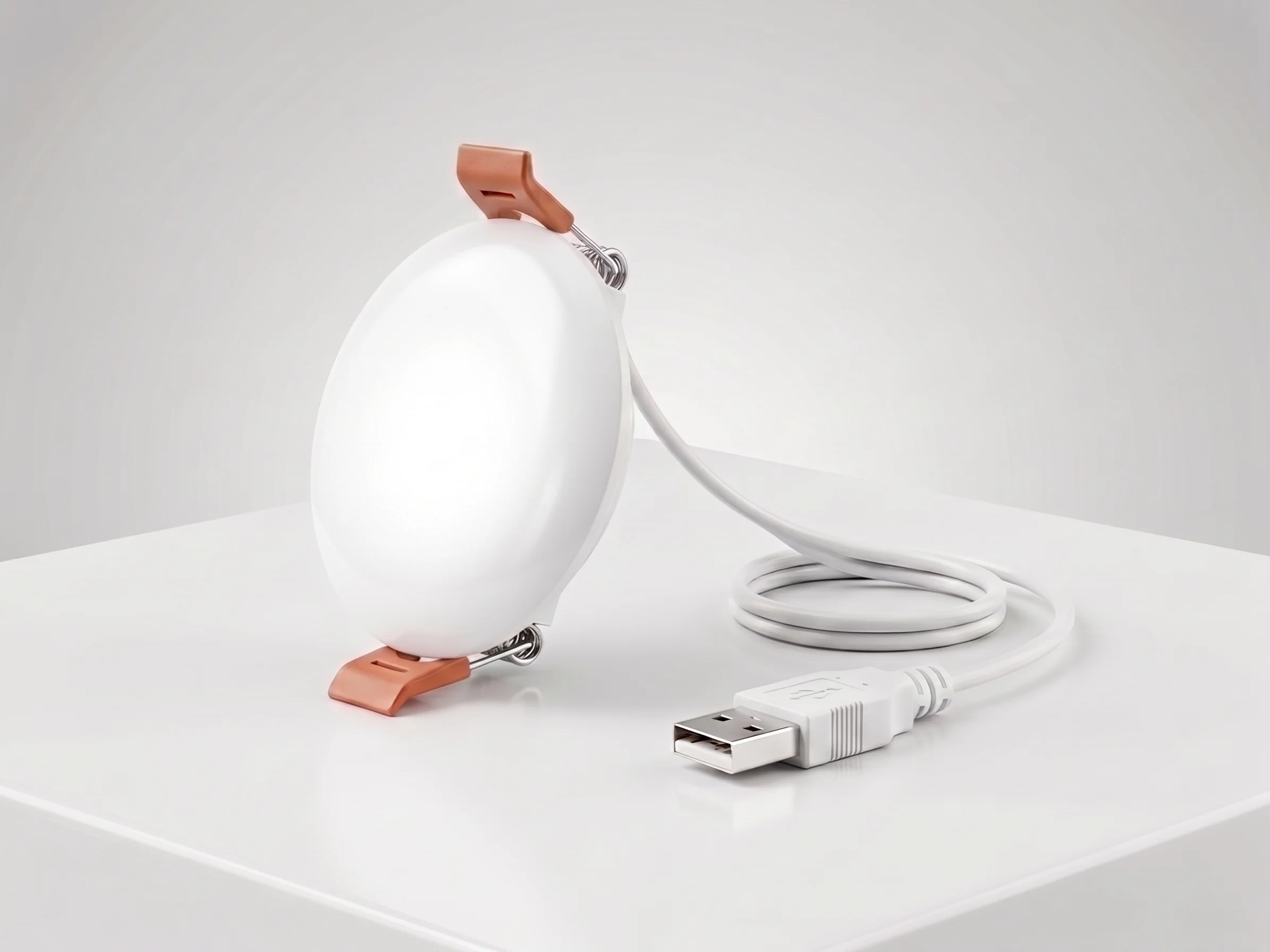
Sensor Kehadiran Manusia mmWave Plafon — WiFi
Sensor kehadiran mmWave 24GHz plafon, deteksi gerak 10m, mikro-gerak 2.5m, pernapasan. Sudut 120°, DC5V, WiFi 2.4GHz. Tanpa gateway, ideal retrofit hotel.
contentGraph.reasons.explicit
contentGraph.sections.solutions
1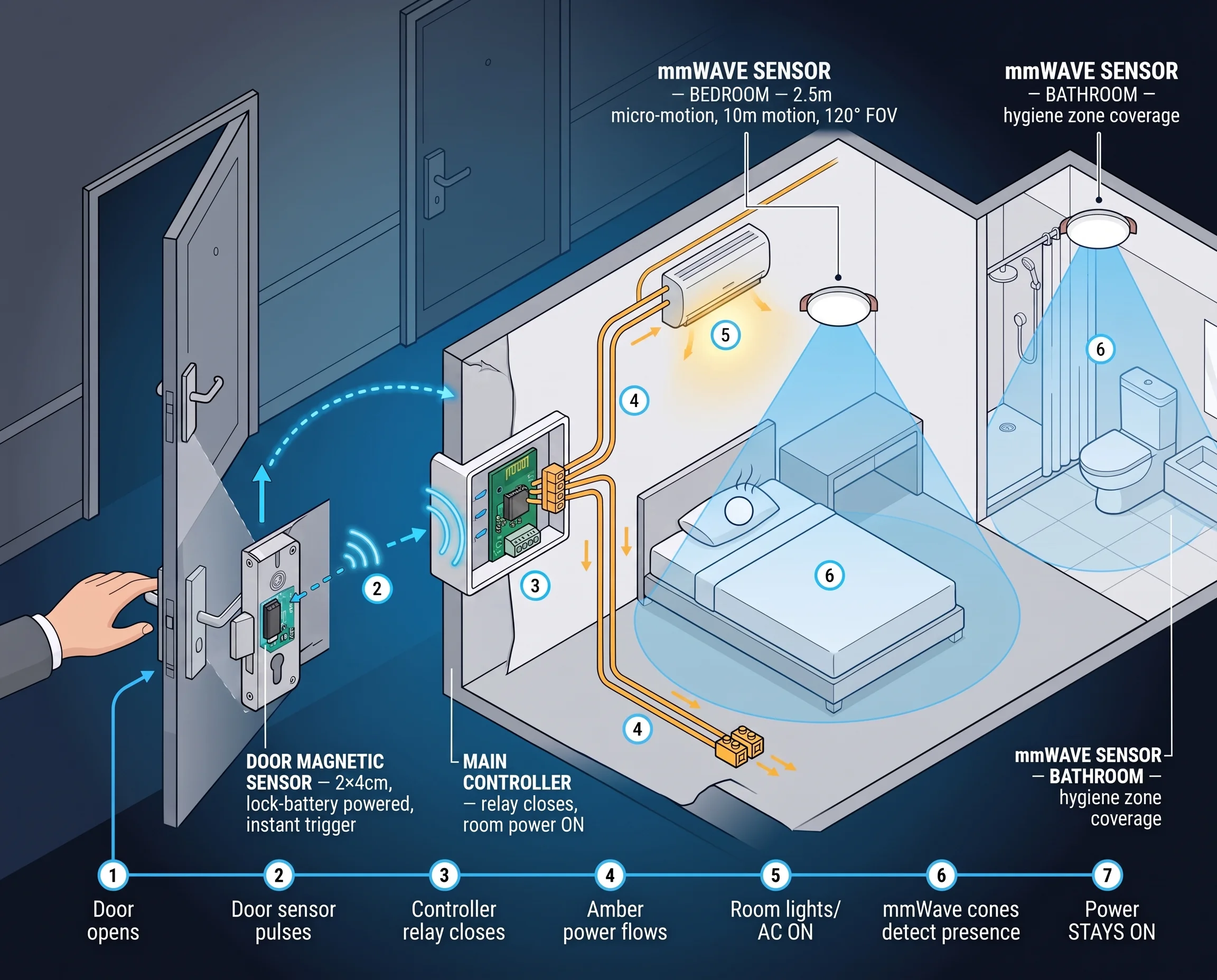
Solusi Sensor Okupansi & Gerak Kamar Hotel
Sensor okupansi radar mmWave untuk kamar hotel: deteksi tamu yang tidur, jadwalkan housekeeping, hemat energi HVAC 20-40% tanpa alarm kosong palsu.
contentGraph.reasons.productContext
contentGraph.sections.blog
3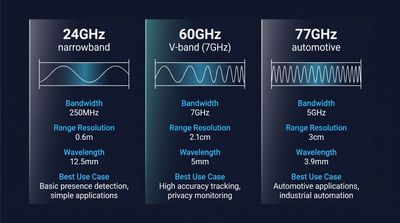
Sensor mmWave 60GHz vs 24GHz vs 77GHz: Memilih Frekuensi yang Tepat untuk Deteksi Kehadiran Komersial
Bandingkan sensor mmWave 60GHz, 24GHz, dan 77GHz untuk deteksi kehadiran komersial. Spesifikasi teknis, jangkauan deteksi, privasi, dan panduan sourcing OEM.
contentGraph.reasons.productContext
Apa Itu Sensor Kehadiran Elektronik? Teknologi dan Akurasi
Pelajari apa itu sensor kehadiran elektronik, cara mendeteksi manusia diam, dan perbedaannya dengan sensor gerak PIR. Membahas mmWave, akurasi, dan penerapan.
contentGraph.reasons.productContext
Cara Integrasi Sensor Kehadiran mmWave dengan Home Assistant
Panduan lengkap kontrol lokal perangkat mmWave: konfigurasi MQTT/Matter, skrip otomasi, kalibrasi, dan tips integrasi sensor kehadiran plafon OEM.
contentGraph.reasons.productContext
nextStep.blog.title
nextStep.blog.description
- nextStep.blog.points.one
- nextStep.blog.points.two
- nextStep.blog.points.three