Detektor Kehadiran Plafon: Instalasi dan Pemilihan 2026
Panduan lengkap detektor kehadiran plafon: instalasi, tinggi pemasangan, jangkauan deteksi, performa, dan kriteria pemilihan untuk berbagai aplikasi.
Detektor kehadiran plafon adalah perangkat deteksi kehadiran yang dirancang khusus untuk pemasangan di plafon, menggunakan teknologi radar gelombang milimeter (mmWave) pada frekuensi 60 GHz (57–64 GHz) dengan bandwidth 7 GHz untuk mendeteksi penghuni manusia yang bergerak maupun diam dari ketinggian pemasangan plafon tipikal 2.5–3.0 meter. Posisi pemasangan di plafon adalah bentuk fisik dominan untuk deteksi kehadiran komersial karena memberikan sudut pandang 360 derajat ke seluruh ruangan, garis pandang yang jelas ke semua penghuni, diskresi visual (detektor terlihat seperti detektor asap kecil atau speaker plafon), serta ketahanan terhadap perusakan. Detektor kehadiran plafon modern mencapai true positive rate penghuni statis di atas 99% dalam pengujian terkontrol dan di atas 95% dalam penerapan dunia nyata, dengan false positive rate di bawah 1% selama periode 24 jam, jangkauan deteksi 6–8 meter untuk penghuni statis, dan sudut pandang ±60° azimuth serta ±40° elevasi.
Panduan ini memberikan gambaran komprehensif tentang detektor kehadiran plafon, mencakup teknologi, praktik terbaik instalasi, karakteristik performa, serta kriteria pemilihan detektor yang tepat untuk aplikasi tertentu.
Detektor Kehadiran Plafon: Teknologi dan Bentuk Fisik
Detektor kehadiran plafon menggunakan teknologi radar mmWave dan tersedia dalam beberapa bentuk fisik.
Detektor Kehadiran Plafon: Teknologi Radar mmWave
Pita ISM 60 GHz (57–64 GHz) adalah frekuensi bawaan untuk detektor kehadiran plafon, menyediakan bandwidth 7 GHz yang memungkinkan resolusi jangkauan 2.1 cm dan deteksi micro-Doppler terhadap pernapasan manusia pada 0.2–0.5 Hz. Panjang gelombang 5 mm pada 60 GHz memungkinkan antena array MIMO 3×3 yang kompak muat dalam area PCB 20×20 mm, memungkinkan bentuk fisik puck plafon berdiameter 70 mm.
Pita 60 GHz memiliki tiga keunggulan utama untuk deteksi kehadiran terpasang plafon: bandwidth lebar, antena kompak, dan penghalang privasi alami (sinyal tidak merambat antar ruangan karena penyerapan oksigen yang tinggi).
Detektor Kehadiran Plafon: Pilihan Bentuk Fisik
Detektor kehadiran plafon tersedia dalam beberapa bentuk fisik:
- Ceiling puck: perangkat melingkar dengan diameter 60–100 mm dan tinggi 20–30 mm, bentuk fisik standar untuk sebagian besar penerapan komersial
- Recessed mount: perangkat pasang rata yang terintegrasi ke plafon hanya dengan cincin trim tipis yang terlihat, untuk instalasi premium
- Tile grid mount: perangkat yang dipasang pada grid ubin plafon gantung (suspended tile ceiling), untuk penerapan kantor
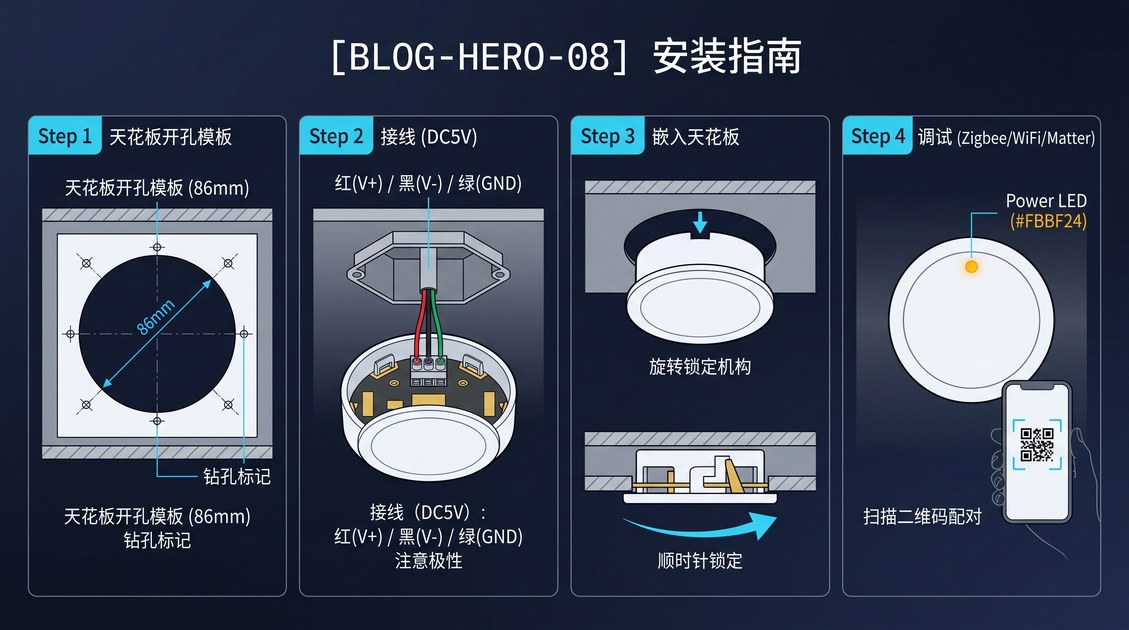
- Junction box mount: perangkat yang dipasang pada kotak sambungan listrik standar di plafon, untuk konstruksi baru
Detektor Kehadiran Plafon: Praktik Terbaik Instalasi
Instalasi detektor kehadiran plafon sangat menentukan kinerjanya, dan praktik terbaik berikut harus diikuti.
Detektor Kehadiran Plafon: Tinggi Pemasangan
Tinggi pemasangan yang direkomendasikan untuk detektor kehadiran plafon adalah 2.5–3.0 m, yang merupakan tinggi plafon standar pada sebagian besar bangunan komersial. Pada ketinggian ini, detektor dengan sudut pandang azimuth ±60° dapat mencakup ruangan hingga 5×5 m, dan detektor dengan sudut pandang elevasi ±40° dapat mencakup area lantai hingga 4×4 m.
Memasang detektor terlalu tinggi (di atas 3.5 m) mengurangi sudut pandang di tingkat lantai dan dapat menciptakan titik mati (dead zone). Memasang detektor terlalu rendah (di bawah 2.0 m) membuat detektor rentan terhadap perusakan dan dapat menghasilkan instalasi yang kurang estetis.
Detektor Kehadiran Plafon: Lokasi Pemasangan
Lokasi pemasangan yang direkomendasikan adalah di tengah plafon, tepat di atas area aktivitas utama. Untuk kamar hotel, area aktivitas utama adalah tempat tidur, sehingga detektor harus dipasang di atas bagian tengah tempat tidur. Untuk kantor, area aktivitas utama adalah meja kerja, sehingga detektor harus dipasang di atas bagian tengah meja. Untuk ruang rapat, area aktivitas utama adalah meja konferensi.
Detektor harus dipasang minimal 0.5 m dari dinding mana pun, 0.5 m dari benda logam apa pun, dan 0.5 m dari difusor HVAC apa pun.
Detektor Kehadiran Plafon: Menghindari Kesalahan Umum
Beberapa kesalahan instalasi umum dapat menurunkan kinerja detektor kehadiran plafon:
- Memasang terlalu dekat dengan dinding: menciptakan titik mati dalam sudut pandang
- Memasang di dekat benda logam: logam dapat memantulkan sinyal radar dan menciptakan deteksi palsu
- Memasang di dekat difusor HVAC: aliran udara dapat memicu deteksi palsu
- Memasang di balik penghalang: papan tulis, layar, atau tanaman dapat memblokir sudut pandang
- Orientasi yang salah: antena array harus diorientasikan untuk memberikan cakupan penuh ruangan
Detektor Kehadiran Plafon: Daya dan Konektivitas
Detektor kehadiran plafon dapat ditenagai oleh jaringan listrik (melalui adaptor daya atau kotak sambungan), Power over Ethernet (PoE), atau baterai. Konektivitasnya dapat berupa Zigbee, WiFi, Matter, BACnet, atau protokol kabel.
Untuk penerapan hotel, Zigbee dengan daya jaringan listrik adalah yang paling umum. Untuk penerapan kantor, WiFi atau PoE dengan BACnet umum digunakan. Untuk penerapan residensial, Matter atau Zigbee dengan daya jaringan listrik atau baterai umum digunakan.
Detektor Kehadiran Plafon: Karakteristik Performa
Kinerja detektor kehadiran plafon dicirikan oleh beberapa metrik utama.
Detektor Kehadiran Plafon: Deteksi Penghuni Statis
True positive rate (TPR) penghuni statis adalah persentase waktu ketika penghuni manusia yang diam dilaporkan dengan benar sebagai hadir. Untuk detektor kehadiran plafon 60 GHz, TPR berada di atas 99% dalam pengujian terkontrol dan di atas 95% dalam penerapan dunia nyata.
Detektor Kehadiran Plafon: False Positive Rate
False positive rate (FPR) adalah persentase waktu ketika detektor melaporkan kehadiran padahal ruangan sebenarnya kosong. Untuk detektor kehadiran plafon yang dirancang dengan baik, FPR berada di bawah 1% selama periode 24 jam.
Detektor Kehadiran Plafon: Jangkauan Deteksi
Jangkauan deteksi detektor kehadiran plafon 60 GHz adalah 6–8 m untuk penghuni statis dan 8–12 m untuk penghuni bergerak ketika dipasang pada ketinggian 2.5–3.0 m.
Detektor Kehadiran Plafon: Sudut Pandang
Sudut pandang detektor kehadiran plafon tipikal adalah ±60° azimuth dan ±40° elevasi, yang memberikan cakupan 360 derajat ke ruangan ketika dipasang di tengah plafon.
Detektor Kehadiran Plafon: Latensi Deteksi
Latensi deteksi adalah waktu antara penghuni memasuki zona deteksi dan detektor melaporkan perubahan tersebut. Untuk detektor kehadiran plafon, latensinya tipikalnya 0.5–3 detik.
Detektor Kehadiran Plafon: Kasus Penggunaan
Detektor kehadiran plafon diterapkan dalam berbagai aplikasi yang luas.
Detektor Kehadiran Plafon: Penerapan Kamar Hotel
Kamar hotel adalah aplikasi kanonik untuk detektor kehadiran plafon. Detektor 60 GHz yang dipasang di tengah plafon pada ketinggian 2.5–3.0 m memberikan cakupan penuh ruangan, termasuk tempat tidur, meja kerja, pintu masuk kamar mandi, dan area duduk. Detektor mendeteksi tamu selama menginap, termasuk saat mereka tidur, dan menyalurkan data hunian ke sistem manajemen bangunan untuk koordinasi housekeeping dan ke sistem HVAC untuk manajemen energi.
Detektor Kehadiran Plafon: Penerapan Kantor dan Ruang Rapat
Gedung perkantoran menggunakan detektor kehadiran plafon untuk kontrol HVAC dan pencahayaan per ruangan, deteksi ketersediaan ruang rapat, dan analitik pemanfaatan ruang. Detektor kehadiran plafon di kantor individual mendeteksi apakah kantor sedang terisi dan menyesuaikan HVAC serta pencahayaan sesuai hal tersebut. Di ruang rapat, detektor mendeteksi apakah ruangan sedang terisi dan menyediakan data ke sistem penjadwalan untuk ketersediaan ruangan secara real-time.
Detektor Kehadiran Plafon: Penerapan Layanan Kesehatan dan Ruang Pasien
Fasilitas kesehatan menggunakan detektor kehadiran plafon di ruang pasien untuk deteksi jatuh, peringatan keluar tempat tidur, dan kontrol lingkungan berbasis hunian. Profil privasi radar mmWave (tanpa gambar, non-invasif) menjadikannya cocok untuk penerapan di ruang pribadi di mana sensor berbasis kamera tidak akan tepat digunakan.
Detektor Kehadiran Plafon: Penerapan Rumah Pintar Residensial
Rumah pintar residensial menggunakan detektor kehadiran plafon untuk pencahayaan berbasis hunian, kontrol HVAC, dan pemantauan keamanan. Kasus penggunaan paling menarik untuk detektor residensial adalah pencegahan masalah "lampu mati saat sedang membaca" yang menghantui sensor gerak berbasis PIR.
Detektor Kehadiran Plafon: Kriteria Pemilihan
Memilih detektor kehadiran plafon yang tepat untuk aplikasi tertentu memerlukan evaluasi terhadap beberapa kriteria.
Detektor Kehadiran Plafon: Performa Deteksi
Performa deteksi adalah kriteria terpenting. Metrik utama meliputi TPR penghuni statis (di atas 99% dalam pengujian terkontrol, di atas 95% dalam penerapan dunia nyata), FPR (di bawah 1% selama periode 24 jam), jangkauan deteksi (6–8 m untuk penghuni statis, 8–12 m untuk penghuni bergerak), dan latensi deteksi (di bawah 3 detik).
Detektor Kehadiran Plafon: Bentuk Fisik
Untuk sebagian besar aplikasi, ceiling puck (diameter 70 mm) adalah pilihan yang tepat. Untuk instalasi premium, opsi pemasangan recessed mungkin lebih dipilih. Untuk penerapan kantor dengan plafon ubin gantung, sistem pemasangan tile grid direkomendasikan.
Detektor Kehadiran Plafon: Konektivitas
Konektivitas harus sesuai dengan infrastruktur yang ada. Untuk penerapan hotel, Zigbee adalah yang paling umum. Untuk penerapan kantor, WiFi atau PoE dengan BACnet umum digunakan. Untuk penerapan residensial, Matter atau Zigbee adalah yang paling umum.
Detektor Kehadiran Plafon: Sertifikasi
Detektor harus memiliki sertifikasi yang diperlukan untuk pasar target: FCC, CE, RoHS, dan sertifikasi regional apa pun.
Detektor Kehadiran Plafon: Produk yang Direkomendasikan
Produk yang direkomendasikan untuk penerapan detektor kehadiran plafon adalah ceiling-presence-sensor-zigbee, ceiling-presence-sensor-wifi, dan ceiling-presence-sensor-matter, yang menyediakan deteksi radar mmWave broadband 24GHz, berbagai opsi konektivitas, sertifikasi lengkap (CE, FCC, RoHS), dan output sinyal hunian ke BMS, BMS, dan platform rumah pintar.
Detektor Kehadiran Plafon: Rekomendasi Akhir
Detektor kehadiran plafon adalah bentuk fisik bawaan untuk deteksi kehadiran komersial di kamar hotel, kantor, fasilitas kesehatan, dan rumah pintar residensial. Radar mmWave 60 GHz adalah teknologi bawaan, menyediakan deteksi penghuni statis yang andal, profil privasi yang sangat baik, dan bentuk fisik kompak yang muat dalam puck plafon.
Bagi tim pengadaan atau konsumen yang memilih detektor kehadiran plafon, pendekatan yang tepat adalah memulai dengan definisi yang jelas tentang persyaratan aplikasi, kemudian mengevaluasi detektor yang tersedia terhadap persyaratan tersebut, lalu memilih vendor dengan rekam jejak terbukti di vertikal target. Detektor harus dipasang mengikuti prosedur pemasangan dan commissioning yang direkomendasikan vendor, dan integrasi dengan sistem otomasi hilir harus diuji secara end-to-end sebelum penerapan dianggap selesai.
Dengan detektor kehadiran plafon yang tepat, terpasang dan terintegrasi dengan benar, detektor dapat memberikan tingkat kesadaran hunian yang mustahil dicapai dengan sensor gerak berbasis PIR, dan dapat membenarkan biaya satuan yang lebih tinggi melalui peningkatan efisiensi energi, pengalaman penghuni yang lebih baik, dan data hunian yang lebih akurat untuk analitik hilir.
Sebagian konten artikel ini dihasilkan oleh AI dan dioptimalkan untuk akurasi profesional dan keterbacaan. Ceiling mounted presence detectors are presence detection devices specifically designed for ceiling mounting, using millimeter-wave (mmWave) radar technology at 60 GHz (57–64 GHz) with 7 GHz of bandwidth to detect both moving and stationary human occupants from a typical ceiling mounting height of 2.5–3.0 meters. The ceiling mounting position is the dominant form factor for commercial presence detection because it provides a 360-degree field of view of the room, a clear line of sight to all occupants, visual discretion (the detector looks like a small smoke detector or ceiling speaker), and tamper resistance. A modern ceiling mounted presence detector achieves a stationary-occupant true positive rate above 99% in controlled testing and above 95% in real-world deployment, with a false positive rate below 1% over a 24-hour period, a detection range of 6–8 meters for stationary occupants, and a field of view of ±60° azimuth and ±40° elevation.
This guide provides a comprehensive overview of ceiling mounted presence detectors, covering the technology, the installation best practices, the performance characteristics, and the selection criteria for choosing the right detector for a specific application.
Ceiling Mounted Presence Detectors: Technology and Form Factor
The ceiling mounted presence detector uses mmWave radar technology and is available in several form factors.
Ceiling Mounted Presence Detectors: mmWave Radar Technology
The 60 GHz ISM band (57–64 GHz) is the default frequency for ceiling mounted presence detectors, providing 7 GHz of bandwidth that enables 2.1 cm range resolution and micro-Doppler detection of human breathing at 0.2–0.5 Hz. The 5 mm wavelength at 60 GHz allows a compact 3×3 MIMO antenna array to fit in a 20×20 mm PCB area, enabling the 70 mm diameter ceiling puck form factor.
The 60 GHz band has three key advantages for ceiling-mounted presence detection: wide bandwidth, compact antennas, and a natural privacy barrier (the signal does not propagate between rooms due to the high oxygen absorption).
Ceiling Mounted Presence Detectors: Form Factor Options
The ceiling mounted presence detector is available in several form factors:
- Ceiling puck: a circular device with a diameter of 60–100 mm and a height of 20–30 mm, the standard form factor for most commercial deployments
- Recessed mount: a flush-mount device that is integrated into the ceiling with only a thin trim ring visible, for premium installations
- Tile grid mount: a device that is mounted in the tile grid of a suspended tile ceiling, for office deployments
- Junction box mount: a device that is mounted in a standard electrical junction box in the ceiling, for new construction
Ceiling Mounted Presence Detectors: Installation Best Practices
The installation of a ceiling mounted presence detector is critical to its performance, and the following best practices should be followed.
Ceiling Mounted Presence Detectors: Mounting Height
The recommended mounting height for a ceiling mounted presence detector is 2.5–3.0 m, which is the standard ceiling height in most commercial buildings. At this height, a detector with a ±60° azimuth field of view can cover a room of up to 5×5 m, and a detector with a ±40° elevation field of view can cover a floor area of up to 4×4 m.
Mounting the detector too high (above 3.5 m) reduces the field of view at floor level and may create dead zones. Mounting the detector too low (below 2.0 m) makes the detector vulnerable to tampering and may create a less aesthetically pleasing installation.
Ceiling Mounted Presence Detectors: Mounting Location
The recommended mounting location is the center of the ceiling, directly above the main activity area. For a hotel room, the main activity area is the bed, so the detector should be mounted above the center of the bed. For an office, the main activity area is the desk, so the detector should be mounted above the center of the desk. For a meeting room, the main activity area is the conference table.
The detector should be mounted at least 0.5 m from any wall, 0.5 m from any metal object, and 0.5 m from any HVAC diffuser.
Ceiling Mounted Presence Detectors: Avoiding Common Mistakes
Several common installation mistakes can undermine the performance of a ceiling mounted presence detector:
- Mounting too close to a wall: creates a dead zone in the field of view
- Mounting near metal objects: metal can reflect the radar signal and create false detections
- Mounting near HVAC diffusers: the airflow can trigger false detections
- Mounting behind obstacles: whiteboards, screens, or plants can block the field of view
- Incorrect orientation: the antenna array should be oriented to provide full coverage of the room
Ceiling Mounted Presence Detectors: Power and Connectivity
A ceiling mounted presence detector can be powered by mains (via a power adapter or a junction box), by Power over Ethernet (PoE), or by battery. The connectivity can be Zigbee, WiFi, Matter, BACnet, or a wired protocol.
For hotel deployments, Zigbee with mains power is the most common. For office deployments, WiFi or PoE with BACnet is common. For residential deployments, Matter or Zigbee with mains or battery power is common.
Ceiling Mounted Presence Detectors: Performance Characteristics
The performance of a ceiling mounted presence detector is characterized by several key metrics.
Ceiling Mounted Presence Detectors: Stationary-Occupant Detection
The stationary-occupant true positive rate (TPR) is the percentage of time that a stationary human occupant is correctly reported as present. For a 60 GHz ceiling mounted presence detector, the TPR is above 99% in controlled testing and above 95% in real-world deployment.
Ceiling Mounted Presence Detectors: False Positive Rate
The false positive rate (FPR) is the percentage of time the detector reports presence when the room is actually empty. For a well-designed ceiling mounted presence detector, the FPR is below 1% over a 24-hour period.
Ceiling Mounted Presence Detectors: Detection Range
The detection range of a 60 GHz ceiling mounted presence detector is 6–8 m for stationary occupants and 8–12 m for moving occupants when mounted at 2.5–3.0 m.
Ceiling Mounted Presence Detectors: Field of View
The field of view of a typical ceiling mounted presence detector is ±60° azimuth and ±40° elevation, which provides 360-degree coverage of a room when mounted in the center of the ceiling.
Ceiling Mounted Presence Detectors: Detection Latency
The detection latency is the time between an occupant entering the detection zone and the detector reporting the change. For a ceiling mounted presence detector, the latency is typically 0.5–3 seconds.
Ceiling Mounted Presence Detectors: Use Cases
The ceiling mounted presence detector is deployed in a wide range of applications.
Ceiling Mounted Presence Detectors: Hotel Room Deployment
Hotel rooms are the canonical application for the ceiling mounted presence detector. A 60 GHz detector mounted in the center of the ceiling at 2.5–3.0 m provides full coverage of the room, including the bed, the desk, the bathroom entry, and the seating area. The detector detects the guest throughout the stay, including when they are sleeping, and feeds the occupancy data to the building management system for housekeeping coordination and the HVAC system for energy management.
Ceiling Mounted Presence Detectors: Office and Conference Room Deployment
Office buildings use ceiling mounted presence detectors for per-room HVAC and lighting control, conference room availability detection, and space utilization analytics. A ceiling mounted presence detector in an individual office detects whether the office is occupied and adjusts the HVAC and lighting accordingly. In a conference room, the detector detects whether the room is occupied and provides the data to the scheduling system for real-time room availability.
Ceiling Mounted Presence Detectors: Healthcare and Patient Room Deployment
Healthcare facilities use ceiling mounted presence detectors in patient rooms for fall detection, bed-exit alerting, and occupancy-based environmental control. The privacy profile of mmWave radar (no images, non-invasive) makes it suitable for deployment in private spaces where camera-based sensing would be inappropriate.
Ceiling Mounted Presence Detectors: Residential Smart Home Deployment
Residential smart homes use ceiling mounted presence detectors for occupancy-based lighting, HVAC control, and security monitoring. The most compelling use case for residential detectors is the prevention of the "light turned off while reading" problem that plagues PIR-based motion sensors.
Ceiling Mounted Presence Detectors: Selection Criteria
Selecting the right ceiling mounted presence detector for a specific application requires evaluating several criteria.
Ceiling Mounted Presence Detectors: Detection Performance
The detection performance is the most important criterion. Key metrics include the stationary-occupant TPR (above 99% in controlled testing, above 95% in real-world deployment), the FPR (below 1% over a 24-hour period), the detection range (6–8 m for stationary occupants, 8–12 m for moving occupants), and the detection latency (below 3 seconds).
Ceiling Mounted Presence Detectors: Form Factor
For most applications, a ceiling puck (70 mm diameter) is the right choice. For premium installations, a recessed mounting option may be preferred. For office deployments with suspended tile ceilings, a tile grid mounting system is recommended.
Ceiling Mounted Presence Detectors: Connectivity
The connectivity should match the existing infrastructure. For hotel deployments, Zigbee is the most common. For office deployments, WiFi or PoE with BACnet is common. For residential deployments, Matter or Zigbee is the most common.
Ceiling Mounted Presence Detectors: Certifications
The detector should carry the required certifications for the target market: FCC, CE, RoHS, and any regional certifications.
Ceiling Mounted Presence Detectors: Recommended Products
The recommended products for ceiling mounted presence detector deployments are the ceiling-presence-sensor-zigbee, ceiling-presence-sensor-wifi, and ceiling-presence-sensor-matter, which provide 24GHz wideband mmWave radar detection, multiple connectivity options, full certification (CE, FCC, RoHS), and occupancy-signal output to BMS, BMS, and smart home platforms.
Ceiling Mounted Presence Detectors: Final Recommendation
The ceiling mounted presence detector is the default form factor for commercial presence detection in hotel rooms, offices, healthcare facilities, and residential smart homes. The 60 GHz mmWave radar is the default technology, providing reliable stationary-occupant detection, an excellent privacy profile, and a compact form factor that fits in a ceiling puck.
For a procurement team or a consumer selecting a ceiling mounted presence detector, the right approach is to start with a clear definition of the application requirements, then evaluate the available detectors against those requirements, then select a vendor with a proven track record in the target vertical. The detector should be installed following the vendor's recommended mounting and commissioning procedures, and the integration with the downstream automation system should be tested end-to-end before the deployment is considered complete.
With the right ceiling mounted presence detector, correctly installed and integrated, the detector can deliver a level of occupancy awareness that is impossible to achieve with PIR-based motion sensors, and can justify the higher unit cost through improved energy efficiency, better occupant experience, and more accurate occupancy data for downstream analytics.
Part of this article content is generated by AI and optimized for professional accuracy and readability.
blog.inArticleCta.title
blog.inArticleCta.description
contentGraph.title
contentGraph.description
contentGraph.sections.products
3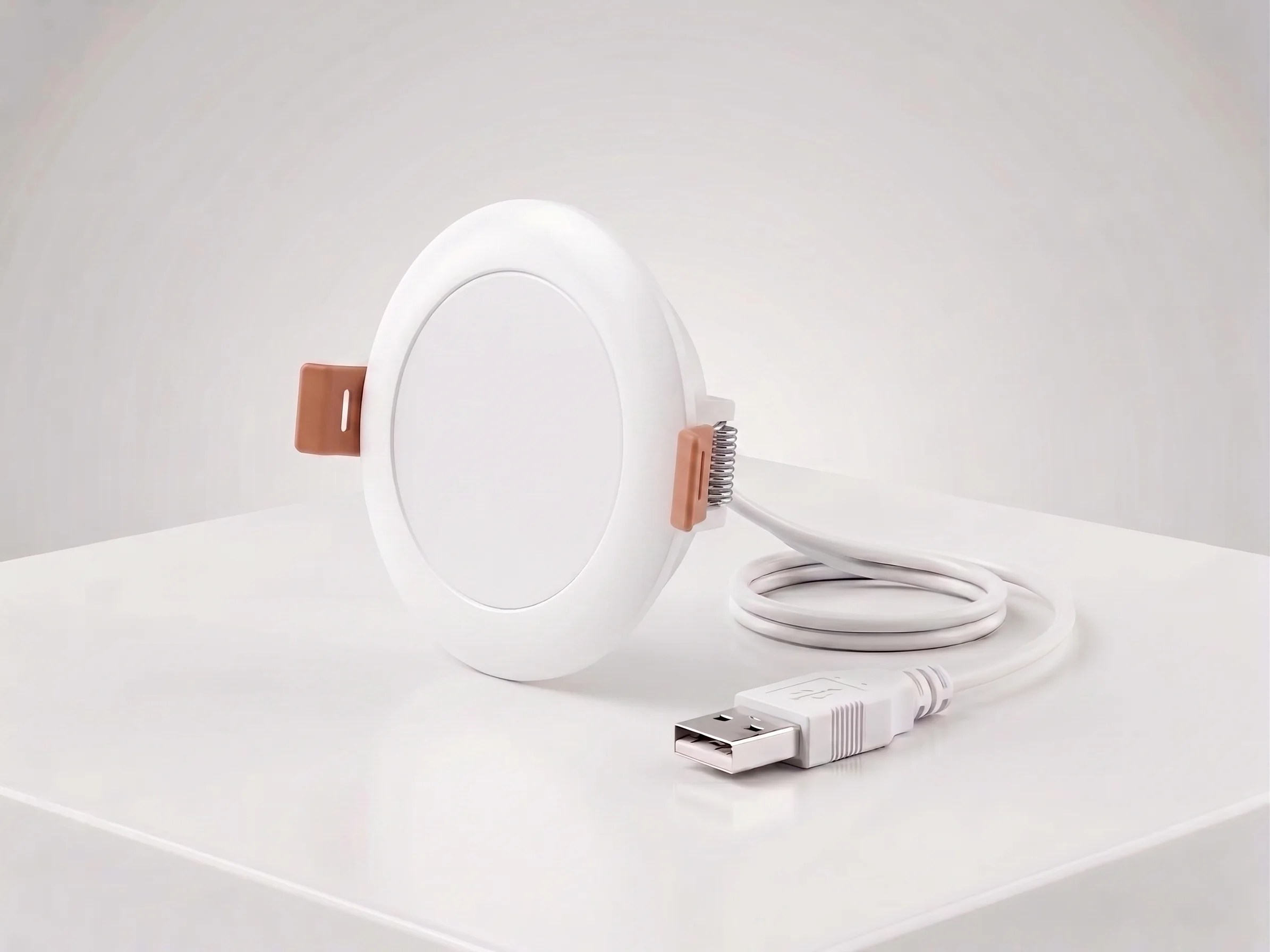
Sensor Kehadiran Manusia mmWave Pasang Plafon — Zigbee
Sensor kehadiran mmWave 24GHz pita lebar untuk plafon: deteksi gerak 10m, mikro-gerak 2,5m, deteksi napas. Sudut 120°, DC5V, Zigbee 3.0, untuk kamar hotel.
contentGraph.reasons.explicit
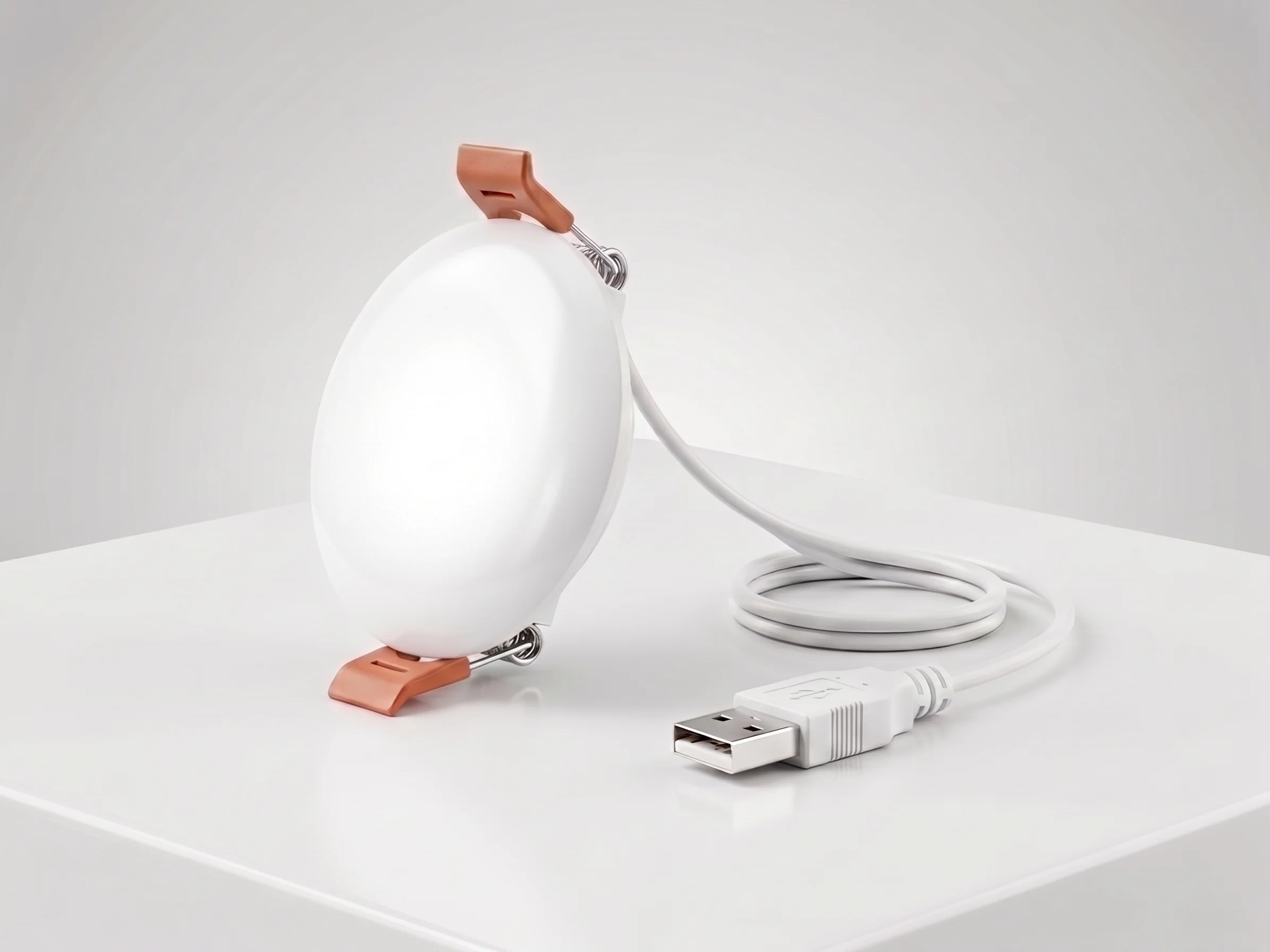
Sensor Kehadiran Manusia mmWave Plafon — WiFi
Sensor kehadiran mmWave 24GHz plafon, deteksi gerak 10m, mikro-gerak 2.5m, pernapasan. Sudut 120°, DC5V, WiFi 2.4GHz. Tanpa gateway, ideal retrofit hotel.
contentGraph.reasons.explicit
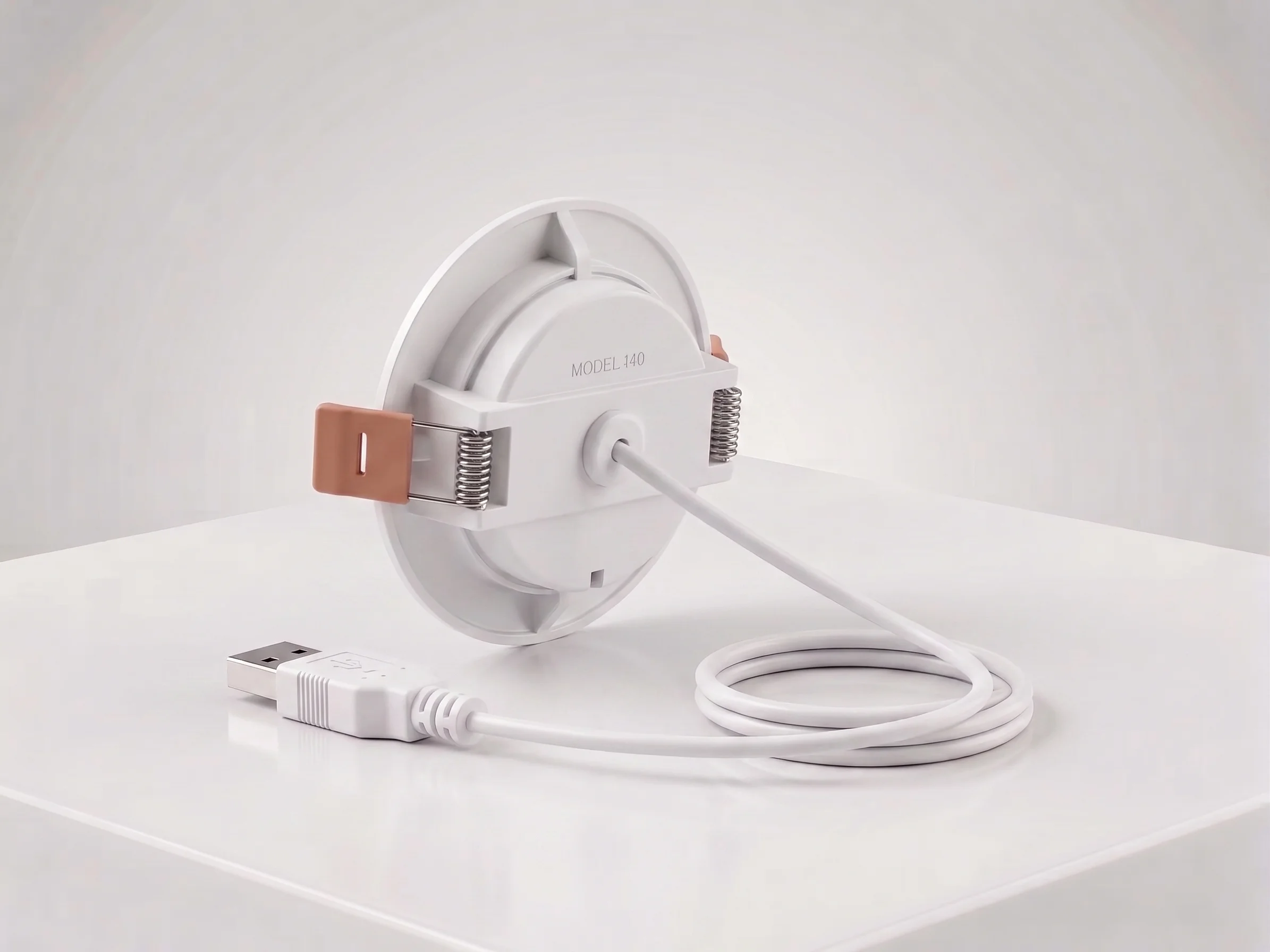
Sensor Kehadiran Manusia mmWave Plafon — Matter over Thread
Sensor kehadiran mmWave plafon 24GHz: gerak 10m, mikro-gerak 2.5m, deteksi napas. 120°, DC5V, Matter over Thread untuk Apple Home, Google Home, dan Alexa.
contentGraph.reasons.explicit
contentGraph.sections.solutions
1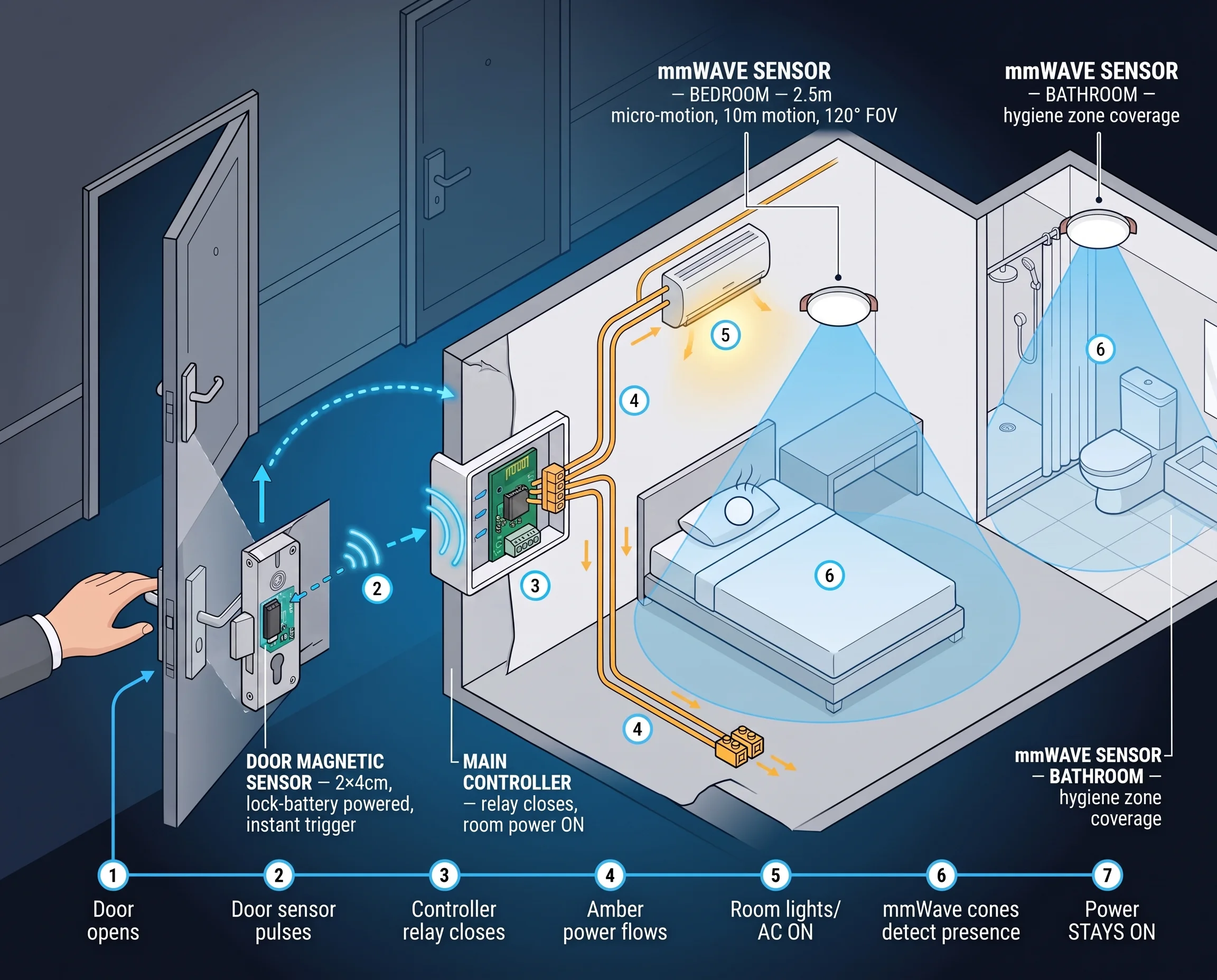
Solusi Sensor Okupansi & Gerak Kamar Hotel
Sensor okupansi radar mmWave untuk kamar hotel: deteksi tamu yang tidur, jadwalkan housekeeping, hemat energi HVAC 20-40% tanpa alarm kosong palsu.
contentGraph.reasons.productContext
contentGraph.sections.blog
3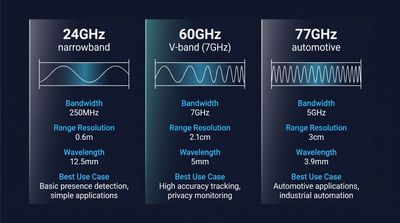
Sensor mmWave 60GHz vs 24GHz vs 77GHz: Memilih Frekuensi yang Tepat untuk Deteksi Kehadiran Komersial
Bandingkan sensor mmWave 60GHz, 24GHz, dan 77GHz untuk deteksi kehadiran komersial. Spesifikasi teknis, jangkauan deteksi, privasi, dan panduan sourcing OEM.
contentGraph.reasons.productContext
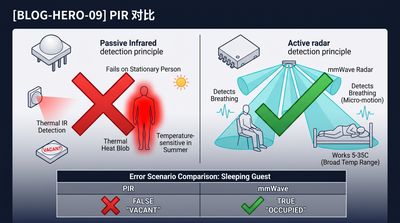
Apa Itu Sensor Kehadiran Elektronik? Teknologi dan Akurasi
Pelajari apa itu sensor kehadiran elektronik, cara mendeteksi manusia diam, dan perbedaannya dengan sensor gerak PIR. Membahas mmWave, akurasi, dan penerapan.
contentGraph.reasons.productContext
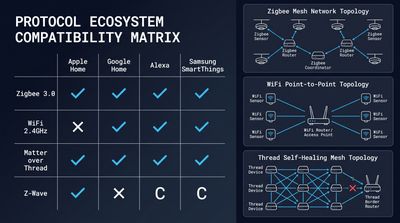
Cara Integrasi Sensor Kehadiran mmWave dengan Home Assistant
Panduan lengkap kontrol lokal perangkat mmWave: konfigurasi MQTT/Matter, skrip otomasi, kalibrasi, dan tips integrasi sensor kehadiran plafon OEM.
contentGraph.reasons.productContext
nextStep.blog.title
nextStep.blog.description
- nextStep.blog.points.one
- nextStep.blog.points.two
- nextStep.blog.points.three