What Is an Electronic Presence Sensor? Technology, Accuracy, and How It Differs From a Motion Sensor
Learn what an electronic presence sensor is, how it detects stationary humans, and how it differs from a PIR motion sensor. Covers mmWave, accuracy, and use cases.
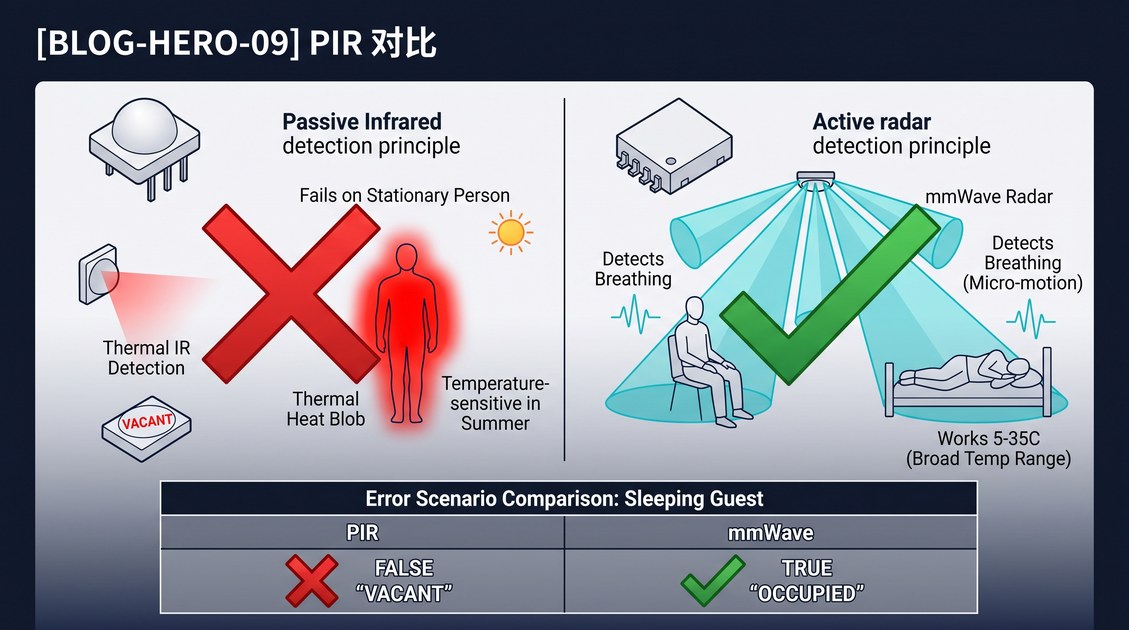
An electronic presence sensor is a device that uses active electronic sensing — most commonly millimeter-wave (mmWave) radar, ultrasonic transducers, or camera-based vision — to determine whether a human is currently inside a defined space, including the case where the person is sitting motionless, lying down, or sleeping with no visible movement. Unlike a passive infrared (PIR) motion sensor, which only triggers when a warm body crosses its detection field, an electronic presence sensor emits its own signal (radio wave or sound wave) and analyzes the reflection to determine occupancy state, micro-motion such as breathing, and in some cases precise location within a room. The defining capability of an electronic presence sensor is the reliable detection of a stationary human at ranges of 2–8 meters with a true positive rate typically above 98% in controlled testing, a level of accuracy that PIR-based motion sensors cannot approach because they fundamentally require macro-motion to fire. Electronic presence sensors of this type are deployed in hotel rooms for housekeeping coordination, in offices for occupancy-based HVAC and lighting control, in healthcare for fall detection and patient monitoring, and in residential smart home systems where lighting and climate must respond to actual presence rather than door openings or recent movement. For a real-world hotel deployment that coordinates housekeeping, HVAC, and energy savings from true occupancy state, see our hotel room occupancy solution; the ceiling presence sensor with Zigbee is the most common model used for that use case.
Understanding the difference between an electronic presence sensor and a traditional motion sensor is one of the most consequential decisions in any building automation, smart home, or hospitality deployment, because the two device classes look similar from the outside, are often sold in the same product category, and yet produce fundamentally different behavior in real-world use. A PIR motion sensor wired to a hotel room light will turn the light on when a guest walks in and turn it off ten minutes after the last detected movement — meaning a guest sitting on the bed reading for two hours will see the light cycle off repeatedly, or a sleeping guest will cause the HVAC to revert to setback mode at 3 a.m. because the sensor concluded the room was empty. An electronic presence sensor, by contrast, will hold the occupied state for the entire eight-hour sleep period because it can detect the micro-motion of breathing, the slight postural adjustments of a sleeping person, and the small movements of a reading person. This article explains what an electronic presence sensor is, how it works at the physical layer, how it differs from a motion sensor, what accuracy benchmarks to expect, and how to choose the right one for a given application. If you are comparing specific models for a rollout, the full presence sensor product lineup groups every option by protocol and mounting form factor.
What Is an Electronic Presence Sensor: The Working Definition for Modern Detection
The phrase "electronic presence sensor" is not a single, IEEE-standardized term, but it has acquired a clear meaning in the building automation and smart home industry over the past decade. An electronic presence sensor is any solid-state electronic device that actively determines whether one or more humans are currently inside a defined detection zone, with the capability to detect stationary occupants, and that reports this occupancy state through a wired or wireless interface to a downstream automation system. The word "electronic" distinguishes this class of sensor from purely mechanical or passive thermal detectors; the word "presence" distinguishes it from devices that only detect motion. Together, "electronic presence sensor" denotes a category of devices that sit above simple motion detectors in capability and complexity, and that are now the default choice for any deployment where stationary-occupant detection is required.
Electronic Presence Sensor: Why "Presence" Is Different From "Motion"
The distinction between presence and motion is not marketing — it reflects a fundamental difference in sensing physics. A motion sensor, in its most common form, is a passive infrared sensor that detects changes in infrared radiation across two or more adjacent sensing zones. When a warm body moves from one zone to another, the differential signal exceeds a threshold and the sensor reports motion. A stationary person emits infrared but does not change the differential signal, so the motion sensor reports nothing. This is why a PIR motion sensor is unable to confirm the presence of a person who sits still for an extended period.
An electronic presence sensor, by contrast, uses active sensing — most commonly mmWave radar, but also ultrasonic, lidar, or computer vision — to emit a signal into the detection zone and analyze the reflected return. By measuring the time-of-flight, phase shift, and Doppler signature of the reflected signal across a wide bandwidth (typically 250 MHz at 24 GHz, 7 GHz at 60 GHz, or 5 GHz at 77 GHz), an electronic presence sensor can resolve the range to objects in the room, their velocity, and their micro-motion characteristics. A sleeping person breathing at 0.3 Hz produces a periodic Doppler signature at the chest wall that is clearly distinguishable from inanimate objects, HVAC airflow, or random noise. This is what makes the electronic presence sensor fundamentally different from a motion sensor: it can answer the question "is anyone actually in this room right now," not just "did someone move recently."
Electronic Presence Sensor: How mmWave Radar Became the Default Technology
Among the various technologies that qualify as electronic presence sensors, mmWave radar has emerged as the dominant choice for most commercial and residential applications, and understanding why requires looking at the tradeoffs across the alternatives. The three principal active sensing technologies used in electronic presence sensor designs are mmWave radar, ultrasonic sensing, and computer vision; each has strengths and weaknesses that determine its fit for a given use case.
mmWave radar is now the most widely deployed electronic presence sensor technology for indoor applications. It operates in the 24 GHz, 60 GHz, or 77 GHz industrial-scientific-medical (ISM) bands, with 60 GHz (specifically 57–64 GHz) being the current default for new product designs. The 7 GHz of bandwidth available in the 60 GHz band enables range resolution on the order of 2 cm and micro-Doppler sensitivity that can detect the chest wall motion of a sleeping human at 4–8 m. The form factor is small (a typical 60 GHz antenna array fits in a 20×20 mm PCB area), the power consumption is low (typically 0.5–2 W for a ceiling-mounted unit), the privacy profile is excellent (no images are produced, and the 5 mm wavelength does not penetrate typical interior walls), and the global regulatory environment is mature under FCC Part 15.255 and EN 305 550.
Ultrasonic sensing uses high-frequency sound waves (typically 40–200 kHz) emitted from a transducer and reflected off room surfaces and occupants. An ultrasonic electronic presence sensor can detect presence by sensing changes in the standing wave pattern of the room, including the Doppler shift caused by moving objects. The technology is mature, inexpensive, and tolerant of obstructions in the line of sight, but it has two important limitations: it cannot easily distinguish a person from other moving objects (a curtain moving in HVAC airflow looks the same as a person), and its detection of stationary occupants is unreliable because the Doppler principle requires motion. Ultrasonic electronic presence sensor designs are common in residential vacancy sensor applications but are being replaced by mmWave in new commercial deployments.
Computer vision uses a camera and on-device image processing to detect and count people in the field of view. A vision-based electronic presence sensor can deliver the highest accuracy in terms of person counting and activity recognition, but it raises significant privacy concerns in hotel rooms, restrooms, healthcare facilities, and other private spaces. The GDPR and CCPA implications of capturing even transient image data in a private space are severe, and most hospitality and healthcare deployments explicitly avoid camera-based electronic presence sensor designs for this reason. Vision-based sensors are used in retail analytics, public space occupancy counting, and security applications, but rarely in the hotel-room or residential-living-space applications that drive most of the demand for electronic presence sensor products.
| Technology | Frequency/Spectrum | Detection type | Stationary occupant | Privacy profile | Typical cost (1k pcs) |
|---|---|---|---|---|---|
| mmWave radar (60 GHz) | 57–64 GHz | Active radio wave | Yes (breathing detection) | Excellent (no imaging) | $6–18 |
| mmWave radar (24 GHz) | 24.0–24.25 GHz | Active radio wave | Limited | Excellent | $3–8 |
| Ultrasonic | 40–200 kHz | Active sound wave | Poor | Excellent | $2–6 |
| Computer vision | Visible/IR light | Active/passive imaging | Yes (highest accuracy) | Poor to fair | $20–80 |
| PIR (passive infrared) | 8–14 μm | Passive thermal | No (requires motion) | Excellent | $0.5–2 |
How an Electronic Presence Sensor Works: The Physical Layer Explained
The inner workings of an electronic presence sensor are worth understanding in some depth because the engineering choices at the physical layer directly determine the real-world performance that a deployment will experience. The most important physical principles are the FMCW (frequency-modulated continuous wave) radar technique, the concept of micro-Doppler signatures, and the role of antenna arrays in determining the field of view and angular resolution.
Electronic Presence Sensor: FMCW Radar and Range Resolution
Most modern mmWave-based electronic presence sensor products use frequency-modulated continuous wave (FMCW) radar rather than pulsed radar. In an FMCW design, the sensor transmits a chirp whose frequency sweeps linearly across a defined bandwidth (typically 4–7 GHz in a 60 GHz sensor) over a short period (typically 50–200 microseconds). The reflected signal from objects in the room is mixed with a copy of the transmitted chirp, and the resulting beat frequency is proportional to the range of the reflecting object. By analyzing the spectrum of the beat signal, the electronic presence sensor can determine the range of every object in the detection zone with a resolution equal to c / (2 × bandwidth), where c is the speed of light. For a 60 GHz sensor with 7 GHz of bandwidth, the range resolution is approximately 2.1 cm, which is more than sufficient to resolve a person from the bed, the floor, and the walls in a typical hotel room.
The FMCW technique has a second critical capability: it preserves phase information across successive chirps, which means the electronic presence sensor can extract Doppler velocity from the phase shift of the reflected signal. A stationary person produces a beat signal at a single range bin with no phase shift; a walking person produces phase shifts corresponding to the walking velocity; a sleeping person breathing at 0.3 Hz produces a slow phase modulation at the range bin corresponding to the chest. This phase modulation is what enables the electronic presence sensor to detect a stationary occupant, and it is the key technical capability that distinguishes a presence sensor from a motion sensor.
Electronic Presence Sensor: Micro-Doppler Signatures of Human Occupants
The micro-Doppler signature of a human body is one of the most distinctive features in radar signal processing, and the ability of an electronic presence sensor to extract this signature is what makes modern presence detection reliable. When a person is sitting still, their body produces a Doppler return that is dominated by the periodic motion of the chest wall during breathing. The amplitude of this motion is on the order of 5–20 mm for a typical adult, and the frequency is 0.2–0.5 Hz, which is a very low Doppler frequency but is well within the resolution of an FMCW radar signal processor. When a person is sleeping, the breathing signature persists but may be reduced in amplitude and may be intermittent during deep sleep stages. When a person is moving, the signature is dominated by the larger motion of the limbs and torso, with the breathing signature superimposed.
A well-designed electronic presence sensor uses signal processing techniques — typically a combination of FFT analysis, time-frequency decomposition, and machine learning classification — to extract the breathing signature from the radar return, distinguish it from background noise (HVAC airflow, building vibration, fan motion), and use it as a positive indicator of human presence. The result is a sensor that can reliably confirm the presence of a sleeping adult at 4 m with a true positive rate above 99% in controlled testing, and above 95% in real-world hotel-room deployment. This is the performance level that has made the electronic presence sensor a viable replacement for PIR-based motion sensors in any application where stationary-occupant detection matters.
Electronic Presence Sensor: Antenna Arrays and Field of View
The antenna array of an electronic presence sensor determines its field of view, its angular resolution, and its ability to localize occupants within the room. A single-antenna design (one transmit antenna, one receive antenna) can detect the presence of occupants and estimate their range, but cannot determine the direction or location of the occupants. A multiple-input multiple-output (MIMO) antenna array, with several transmit and several receive antennas arranged in a defined geometry, can use the phase differences across the array to estimate the angle of arrival of the reflected signal and produce a 2D or 3D point cloud of the room.
For a ceiling-mounted electronic presence sensor in a hotel room, a typical antenna array is a 2×2 or 3×3 MIMO configuration that provides a field of view of approximately ±60° in azimuth and ±40° in elevation, with angular resolution on the order of 1–3° at the center of the field of view. This is sufficient to localize an occupant to within roughly 0.5–1 m at floor level, which is enough to determine whether the occupant is in the bed, at the desk, or in the bathroom — a useful capability for the housekeeping coordination use case. For a wall-mounted electronic presence sensor in a corridor, a narrower field of view (typically ±20° to ±40°) with higher angular resolution is preferred to detect the direction of approach and to ignore activity in adjacent spaces.
The choice of antenna array size and geometry is one of the most consequential design decisions in an electronic presence sensor product, because it determines the sensor's angular resolution (and therefore its ability to distinguish multiple occupants and to localize a single occupant within a zone), the sensor's form factor (larger arrays require larger housings), and the sensor's per-unit cost. The 60 GHz band, with its 5 mm wavelength, allows much smaller antenna arrays than the 24 GHz band (12.5 mm wavelength) for equivalent angular resolution, which is one of the reasons 60 GHz has become the dominant frequency for new electronic presence sensor designs.
Electronic Presence Sensor vs Motion Sensor: A Side-by-Side Comparison
The most common question from first-time buyers of an electronic presence sensor is how it differs from a motion sensor, and the answer is more nuanced than a simple "presence is better than motion." The two device classes have different operating principles, different strengths, different cost points, and different ideal use cases, and the right choice depends on the specific application.
Electronic Presence Sensor vs Motion Sensor: Detection Capability
The detection capability difference is the most important practical distinction. A motion sensor (typically PIR-based) detects motion events: it fires when a person or object moves across its detection field, and it does not fire when the field is static. An electronic presence sensor detects occupancy state: it continuously reports whether a person is in the detection zone, regardless of whether the person is moving. In practical terms:
- A PIR motion sensor in a hotel room will report "motion detected" when the guest enters the room, will continue to report "motion" whenever the guest moves (sitting up, walking to the bathroom, adjusting the bedding), and will report "no motion" within a few minutes after the guest falls asleep. The HVAC system, which is triggered by motion events, will revert to setback mode during the sleep period even though the room is occupied.
- An electronic presence sensor in the same hotel room will report "occupied" the entire time the guest is in the room, because it can detect the micro-motion of breathing. The HVAC system will remain in comfort mode throughout the night, the housekeeping system will know that the room is occupied, and the lighting system can be configured to respond to actual presence rather than to motion events.
This detection capability difference is the single most important reason to choose an electronic presence sensor over a motion sensor for any application where the occupant may be still for extended periods: hotel rooms, bedrooms, offices with focused workers, hospital rooms, and assisted living facilities.
Electronic Presence Sensor vs Motion Sensor: Power Consumption and Cost
The tradeoffs are not all in favor of the electronic presence sensor. A PIR motion sensor is a remarkably simple device: a passive thermal detector, a small amount of analog front-end electronics, and a digital output. It costs between $0.50 and $2 per unit at volume, consumes essentially zero standby power (the passive element draws microamps), and can run for years on a coin cell battery in a wireless configuration. An electronic presence sensor, particularly an mmWave-based design, is significantly more complex: an active radio transceiver, a digital signal processor, an antenna array, and a power management system. It costs between $6 and $60 per unit at volume depending on the frequency band, consumes between 0.5 and 2 W of active power, and typically requires either mains power or a substantial battery.
For battery-powered applications where detection of motion is sufficient (such as a stairwell vacancy sensor that turns off the light after no one has walked through for 10 minutes), a PIR motion sensor remains the right choice. The electronic presence sensor is the right choice for applications where stationary-occupant detection is required and where mains or substantial battery power is available.
Electronic Presence Sensor vs Motion Sensor: Privacy and Regulatory Considerations
Both PIR motion sensors and mmWave-based electronic presence sensors produce non-imaging data and have excellent privacy profiles compared to camera-based sensors. However, there are some subtle differences. A PIR motion sensor produces only a binary "motion detected / no motion" output, with no information about the location, identity, or behavior of the occupant. An mmWave-based electronic presence sensor can produce a 2D or 3D point cloud of the room, which in some cases is enough to infer activity patterns (sleeping, walking, sitting at a desk). Most commercial electronic presence sensor products are configured to retain only the binary occupancy state and to discard the raw point cloud data after a few seconds, which puts them in a similar privacy posture to a PIR motion sensor. In the European Union, a properly configured electronic presence sensor that does not collect personal data and does not link occupancy events to identifiable individuals falls outside the scope of GDPR. In California, the same configuration generally falls outside the scope of CCPA personal data, although a deployment that links occupancy to guest identity through a building management system would be in scope.
| Attribute | PIR motion sensor | Electronic presence sensor (60 GHz mmWave) |
|---|---|---|
| Detection principle | Passive thermal differential | Active radio wave reflection |
| Stationary occupant detection | No | Yes (breathing, micro-motion) |
| Typical cost (1k pcs) | $0.5–2 | $6–18 |
| Power consumption | <100 μA standby | 0.5–2 W active |
| Battery life (coin cell) | 3–5 years | Not practical |
| Range | 5–12 m (line of sight) | 6–12 m (line of sight, all motion types) |
| Privacy profile | Excellent (binary output) | Excellent (with proper data handling) |
| Field of view | Wide, lens-dependent | Configurable via antenna array |
| Mounting | Wall or ceiling | Typically ceiling |
| Ideal use case | Vacancy sensor, battery-powered, motion-only | Hotel rooms, offices, healthcare, residential presence |
Electronic Presence Sensor: Accuracy Benchmarks and Real-World Performance
The performance of an electronic presence sensor is typically described in terms of several key metrics: stationary-occupant true positive rate, stationary-occupant false negative rate, moving-occupant detection latency, false positive rate (sensor reports presence when room is empty), and detection range. Understanding these metrics is essential for any procurement decision.
Electronic Presence Sensor: Stationary-Occupant True Positive Rate
The stationary-occupant true positive rate is the single most important performance metric for an electronic presence sensor in most applications. It measures the percentage of time that a stationary human occupant is correctly reported as present. For a well-designed 60 GHz electronic presence sensor in a typical indoor environment, this rate is above 99% in controlled testing and above 95% in real-world hotel-room deployment. The gap between controlled and real-world performance is driven by environmental factors including HVAC airflow (which can produce radar returns that partially mask the breathing signature), furniture and bedding (which absorb and scatter the radar signal), and occupant variability (different people have different breathing depths and different micro-motion characteristics during sleep).
A 24 GHz electronic presence sensor typically achieves a stationary-occupant true positive rate of 85–92% under identical conditions, because the 250 MHz of available bandwidth provides less phase resolution than the 7 GHz available at 60 GHz. This is the reason 60 GHz has become the default frequency for new electronic presence sensor designs: the difference between 90% and 99% true positive rate is the difference between a sensor that requires constant customer support and a sensor that simply works.
Electronic Presence Sensor: False Positive and False Negative Rates
The false positive rate of an electronic presence sensor measures how often the sensor reports presence when the room is actually empty. This is a critical metric for energy management applications, because a false positive will keep the HVAC in comfort mode and waste energy. For a well-designed electronic presence sensor, the false positive rate is below 1% over a 24-hour period in a typical indoor environment. The most common causes of false positives are HVAC airflow (which can produce micro-Doppler signatures that look similar to human breathing), heavy curtains moving in HVAC-induced air currents, and external vibration (foot traffic in adjacent rooms, nearby elevator machinery).
The false negative rate measures how often the sensor reports no presence when the room is actually occupied. This is a critical metric for safety applications (fall detection, patient monitoring) and for housekeeping coordination (where a false negative means the housekeeping team is dispatched to a room that is already occupied). The false negative rate is closely related to the stationary-occupant true positive rate and is typically 1–5% for a well-designed 60 GHz electronic presence sensor in a real-world environment.
Electronic Presence Sensor: Detection Latency and Response Time
The detection latency of an electronic presence sensor is the time between an occupant entering the detection zone and the sensor reporting the change in occupancy state. For a typical 60 GHz mmWave-based electronic presence sensor, this latency is between 0.5 and 3 seconds, depending on the signal processing configuration and the trade-off between latency and false positive rate. Faster response times (sub-second) are achievable but typically come at the cost of higher false positive rates because the sensor has less time to confirm the detection.
For applications where rapid response is critical (security, intrusion detection), some electronic presence sensor designs can be configured to report motion events in real time (sub-100 ms latency) while still maintaining reliable presence detection over longer time windows. This dual-mode operation is one of the more sophisticated features of modern electronic presence sensor products and is enabled by the dual-time-scale signal processing capabilities of modern mmWave transceivers.
Electronic Presence Sensor: Use Cases Across Industries
The electronic presence sensor has moved from a niche technology used primarily in high-end smart home installations to a mainstream building automation product with deployments across hospitality, commercial real estate, healthcare, residential, and industrial markets. Each vertical has its own requirements, its own deployment patterns, and its own procurement specifications.
Electronic Presence Sensor: Hotel Rooms and Hospitality
Hotel rooms are the canonical use case for the electronic presence sensor and the application where the technology delivers the most visible value. A 60 GHz ceiling-mounted electronic presence sensor in a hotel room can reliably determine whether the room is occupied throughout a guest's stay, even when the guest is sleeping, and can feed this information into the building management system for housekeeping coordination, into the HVAC system for energy management, and into the in-room automation system for personalized guest experiences. The major hotel chains have run extensive pilots comparing electronic presence sensors to traditional PIR-based motion sensors and have consistently found that the presence sensor delivers measurable improvements in guest satisfaction (no more light cycling off while reading), energy efficiency (HVAC stays in comfort mode during sleep rather than reverting to setback), and housekeeping efficiency (real-time occupancy data means rooms are not entered unnecessarily during a guest's stay or after checkout).
The hospitality electronic presence sensor market is also one of the most demanding in terms of privacy and compliance. A hotel room is a private space, and the electronic presence sensor must be designed to collect only the minimum data necessary for the intended functions and to retain that data only for the period required. Most hospitality-grade electronic presence sensor products are configured to retain only the binary occupancy state, to discard raw radar data within seconds of generation, and to provide the hotel operator with a documented data handling policy that meets GDPR, CCPA, and local privacy law requirements.
Electronic Presence Sensor: Offices and Commercial Real Estate
Office buildings are the second major deployment vertical for electronic presence sensors, with applications ranging from per-room HVAC and lighting control in individual offices to zone-level occupancy analytics in open-plan workspaces. In individual offices, an electronic presence sensor mounted in the ceiling can determine whether the office is occupied and adjust the HVAC and lighting accordingly, with the benefit that a person working quietly at their desk with minimal movement is still detected as present. In open-plan workspaces, an electronic presence sensor with multi-target tracking capability can provide zone-level occupancy data that informs space utilization analytics, cleaning schedules, and HVAC zoning.
The commercial real estate market for electronic presence sensors is driven by both energy cost reduction and by the increasing demand for occupancy analytics from corporate real estate teams. A typical office deployment might use 50–500 electronic presence sensor units per building, depending on the size and the granularity of the occupancy data required. The procurement decision is often driven by integration with the existing building management system (BMS), with most deployments preferring open protocols (Zigbee, WiFi, Matter, BACnet over IP) over proprietary wireless protocols.
Electronic Presence Sensor: Healthcare and Assisted Living
Healthcare and assisted living is a high-stakes deployment vertical where the electronic presence sensor can be used for fall detection, bed-exit alerting, and occupancy-based HVAC control in patient rooms and resident rooms. The privacy and reliability requirements are more stringent than in any other vertical, because a missed detection (false negative) can have direct safety consequences. A 60 GHz electronic presence sensor in a hospital room is now a standard offering in many new hospital construction projects, with the sensor integrated into the nurse call system and the room's environmental controls.
The assisted living market is similarly demanding, with the additional requirement that the electronic presence sensor must operate reliably over long periods without requiring maintenance or recalibration. Most assisted living deployments use ceiling-mounted 60 GHz sensors with battery backup and wireless connectivity to a central monitoring system.
Electronic Presence Sensor: Residential and Smart Home
The residential smart home market is the largest potential deployment vertical for the electronic presence sensor, but it is also the most cost-sensitive. The smart home buyer typically expects an electronic presence sensor to cost between $20 and $80 per unit (well above the wholesale cost of $6–18 for the mmWave module), and to integrate with the major smart home ecosystems (Apple HomeKit, Amazon Alexa, Google Home, Matter). The leading consumer electronic presence sensor products as of 2026 include ceiling-mounted mmWave sensors with multi-zone presence detection, fall detection (for elderly care), and integration with the major smart home platforms.
The residential market is also where the electronic presence sensor is most likely to encounter consumer confusion about the difference between a presence sensor and a motion sensor, and where clear documentation and education are most important. The "the light turned off while I was sitting still" complaint is the single most common reason for negative reviews of PIR-based smart home occupancy products, and the most common reason for positive reviews of mmWave-based presence sensors is that the lights stay on when the occupant is still.
Electronic Presence Sensor: How to Choose the Right Product for Your Application
Choosing an electronic presence sensor for a specific application requires considering several factors: the required detection range, the expected occupant behavior, the deployment environment, the available power, the integration requirements, the privacy and compliance requirements, and the budget. The following decision framework is intended to help procurement and engineering teams narrow down the options.
Electronic Presence Sensor: Frequency Band Selection
The first decision is the frequency band: 24 GHz, 60 GHz, or 77 GHz. As discussed in the previous article on this topic, 60 GHz is the default choice for most indoor applications because of its micro-motion sensitivity, compact antenna size, mature regulatory environment, and competitive pricing. The 24 GHz band is appropriate for cost-sensitive applications where stationary-occupant detection is less critical. The 77 GHz band is reserved for long-range and high-precision applications such as warehouse and large-venue deployments. For a hotel room, office, healthcare facility, or residential installation, 60 GHz is almost always the right choice.
Electronic Presence Sensor: Mounting and Form Factor
The mounting style of the electronic presence sensor is determined by the deployment environment. Ceiling-mounted designs are the most common and provide the most uniform coverage of a room, but require ceiling access for installation. Wall-mounted designs are appropriate for corridors, restrooms, and entryways, and typically have a narrower field of view optimized for approach detection. Corner-mounted designs (less common) are used in some hotel and residential installations where ceiling mounting is not practical.
The form factor of the electronic presence sensor affects the visual impact of the installation. A 60 GHz sensor can be manufactured in a ceiling puck of approximately 70 mm diameter, which is visually similar to a smoke detector and is generally acceptable in hotel rooms and offices. A 24 GHz sensor typically requires a 100–120 mm housing, which is more visually obtrusive. The 77 GHz sensor, with its smaller antenna, can also be manufactured in a small form factor but at higher cost.
Electronic Presence Sensor: Connectivity and Integration
The connectivity of the electronic presence sensor determines how it integrates with the rest of the building automation system. The major options are:
- Zigbee: low power, mesh networking, common in residential and hospitality deployments. A Zigbee electronic presence sensor can be powered by mains or by battery and can communicate with a Zigbee coordinator that bridges to the building management system or the cloud.
- WiFi: higher power consumption but simpler integration with existing WiFi infrastructure. A WiFi electronic presence sensor is common in commercial deployments where WiFi coverage is already comprehensive.
- Matter: the emerging smart home standard that promises interoperability across vendors. Matter-based electronic presence sensors are becoming more common and are expected to dominate the residential market over the next few years.
- BACnet over IP or Modbus TCP: industrial protocols used in commercial building automation. An electronic presence sensor with BACnet or Modbus connectivity can be integrated directly into a building management system without requiring a separate gateway.
- Proprietary wireless: used by some vendors for closed-system deployments. Generally not recommended for new deployments because of vendor lock-in.
Electronic Presence Sensor: Privacy and Compliance Features
For deployments in the European Union, the United States (especially California), or any other jurisdiction with comprehensive data protection laws, the electronic presence sensor must be designed with privacy and compliance in mind. The key features to look for are:
- On-device data processing: the sensor should perform all occupancy detection on-device and should not transmit raw radar data to the cloud. Only the classified occupancy events (and any aggregate statistics) should be transmitted.
- Configurable data retention: the sensor should allow the operator to configure how long occupancy events are retained, both on-device and in the cloud.
- Documented data handling policy: the vendor should provide a clear data handling policy that specifies what data is collected, how it is stored, who has access, and how it is deleted.
- Compliance certifications: depending on the target market, the sensor should carry CE, FCC, RoHS, and other relevant certifications.
For deployments under the EU GDPR or California CCPA, the electronic presence sensor vendor should be able to provide documentation showing that the sensor's data handling practices meet the relevant legal requirements. The European Commission's guidance on whether data protection rules apply to company data is a useful reference point: a properly configured electronic presence sensor that captures only anonymous occupancy events in a physically bounded space is generally outside the GDPR's scope, but the moment occupancy events are linked to identifiable individuals, the full data protection obligations apply.
Electronic Presence Sensor: Installation Best Practices
The performance of an electronic presence sensor in real-world deployment depends not only on the sensor's specifications but also on the installation. The most common installation mistakes are incorrect mounting location, incorrect height, incorrect orientation, and interference from nearby objects or other sensors.
Electronic Presence Sensor: Mounting Location
The mounting location of the electronic presence sensor determines the field of view and the detection range. For a ceiling-mounted sensor in a hotel room, the optimal location is typically in the center of the room, mounted at a height of 2.5–3.0 m, with the antenna array oriented to provide full coverage of the bed, the desk, and the bathroom entry. For an office, the optimal location is typically above the primary work area, with the field of view oriented to cover the desk and the seating area. For a corridor, the sensor is typically wall-mounted at a height of 2.0–2.5 m, with the field of view oriented along the corridor.
A common installation mistake is to mount the electronic presence sensor too close to a wall, which can create a dead zone in the field of view and reduce the effective detection range. Another common mistake is to mount the sensor near a metal object (such as a metal ceiling tile or a metal HVAC duct), which can reflect the radar signal and create false detections.
Electronic Presence Sensor: Avoiding Interference
In a multi-sensor deployment, electronic presence sensors can interfere with each other if they are mounted too close together and operate on overlapping frequency channels. A typical 60 GHz electronic presence sensor has a beamwidth of approximately ±60° in azimuth, and two sensors with overlapping beams can create cross-sensor interference that degrades the performance of both. The recommended minimum spacing between ceiling-mounted 60 GHz electronic presence sensors is 2.5–3.0 m, depending on the mounting height and the desired field of view overlap.
Other sources of interference to be aware of include:
- HVAC ducts and grilles: can reflect the radar signal and create false detections. The sensor should be mounted at least 0.5 m from any HVAC duct or grille.
- Metal furniture and fixtures: can block the radar signal and create shadows in the detection zone. The sensor should be oriented to avoid placing metal objects directly in the field of view.
- Glass and mirrors: can reflect the radar signal in unexpected ways. The sensor should be tested in its actual mounting position to verify the field of view.
Electronic Presence Sensor: Calibration and Commissioning
Most modern electronic presence sensors are designed to be self-calibrating, meaning that they learn the background radar signature of the room during the first few hours of operation and use this as a baseline for occupancy detection. However, some commissioning is still required: the sensor's detection zone should be verified by walking through the room and confirming that the sensor reports presence in all expected locations, and the sensor's integration with the downstream automation system should be verified by triggering occupancy events and confirming that the system responds correctly.
For hotel and commercial deployments, it is common to run a multi-day commissioning process in which the electronic presence sensor's performance is monitored against ground truth (manual occupancy logs) and the sensor's configuration is adjusted to optimize the trade-off between false positives and false negatives for the specific deployment. This process typically takes 2–5 days per property and is essential for achieving the high accuracy levels (above 99% stationary-occupant true positive rate) that justify the higher cost of the electronic presence sensor compared to a PIR motion sensor.
Electronic Presence Sensor: Market Trends and Future Directions
The electronic presence sensor market is in a rapid growth phase, driven by the increasing demand for accurate occupancy data in hospitality, commercial real estate, healthcare, and residential applications. Several trends are worth tracking for any organization planning a deployment in 2026 and beyond.
Electronic Presence Sensor: Chipset Integration and Cost Reduction
The single most important trend in the electronic presence sensor market is the increasing integration of mmWave transceivers into single-chip solutions that include the radio, baseband, and a microcontroller. This integration is reducing the bill of materials cost of an electronic presence sensor product, simplifying the PCB design, and enabling smaller form factors. As a result, the per-unit cost of 60 GHz electronic presence sensor modules has fallen from $30–50 in 2020 to $6–18 in 2026, and is expected to continue falling as the chipset ecosystem matures and production volumes increase.
Electronic Presence Sensor: On-Device Machine Learning
A second major trend is the increasing use of on-device machine learning inference to classify occupancy events. A modern electronic presence sensor can run a small neural network locally to distinguish between sleeping, sitting, walking, and room-empty states, and to detect anomalous events (such as a fall). The on-device inference architecture has two important benefits: it reduces the data transmitted to the cloud (improving privacy and reducing bandwidth), and it reduces the latency of event detection (improving the responsiveness of the downstream automation system). The on-device ML capability is becoming a standard feature of mid-range and high-end electronic presence sensor products.
Electronic Presence Sensor: Matter and Smart Home Interoperability
The Matter smart home standard, which launched in 2022 and has gained significant momentum through 2025 and 2026, is becoming the dominant interoperability protocol for residential electronic presence sensor products. A Matter-based electronic presence sensor can be integrated into any Matter-compatible smart home ecosystem (Apple Home, Amazon Alexa, Google Home, Samsung SmartThings) without requiring a vendor-specific bridge or app. The Matter standard is expected to be the primary growth driver for the residential electronic presence sensor market over the next several years, and any procurement decision for a residential deployment should give preference to Matter-compatible products.
Electronic Presence Sensor: Multi-Sensor Convergence
A fourth trend is the convergence of the electronic presence sensor with other in-room sensing modalities. A modern ceiling-mounted smart room device may combine an electronic presence sensor (mmWave radar) with a CO₂ sensor (for ventilation control), a light sensor (for daylight harvesting), a temperature/humidity sensor (for HVAC optimization), and a microphone array (for voice control and acoustic event detection). The convergence of these sensing modalities into a single device reduces the per-room cost of a comprehensive sensing stack and simplifies the installation. The major hotel chains and office operators are increasingly specifying these multi-sensor devices in their new construction and retrofit projects.
Electronic Presence Sensor: Frequently Asked Questions
Electronic Presence Sensor: Can It See Through Walls?
No. A 60 GHz electronic presence sensor cannot see through typical interior walls (drywall, wood framing, glass). The 5 mm wavelength at 60 GHz is strongly absorbed by these materials, and the oxygen absorption in the 60 GHz band (~15 dB/km) further reduces the signal that can penetrate a wall. A 24 GHz electronic presence sensor, with its 12.5 mm wavelength, can in some cases detect motion through a single drywall partition, which is a privacy concern in some deployments and is one of the reasons 60 GHz is preferred for hotel and residential applications.
Electronic Presence Sensor: Is It Safe for Long-Term Exposure?
Yes. An electronic presence sensor operates at very low radiated power (typically less than 10 mW, well below the output power of a WiFi router) and uses unlicensed ISM frequencies that have been extensively studied for safety. The international safety standards for radio frequency exposure (IEEE C95.1, ICNIRP guidelines) are satisfied by all commercial electronic presence sensor products on the market. The specific absorption rate (SAR) of a 60 GHz electronic presence sensor at typical mounting distances is orders of magnitude below the safety limits.
Electronic Presence Sensor: How Does It Compare to a Camera?
An electronic presence sensor is fundamentally different from a camera in that it does not produce images. The mmWave radar signal is processed on-device to produce an occupancy state (and, in some cases, a low-resolution point cloud of the room), but no image data is ever generated or transmitted. This makes the electronic presence sensor a much better choice for privacy-sensitive deployments (hotel rooms, restrooms, healthcare facilities) where cameras would be inappropriate. The accuracy of an electronic presence sensor for occupancy detection is comparable to or better than a camera-based system, with the added benefit of working in darkness, through smoke, and without illuminating the room.
Electronic Presence Sensor: Can It Count People?
Yes, with limitations. A 60 GHz electronic presence sensor with a 2D antenna array can typically resolve 3–5 simultaneous occupants within a single zone, which is sufficient for most hotel, office, and residential applications. A 77 GHz sensor can resolve 5–8 occupants with higher confidence. The person-counting accuracy is typically above 90% in controlled testing for occupant counts up to the sensor's design limit, and degrades in cluttered environments with heavy furniture or in spaces with significant occlusion.
Electronic Presence Sensor: How Long Does It Last?
The operational lifetime of an electronic presence sensor is determined by the reliability of the solid-state electronics and by the wear-out mechanisms of the components. A well-designed 60 GHz electronic presence sensor has a mean time between failures (MTBF) of typically 100,000–200,000 hours, or 11–22 years of continuous operation. The actual deployed lifetime is often shorter than the MTBF because of installation damage, environmental factors, or obsolescence (the sensor is replaced before it fails because the building automation system is upgraded). Most commercial electronic presence sensor products carry a 3–5 year warranty.
Electronic Presence Sensor: Final Recommendation
The electronic presence sensor is a mature, reliable, and rapidly improving technology that has become the default choice for any building automation, hospitality, healthcare, or residential deployment where stationary-occupant detection is required. The leading products in 2026 are 60 GHz mmWave-based, ceiling-mounted, and integrated with the major building automation and smart home protocols (Zigbee, WiFi, Matter, BACnet). They deliver stationary-occupant true positive rates above 99% in controlled testing and above 95% in real-world deployment, with false positive rates below 1% and detection latencies below 3 seconds. The per-unit cost has fallen to a level ($6–18 at volume for the mmWave module) that is competitive with high-end PIR motion sensors when the total cost of ownership is considered.
For a procurement or engineering team evaluating the electronic presence sensor for a new deployment, the right starting point is to define the use case (hotel room, office, healthcare facility, residential), confirm the requirement for stationary-occupant detection (which is the defining capability of an electronic presence sensor), and select a 60 GHz product from a vendor with a proven track record in the target vertical. The installation should follow the vendor's recommended mounting and commissioning procedures, and the integration with the downstream automation system should be tested end-to-end before the deployment is considered complete. With these steps, the electronic presence sensor will deliver a level of occupancy awareness that is impossible to achieve with PIR-based motion sensors, and will justify its higher unit cost through improved energy efficiency, better guest or occupant experience, and more accurate occupancy data for downstream analytics.
Not sure which sensor fits your project?
Talk to our mmWave application engineers for a free consultation.
Find the right presence sensor for your hotel project
Compare the 3 protocols, check hotel-specific case studies, and download the installation guide
Related products
3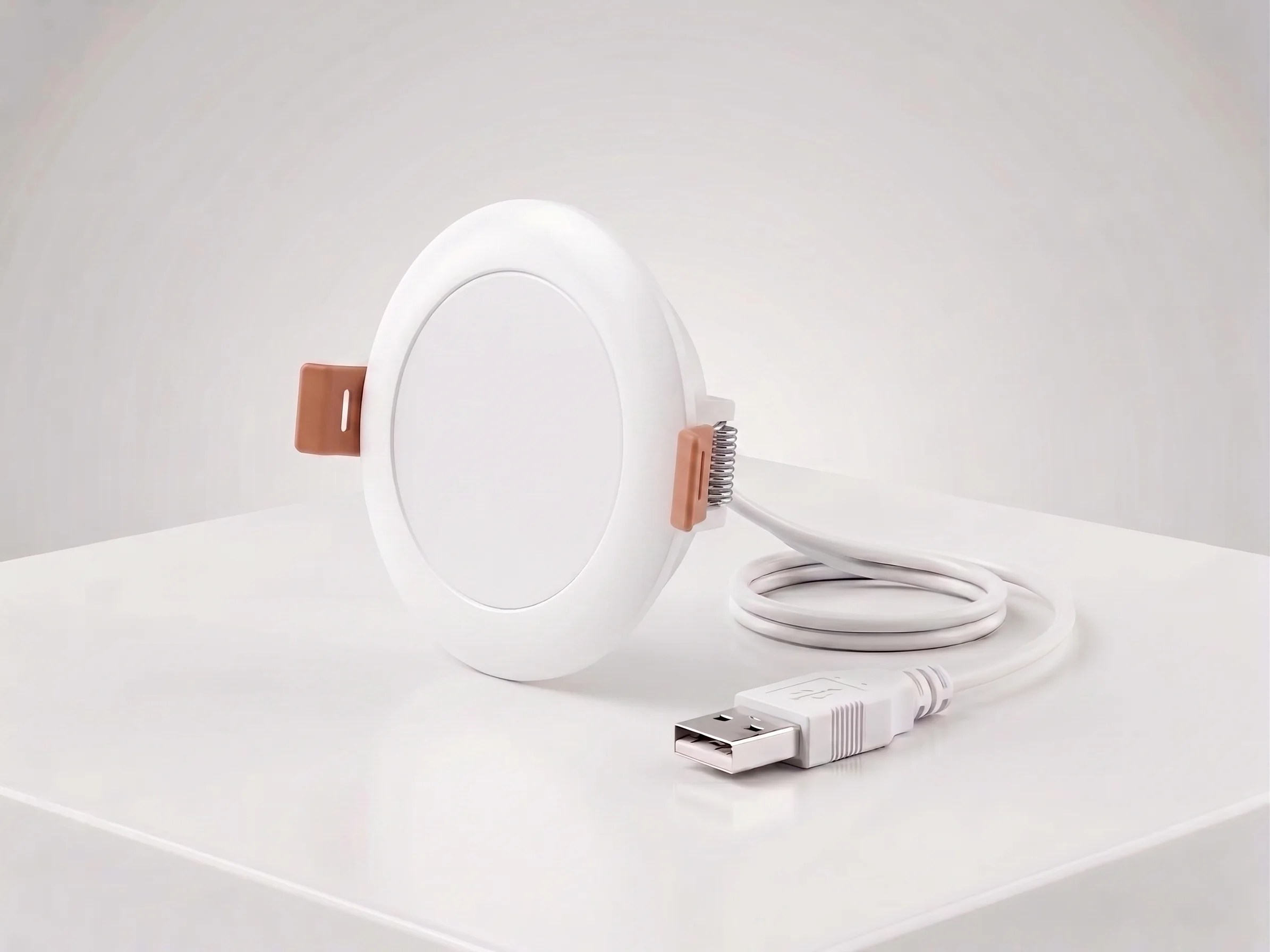
Ceiling Mount mmWave Human Presence Sensor — Zigbee
24GHz wideband mmWave ceiling presence sensor with 10m motion detection, 2.5m micro-motion, and breathing detection. 120° field, DC5V, Zigbee 3.0. For hotel room occupancy and commercial automation.
This page already points to it as the next recommended reference.
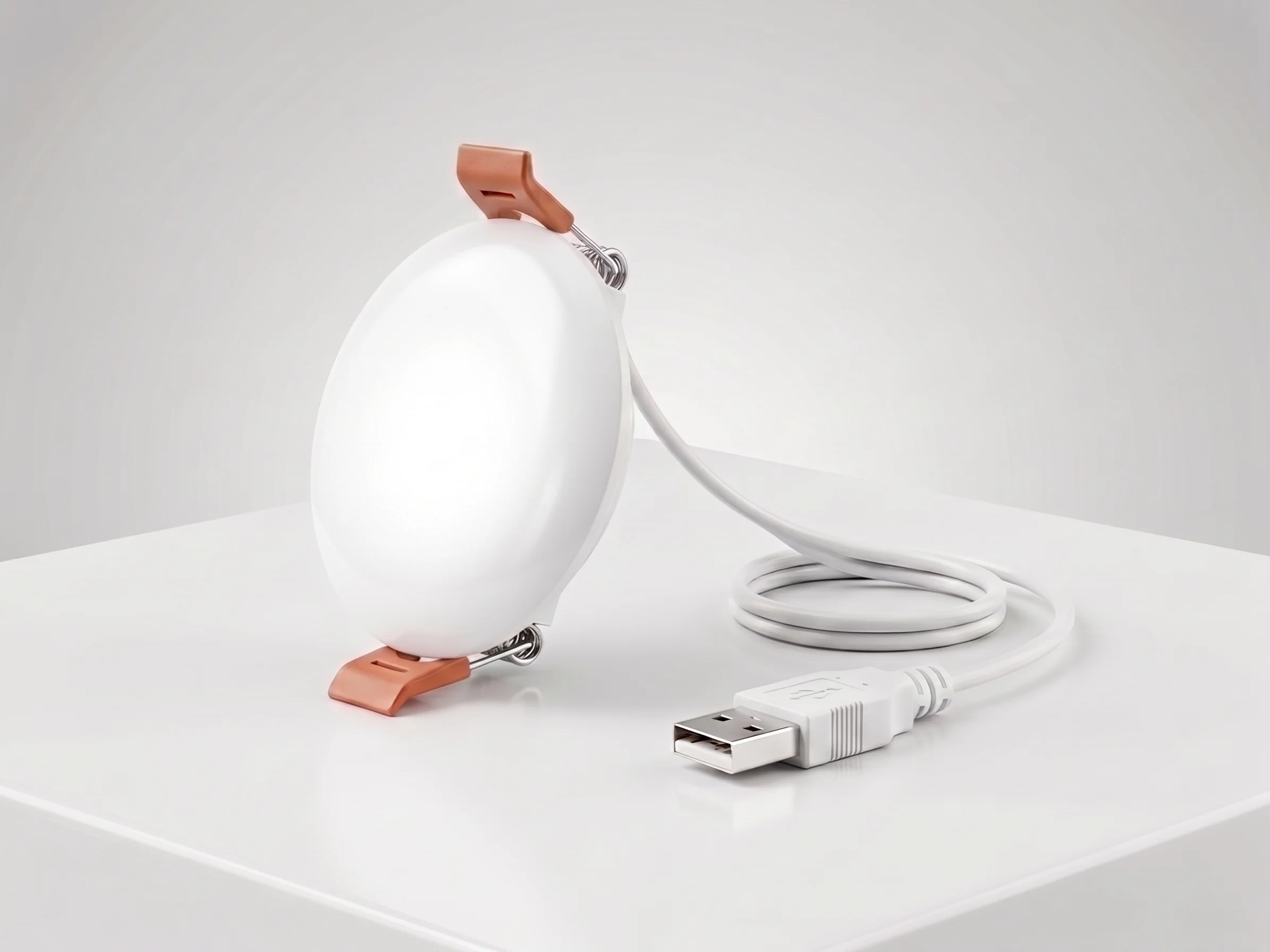
Ceiling Mount mmWave Human Presence Sensor — WiFi
24GHz wideband mmWave ceiling presence sensor with 10m motion detection, 2.5m micro-motion, and breathing detection. 120° field, DC5V, WiFi 2.4GHz. No gateway required for retrofit hotel and apartment projects.
This page already points to it as the next recommended reference.
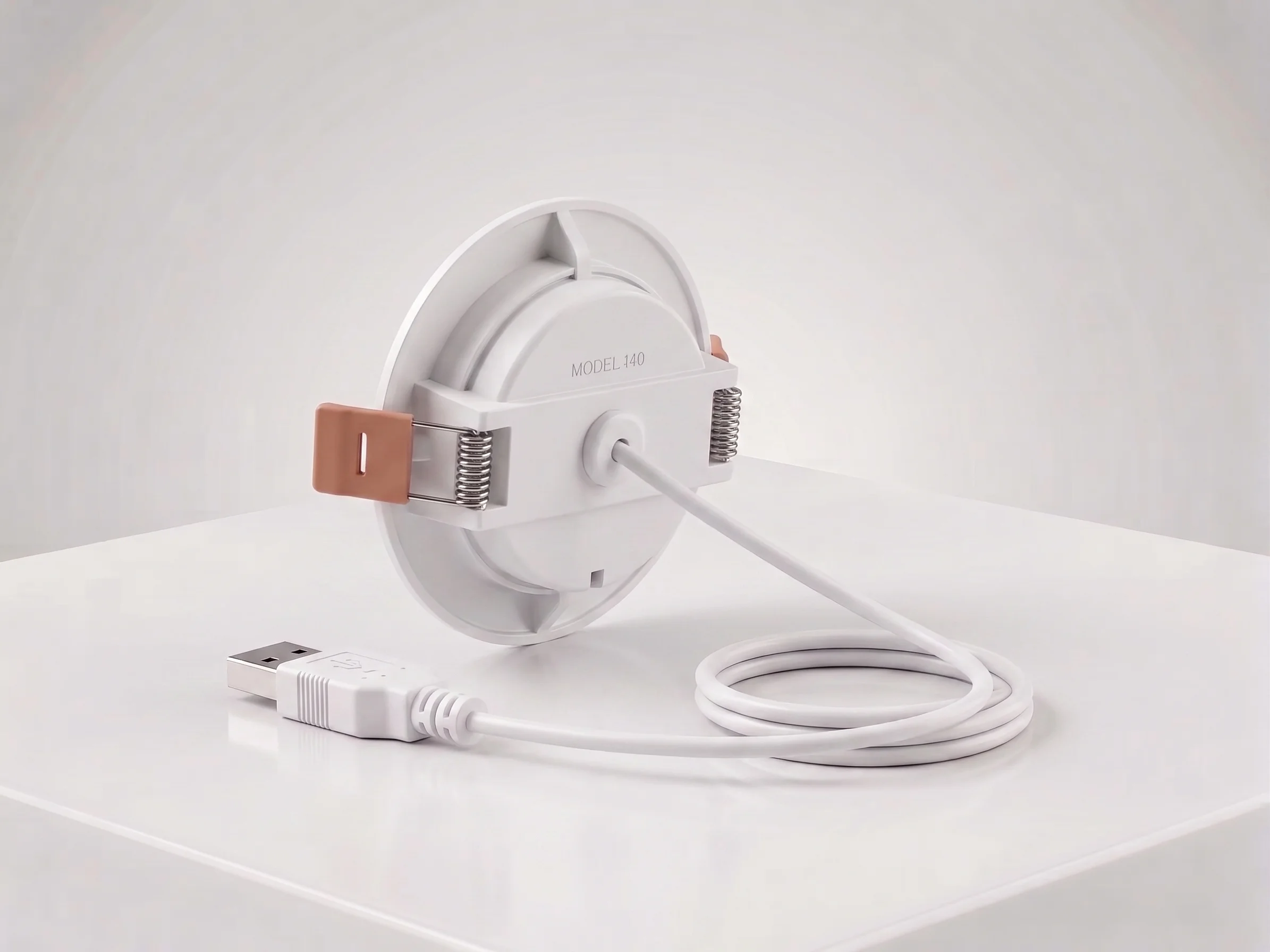
Ceiling Mount mmWave Human Presence Sensor — Matter over Thread
24GHz wideband mmWave ceiling presence sensor with 10m motion, 2.5m micro-motion, and breathing detection. 120° field, DC5V, Matter over Thread. Works natively with Apple Home, Google Home, and Alexa.
This page already points to it as the next recommended reference.
Related solutions
1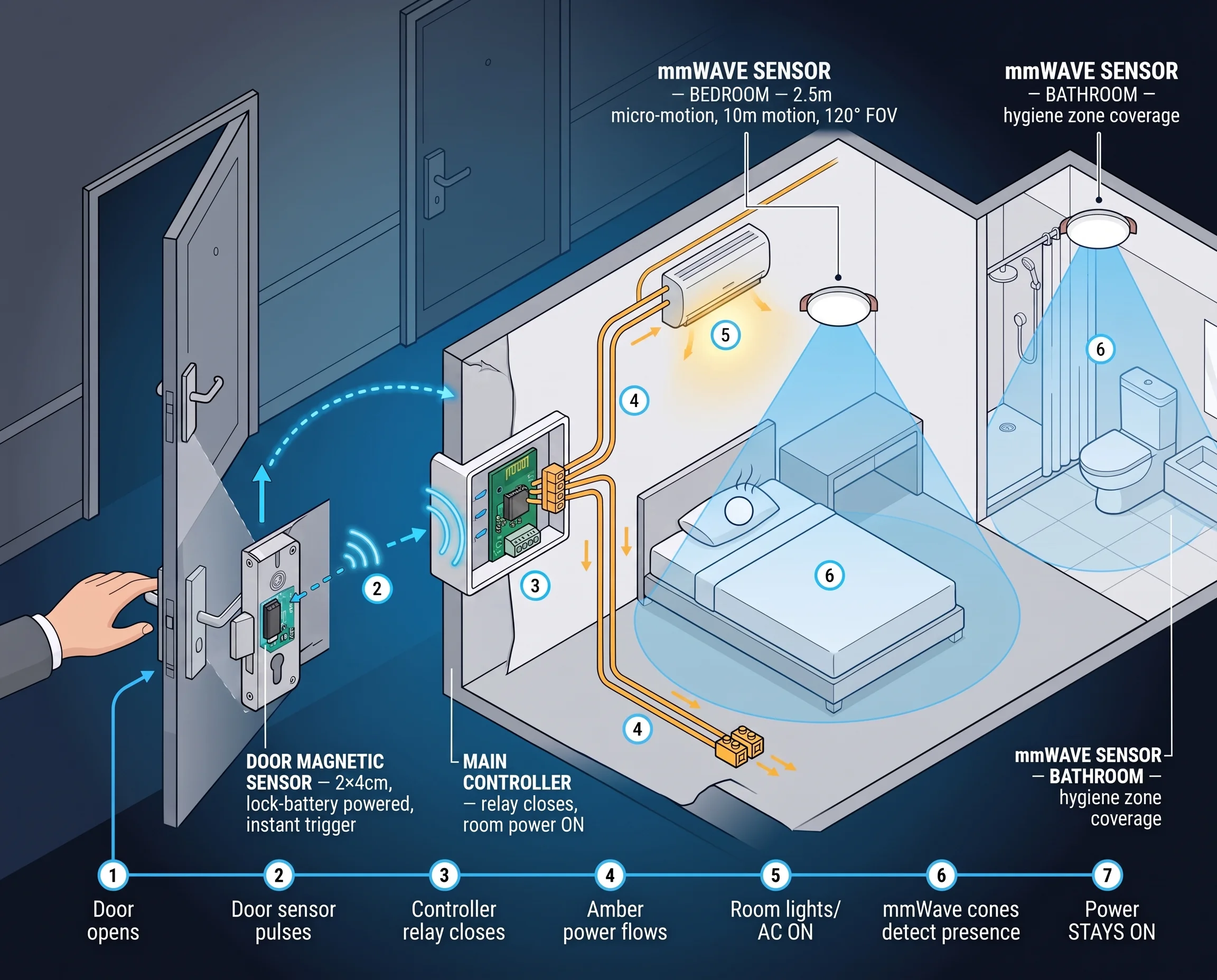
Hotel Room Occupancy & Motion Sensor Solution
mmWave radar presence sensors for hotel room occupancy, housekeeping scheduling, and HVAC energy saving. Detect true occupancy — even when the guest is asleep — with our ceiling-mount hotel room motion sensor.
It supports the same product context: Ceiling Mount mmWave Human Presence Sensor — Zigbee, Ceiling Mount mmWave Human Presence Sensor — WiFi, Ceiling Mount mmWave Human Presence Sensor — Matter over Thread.
Related blog posts
3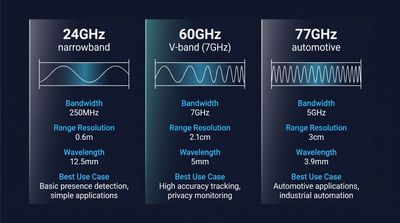
60GHz vs 24GHz vs 77GHz mmWave Sensors: Choosing the Right Frequency for Commercial Presence Detection
Compare 60GHz, 24GHz, and 77GHz mmWave sensors for commercial presence detection. Technical specs, detection range, privacy, and OEM sourcing guidance.
It supports the same product context: Ceiling Mount mmWave Human Presence Sensor — Zigbee, Ceiling Mount mmWave Human Presence Sensor — WiFi.
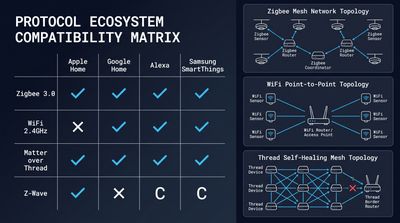
How to Integrate mmWave Presence Sensors With Home Assistant (Local Control Guide)
Step-by-step local control setup guide for mmWave devices, covering MQTT/Matter config, automation scripts, calibration and OEM ceiling presence sensor integration tips.
It supports the same product context: Ceiling Mount mmWave Human Presence Sensor — Matter over Thread, Ceiling Mount mmWave Human Presence Sensor — WiFi, Ceiling Mount mmWave Human Presence Sensor — Zigbee.
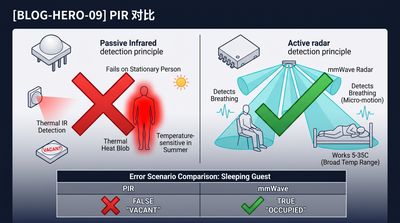
Best Presence Sensor for Hotel and Commercial Automation in 2026
A practical guide to choosing the best presence sensor for hotel room occupancy, smart office, and building automation. Compare mmWave presence sensors, PIR presence detectors, and Zigbee/WiFi/Matter presence sensors by detection range, breathing sensing, and protocol.
It supports the same product context: Ceiling Mount mmWave Human Presence Sensor — Zigbee, Ceiling Mount mmWave Human Presence Sensor — WiFi, Ceiling Mount mmWave Human Presence Sensor — Matter over Thread.
Specify your hotel project with our engineers
Send your room count, ceiling type, and protocol preference. We will return a sample plan and quote within 24 business hours.
- Move from general guidance into a product or application discussion.
- Use RFQ when pricing, drawings, MOQ, or launch timing needs structure.
- Keep a direct contact path visible for fast clarifications and handoff.