Sensor Presencia: Spanish-Language Presence Sensor Buying Guide
A Spanish-language buying guide for sensor presencia. Learn about presence sensors, how to choose the right one, and how to find the best deal.
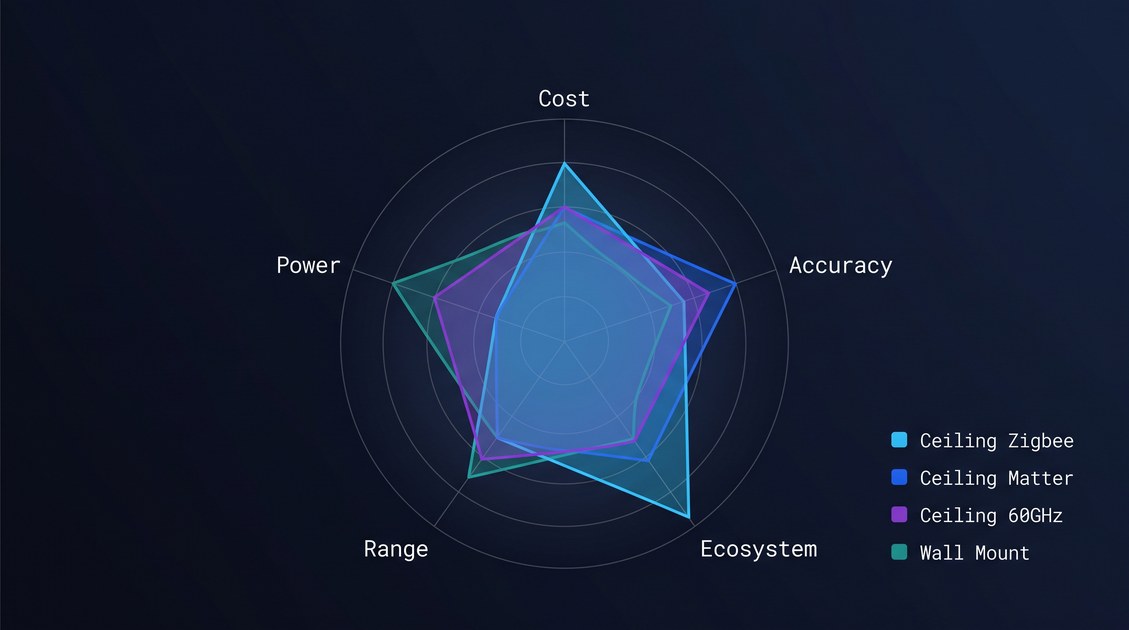
A sensor presencia (Spanish for "presence sensor") is an electronic device that determines whether one or more human occupants are currently present within a defined space, including the case where the person is sitting motionless, lying down, or sleeping with no visible movement, using millimeter-wave (mmWave) radar technology at 60 GHz (57–64 GHz) with 7 GHz of bandwidth to detect the micro-Doppler signature of human breathing at 0.2–0.5 Hz from ranges of 6–8 meters. A modern 60 GHz mmWave sensor presencia achieves a stationary-occupant true positive rate above 99% in controlled testing and above 95% in real-world deployment, with a false positive rate below 1% over a 24-hour period. The sensor presencia is deployed in hotel rooms (habitaciones de hotel), offices (oficinas), healthcare facilities (centros de salud), and residential smart homes (hogares inteligentes) across Spanish-speaking markets including Spain, Mexico, Argentina, Colombia, Chile, and Peru.
This guide provides a comprehensive overview of the sensor presencia for Spanish-speaking buyers, covering the technology, the buying decision framework, the recommended products, and the price ranges to expect.
Sensor Presencia: How to Choose the Right One
Choosing the right sensor presencia requires understanding the technology options, the performance characteristics, and the application requirements. The following framework helps narrow down the choice.
Sensor Presencia: Step 1 — Determine the Technology
The first decision is the technology. For indoor presence detection, 60 GHz mmWave radar is the default choice, providing reliable stationary-occupant detection with an excellent privacy profile. For cost-sensitive motion-only applications, 24 GHz mmWave radar or PIR sensors may be sufficient.
Sensor Presencia: Step 2 — Determine the Frequency Band
The 60 GHz band is the default for indoor applications. The 24 GHz band is appropriate for cost-sensitive motion-only applications, and the 77 GHz band is appropriate for long-range industrial applications.
Sensor Presencia: Step 3 — Determine the Form Factor
For most applications, a ceiling-mounted sensor (70 mm diameter ceiling puck) is the right choice. For corridors and entryways, a wall-mounted sensor may be preferred.
Sensor Presencia: Step 4 — Determine the Connectivity
The connectivity should match the existing infrastructure. For hotel deployments, Zigbee is the most common. For office deployments, WiFi or PoE with BACnet is common. For residential deployments, Matter or Zigbee is the most common.
Sensor Presencia: Step 5 — Evaluate the Vendor
The vendor should provide strong technical support, including documentation, application notes, integration guides, and responsive engineering assistance. A vendor with a proven track record in the target vertical is preferred.
Sensor Presencia: Price Ranges
The price of a sensor presencia depends on the technology, the form factor, the connectivity, and the vendor.
Sensor Presencia: Retail Price Ranges
- Consumer-grade finished products (Aqara, Xiaomi, Tuya): $30–100 per unit
- Commercial-grade finished products (PresenceSensor, Honeywell): $50–200 per unit
- Industrial-grade modules and evaluation kits (TI, Infineon, Vayyar): $100–500 per module/kit
Sensor Presencia: Volume Price Ranges (Wholesale)
- 60 GHz module at 1,000-unit volume: $6–18 per module
- 60 GHz module at 10,000-unit volume: $4–12 per module
- 60 GHz module at 100,000-unit volume: $3–8 per module
- Commercial-grade finished product at 1,000-unit volume: $50–100 per unit
Sensor Presencia: Where to Buy
The sensor presencia can be purchased through multiple channels, depending on the buyer's needs and the deployment scale.
Sensor Presencia: Retail Channels
For individual buyers and small deployments, the retail consumer channel (Amazon, eBay, AliExpress, local electronics stores) offers consumer-grade finished products at $30–100 per unit. The retail channel is suitable for residential smart home deployments and for evaluation or prototyping.
Sensor Presencia: Specialized Distributor Channels
For system integrators and small OEMs, the specialized distributor channel (industrial automation distributors, building automation distributors, IoT distributors) offers commercial-grade finished products at $50–150 per unit, with better technical support and integration assistance.
Sensor Presencia: OEM Direct Channels
For large OEMs and commercial deployments, the OEM direct channel (manufacturers, industrial supply chains) offers the lowest pricing at $30–100 per unit for finished products, with full technical documentation, engineering support, and supply agreement possibility.
Sensor Presencia: Recommended Products
The recommended products for sensor presencia deployments are the ceiling-presence-sensor-zigbee, ceiling-presence-sensor-wifi, and ceiling-presence-sensor-matter, which provide 24GHz wideband mmWave radar detection, multiple connectivity options, full certification, and occupancy-signal output to BMS, BMS, and smart home platforms.
For hotel deployments, the ceiling-presence-sensor-zigbee is the recommended choice. For office deployments, the ceiling-presence-sensor-wifi is the recommended choice. For residential deployments, the choice depends on the existing smart home platform, with the ceiling-presence-sensor-matter being the recommended choice for newer Matter-compatible platforms.
Sensor Presencia: What to Look for When Buying
When buying a sensor presencia, the buyer should look for the following:
Sensor Presencia: Detection Performance
- Stationary-occupant true positive rate: above 99% in controlled testing, above 95% in real-world deployment
- False positive rate: below 1% over a 24-hour period
- Detection range: 6–8 m for stationary occupants, 8–12 m for moving occupants
- Field of view: ±60° azimuth, ±40° elevation for a typical ceiling-mounted sensor
- Detection latency: below 3 seconds
Sensor Presencia: Certifications
The sensor presencia should carry the required certifications for the target market. In Spain and the EU, CE marking is required. In Mexico, IFETEL is required. In Argentina, ENACOM is required. In Colombia, CRC is required. In Chile, SUBTEL is required.
Sensor Presencia: Vendor Support
The vendor should provide strong technical support, including documentation, application notes, integration guides, and responsive engineering assistance. A vendor with a proven track record in the target vertical is preferred.
Sensor Presencia: Warranty
The warranty period should be at least 12 months, with longer warranties (24 months) preferred for commercial deployments. A clear return process is also important for any defective units.
Sensor Presencia: Common Mistakes to Avoid
Several common mistakes can undermine a sensor presencia purchase:
- Choosing based on price alone: the cheapest sensor may not meet the application requirements
- Not verifying the stationary-occupant TPR: a sensor that claims "99% accuracy" without providing independent test data may not actually achieve that accuracy
- Ignoring compliance requirements: failing to ensure that the product carries the required certifications
- Not considering the integration requirements: a sensor that cannot integrate with the downstream system is useless
- Not conducting a pilot: committing to a full purchase without first verifying the sensor's performance
Sensor Presencia: Final Recommendation
The sensor presencia is a mature, reliable technology that has become the default choice for presence detection in hotel rooms, offices, healthcare facilities, and residential smart homes across Spanish-speaking markets. The 60 GHz mmWave radar is the default technology, providing reliable stationary-occupant detection, an excellent privacy profile, and a compact form factor.
For a buyer selecting a sensor presencia, the right approach is to start with a clear definition of the application requirements, then evaluate the available products against those requirements, then select a vendor with a proven track record in the target vertical. The recommended products for most applications are the ceiling-presence-sensor-zigbee, ceiling-presence-sensor-wifi, and ceiling-presence-sensor-matter from vendors with strong product portfolios and proven deployment track records.
With the right sensor presencia, correctly installed and integrated, the sensor can deliver a level of occupancy awareness that is impossible to achieve with PIR-based motion sensors, and can justify the higher unit cost through improved energy efficiency, better occupant experience, and more accurate occupancy data for downstream analytics.
Not sure which sensor fits your project?
Talk to our mmWave application engineers for a free consultation.
Find the right presence sensor for your hotel project
Compare the 3 protocols, check hotel-specific case studies, and download the installation guide
Related products
2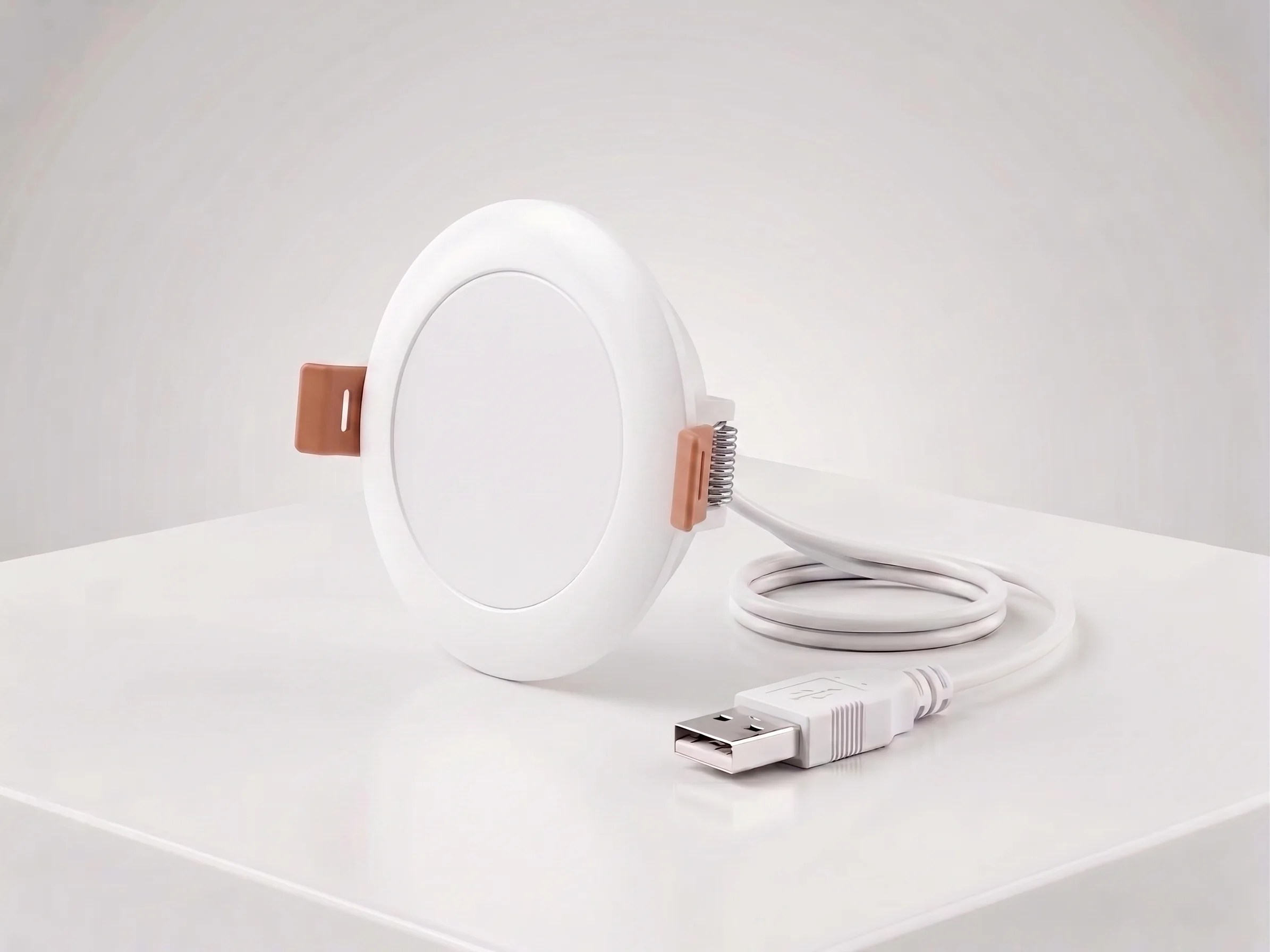
Ceiling Mount mmWave Human Presence Sensor — Zigbee
24GHz wideband mmWave ceiling presence sensor with 10m motion detection, 2.5m micro-motion, and breathing detection. 120° field, DC5V, Zigbee 3.0. For hotel room occupancy and commercial automation.
This page already points to it as the next recommended reference.
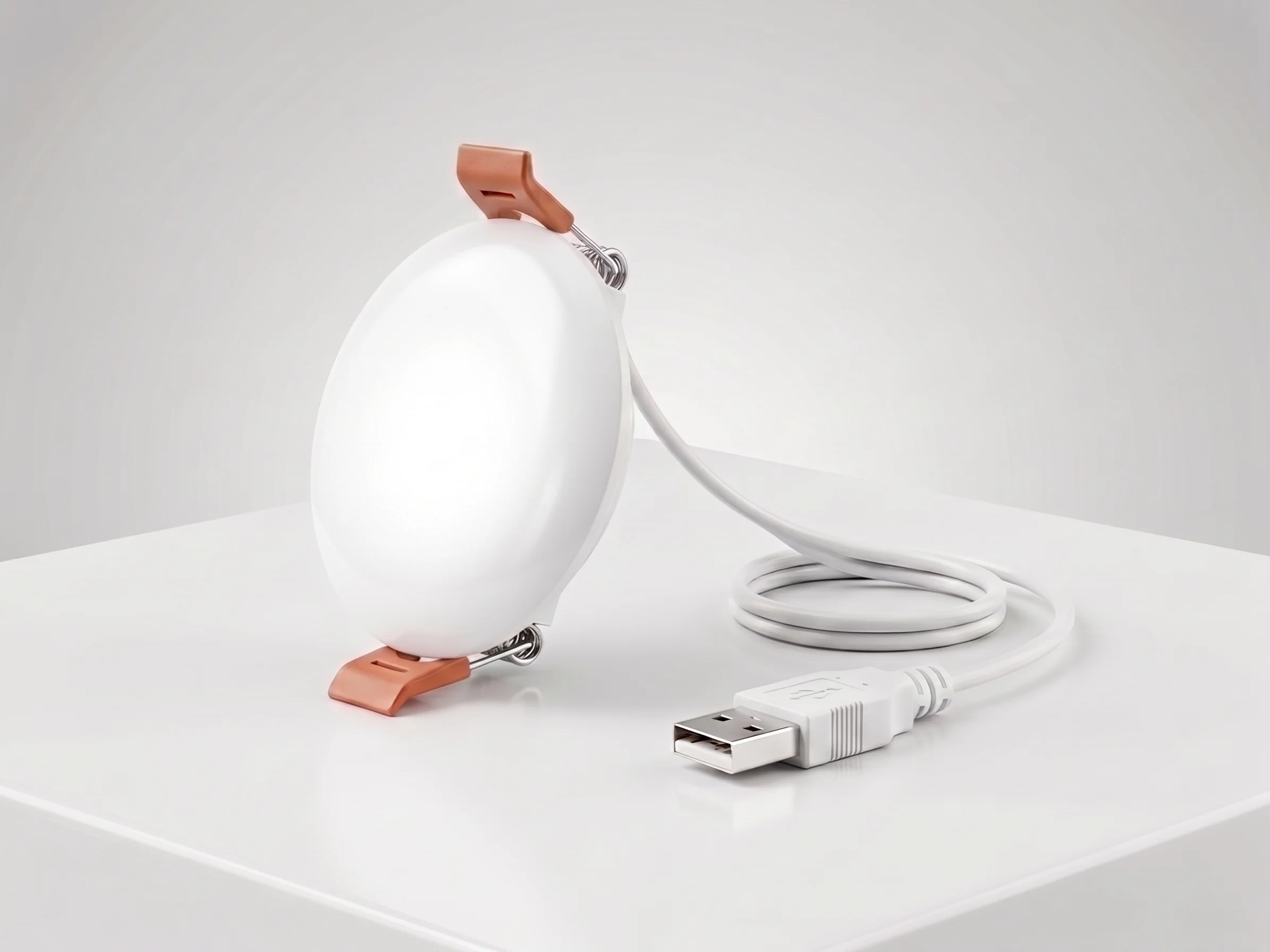
Ceiling Mount mmWave Human Presence Sensor — WiFi
24GHz wideband mmWave ceiling presence sensor with 10m motion detection, 2.5m micro-motion, and breathing detection. 120° field, DC5V, WiFi 2.4GHz. No gateway required for retrofit hotel and apartment projects.
This page already points to it as the next recommended reference.
Related solutions
1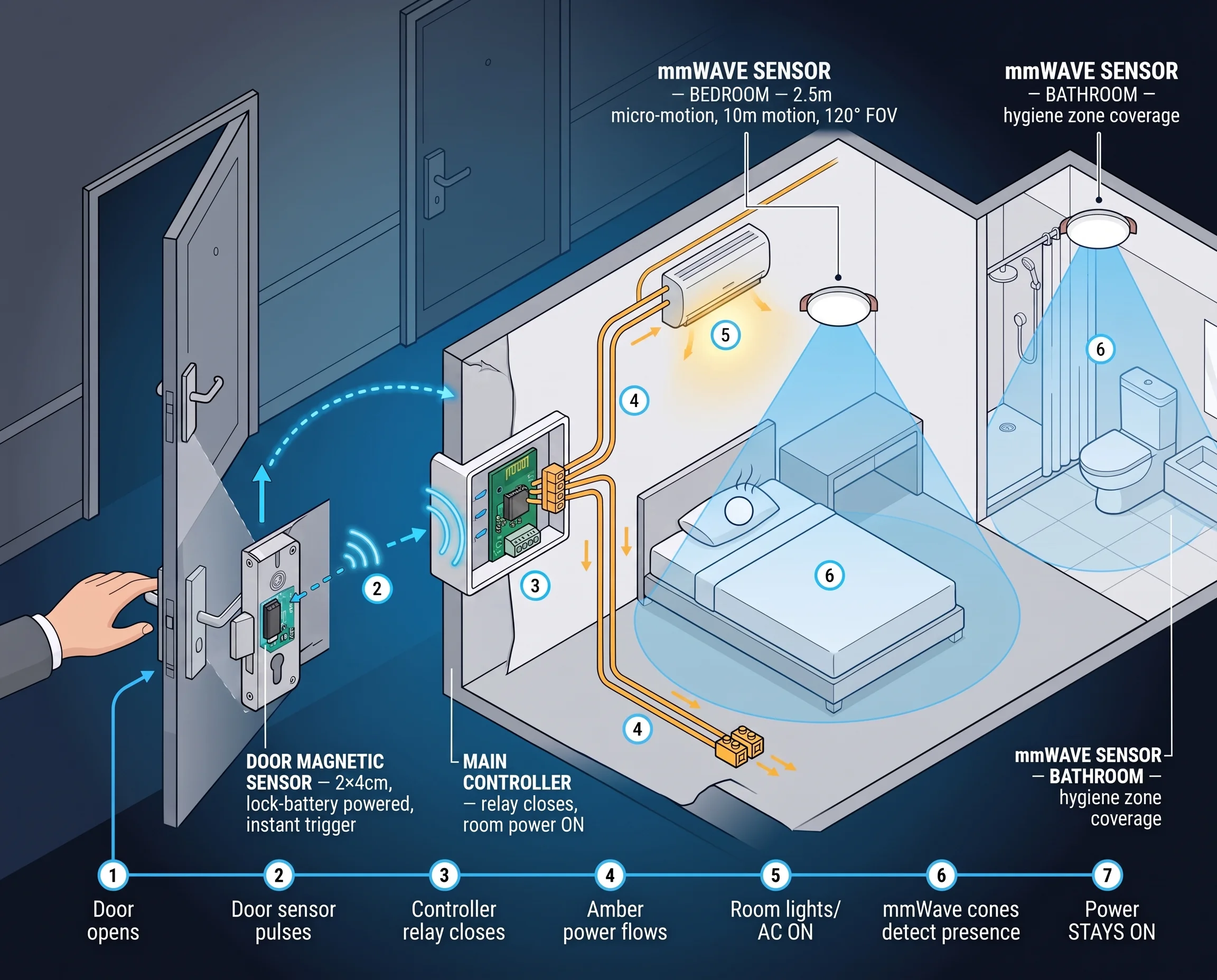
Hotel Room Occupancy & Motion Sensor Solution
mmWave radar presence sensors for hotel room occupancy, housekeeping scheduling, and HVAC energy saving. Detect true occupancy — even when the guest is asleep — with our ceiling-mount hotel room motion sensor.
It supports the same product context: Ceiling Mount mmWave Human Presence Sensor — Zigbee, Ceiling Mount mmWave Human Presence Sensor — WiFi.
Related blog posts
3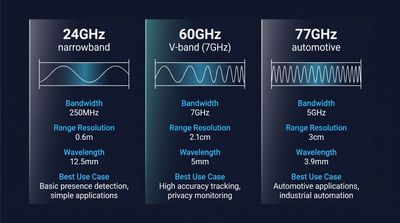
60GHz vs 24GHz vs 77GHz mmWave Sensors: Choosing the Right Frequency for Commercial Presence Detection
Compare 60GHz, 24GHz, and 77GHz mmWave sensors for commercial presence detection. Technical specs, detection range, privacy, and OEM sourcing guidance.
It supports the same product context: Ceiling Mount mmWave Human Presence Sensor — Zigbee, Ceiling Mount mmWave Human Presence Sensor — WiFi.
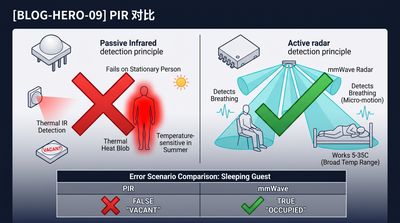
What Is an Electronic Presence Sensor? Technology, Accuracy, and How It Differs From a Motion Sensor
Learn what an electronic presence sensor is, how it detects stationary humans, and how it differs from a PIR motion sensor. Covers mmWave, accuracy, and use cases.
It supports the same product context: Ceiling Mount mmWave Human Presence Sensor — Zigbee, Ceiling Mount mmWave Human Presence Sensor — WiFi.
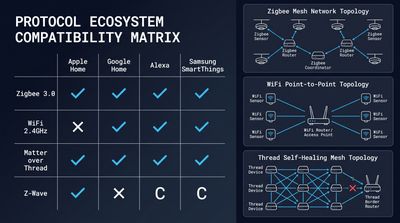
How to Integrate mmWave Presence Sensors With Home Assistant (Local Control Guide)
Step-by-step local control setup guide for mmWave devices, covering MQTT/Matter config, automation scripts, calibration and OEM ceiling presence sensor integration tips.
It supports the same product context: Ceiling Mount mmWave Human Presence Sensor — WiFi, Ceiling Mount mmWave Human Presence Sensor — Zigbee.
Specify your hotel project with our engineers
Send your room count, ceiling type, and protocol preference. We will return a sample plan and quote within 24 business hours.
- Move from general guidance into a product or application discussion.
- Use RFQ when pricing, drawings, MOQ, or launch timing needs structure.
- Keep a direct contact path visible for fast clarifications and handoff.