Präsenzsensoren Außen: German Guide to Outdoor Presence Sensors
A guide to präsenzsensoren außen. Learn about outdoor presence sensors, IP ratings, detection ranges, and how to choose the right outdoor sensor.
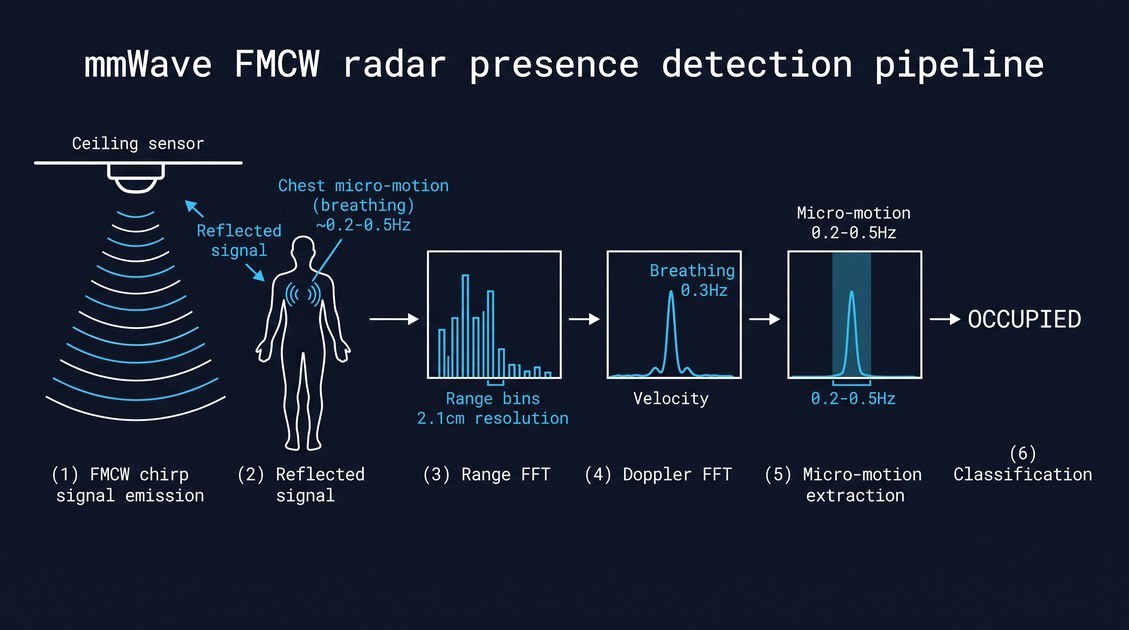
Präsenzsensoren außen (German for "outdoor presence sensors") are presence detection devices specifically designed for outdoor deployment, with weatherproof housing (typically IP65, IP66, or IP67 ingress protection), extended operating temperature ranges (typically -20°C to +60°C, with some industrial-grade sensors rated for -40°C to +85°C), UV-resistant materials to withstand long-term sun exposure, and corrosion-resistant finishes for marine and coastal environments. The outdoor presence sensor market uses similar sensing technologies to indoor sensors, including 24 GHz and 60 GHz mmWave radar, PIR, and ultrasonic, but with additional considerations for weather resistance, temperature variation, and environmental interference. The 24 GHz band is commonly used for outdoor presence detection because of its long range (up to 20–30 m for moving targets) and its good penetration of rain, fog, and snow. The 60 GHz band is less commonly used for outdoor applications because of its higher atmospheric attenuation (which reduces the effective range in rain and fog), but it is used in some specialized applications that require micro-motion detection. The outdoor presence sensor is deployed in parking lots, driveways, walkways, building perimeters, garden and landscape lighting, security applications, and industrial outdoor areas.
This guide provides a comprehensive overview of präsenzsensoren außen, covering the technology options, the environmental requirements, the major applications, and the selection criteria for choosing the right outdoor presence sensor for a specific application. The guide is written in English to serve the international German-speaking audience that searches for präsenzsensoren außen but reads technical content in English.
Präsenzsensoren Außen: Technology Options
The outdoor presence sensor market uses several sensing technologies, each with different strengths for outdoor applications.
Präsenzsensoren Außen: 24 GHz mmWave Radar
The 24 GHz band (24.0–24.25 GHz narrowband ISM) is the most common frequency for outdoor presence detection because of its long range and its good penetration of rain, fog, and snow. A 24 GHz sensor can detect motion at ranges of 20–30 m, which is sufficient for most outdoor applications (parking lots, driveways, walkways, building perimeters).
The 24 GHz sensor is relatively inexpensive ($3–8 per module at 1,000-unit volume), robust to environmental conditions, and suitable for both security and lighting control applications. The main limitation is the inability to detect stationary occupants (the 24 GHz narrowband sensor has 250 MHz of bandwidth, which is insufficient for micro-motion detection).
Präsenzsensoren Außen: 60 GHz mmWave Radar
The 60 GHz band (57–64 GHz) is less commonly used for outdoor applications because of its higher atmospheric attenuation, which reduces the effective range in rain and fog. However, the 60 GHz sensor can detect stationary occupants (through micro-Doppler breathing detection), which is valuable for some outdoor applications (e.g., detecting a person sitting on a bench in a park).
The 60 GHz sensor is more expensive than the 24 GHz sensor ($6–18 per module at 1,000-unit volume) and has a shorter range (6–12 m), but it offers the unique capability of stationary-occupant detection.
Präsenzsensoren Außen: PIR Motion Sensor
The passive infrared (PIR) motion sensor is a common choice for outdoor applications because of its low cost ($0.5–2 per component), low power consumption (can run for years on a coin cell), and wide availability. The PIR sensor detects motion, not presence, and is suitable for applications where motion-based control is sufficient (e.g., security lighting that turns on when motion is detected).
The main limitations of the PIR sensor for outdoor use are its sensitivity to ambient temperature (which can cause false triggers or missed detections in extreme temperatures), its sensitivity to sunlight (which can cause false triggers), and its inability to detect stationary occupants.
Präsenzsensoren Außen: Dual-Technology (PIR + mmWave)
A dual-technology outdoor presence sensor combines PIR and mmWave radar to improve accuracy and reduce false positives. The PIR sensor provides fast motion detection, and the mmWave sensor provides additional coverage and the ability to detect stationary occupants (if a 60 GHz mmWave sensor is used). The dual-technology approach is particularly valuable for security applications where false positives can lead to alarm fatigue.
Präsenzsensoren Außen: Environmental Requirements
Outdoor presence sensors face a more challenging environment than indoor sensors, and the following requirements must be considered.
Präsenzsensoren Außen: Ingress Protection (IP) Rating
The ingress protection rating determines the sensor's resistance to dust and water:
- IP54: dust-protected and splash-water-resistant — suitable for sheltered outdoor locations (under a porch or awning)
- IP65: dust-tight and water-jet-resistant — suitable for most outdoor locations
- IP66: dust-tight and powerful water-jet-resistant — suitable for locations exposed to heavy rain
- IP67: dust-tight and immersion-resistant — suitable for locations that may be temporarily submerged
For most outdoor presence sensor applications, IP65 or IP66 is the recommended rating.
Präsenzsensoren Außen: Operating Temperature Range
The operating temperature range determines the sensor's performance in extreme temperatures:
- Standard range: -20°C to +60°C — suitable for most temperate climates
- Extended range: -40°C to +85°C — suitable for extreme climates (Scandinavian winters, Middle Eastern summers)
For outdoor applications in Germany, Austria, and Switzerland, a standard range of -20°C to +60°C is typically sufficient. For applications in Nordic countries, the Middle East, or other extreme climate regions, an extended range may be required.
Präsenzsensoren Außen: UV Resistance
Outdoor presence sensors are exposed to sunlight, which can degrade the housing materials over time. The sensor housing should be made of UV-resistant materials (such as ASA, PC, or specialized UV-stabilized ABS) to ensure long-term durability.
Präsenzsensoren Außen: Corrosion Resistance
In coastal and marine environments, the sensor housing and mounting hardware should be corrosion-resistant (stainless steel, anodized aluminum, or specialized anti-corrosion coatings) to withstand the salt air.
Präsenzsensoren Außen: Applications
The outdoor presence sensor is deployed in a wide range of applications.
Präsenzsensoren Außen: Parking Lot Lighting Control
A 24 GHz mmWave sensor mounted on a parking lot light pole can detect the presence of vehicles and pedestrians and turn on the lights when motion is detected. The 24 GHz sensor is preferred for this application because of its long range (covering a large parking lot area) and its robustness to environmental conditions.
Präsenzsensoren Außen: Driveway and Walkway Lighting
A 24 GHz or 60 GHz sensor mounted on a building or a pole can detect the presence of people and vehicles on a driveway or walkway and turn on the lights. The sensor can be configured to turn on the lights only when motion is detected, and to turn off the lights after a preset period of no motion.
Präsenzsensoren Außen: Building Perimeter Security
A 24 GHz mmWave sensor can monitor a building perimeter, detecting intruders in all lighting conditions (including complete darkness) and through fog, rain, and snow. The sensor can be integrated with a security system to trigger alarms or notifications.
Präsenzsensoren Außen: Garden and Landscape Lighting
A PIR or 24 GHz mmWave sensor can control garden and landscape lighting, turning on the lights when motion is detected and turning them off after a preset period.
Präsenzsensoren Außen: Industrial Outdoor Areas
In industrial outdoor areas (loading docks, storage yards, equipment areas), a 24 GHz mmWave sensor can monitor the presence of workers and vehicles, enabling safety interlocks, lighting control, and security monitoring.
Präsenzsensoren Außen: Selection Criteria
Selecting the right outdoor presence sensor requires evaluating several criteria.
Präsenzsensoren Außen: Detection Performance
- Detection range: 20–30 m for a 24 GHz sensor, 6–12 m for a 60 GHz sensor
- Stationary-occupant detection: only available with 60 GHz mmWave
- False positive rate: below 1% over a 24-hour period in outdoor conditions
- Detection latency: below 3 seconds for most applications
Präsenzsensoren Außen: Environmental Specifications
- IP rating: IP65 or IP66 for most outdoor locations
- Operating temperature range: -20°C to +60°C for temperate climates, -40°C to +85°C for extreme climates
- UV resistance: ASA, PC, or UV-stabilized ABS housing
- Corrosion resistance: stainless steel or anodized aluminum hardware for coastal environments
Präsenzsensoren Außen: Connectivity
- Dry contact: for simple lighting control
- Zigbee: for integration with smart home or building automation systems
- WiFi: for integration with smart home or building automation systems
- LoRaWAN: for long-range, low-power applications
- Wired (RS-485, Modbus): for industrial applications
Präsenzsensoren Außen: Certifications
The outdoor presence sensor should carry the required certifications: CE marking (for the EU, including the Radio Equipment Directive for wireless sensors), FCC (for the US), RoHS, and any regional certifications.
Präsenzsensoren Außen: Common Pitfalls
Several common pitfalls can undermine an outdoor presence sensor deployment:
- Choosing an indoor sensor for outdoor use: indoor sensors are not weatherproof and will fail quickly in outdoor conditions
- Choosing a PIR sensor for applications that require stationary-occupant detection: PIR sensors cannot detect stationary occupants
- Underestimating the environmental conditions: selecting a sensor with an insufficient IP rating or an insufficient operating temperature range
- Not considering the atmospheric attenuation for 60 GHz sensors: the effective range of a 60 GHz sensor is reduced in rain and fog
- Not considering the sunlight interference for PIR sensors: PIR sensors can be triggered by sunlight reflections
Präsenzsensoren Außen: Final Recommendation
The präsenzsensoren außen market offers a range of technologies and products for outdoor presence detection. For applications that require long-range motion detection (parking lots, driveways, building perimeters), a 24 GHz mmWave sensor with an IP65 or IP66 rating is the recommended choice. For applications that require stationary-occupant detection (parks, benches, outdoor seating areas), a 60 GHz mmWave sensor with an IP65 rating is the recommended choice, with the caveat that the effective range is reduced in rain and fog. For cost-sensitive applications where motion-only detection is sufficient (garden lighting, simple security), a PIR sensor with an IP65 rating is a cost-effective choice.
For a procurement team or a consumer selecting an outdoor presence sensor, the right approach is to start with a clear definition of the application requirements (detection range, stationary-occupant detection, environmental conditions, connectivity), then evaluate the available sensors against those requirements, then select a vendor with a proven track record in outdoor deployments. With the right outdoor presence sensor, correctly installed and integrated, the sensor can provide reliable presence detection in outdoor conditions for years, enabling efficient lighting control, enhanced security, and improved safety.
Part of this article content is generated by AI and optimized for professional accuracy and readability.
Not sure which sensor fits your project?
Talk to our mmWave application engineers for a free consultation.
Specify your hotel project with our engineers
Send your room count, ceiling type, and protocol preference. We will return a sample plan and quote within 24 business hours.
- Move from general guidance into a product or application discussion.
- Use RFQ when pricing, drawings, MOQ, or launch timing needs structure.
- Keep a direct contact path visible for fast clarifications and handoff.