mmWave Radar Applications: Complete Guide to 2026 Use Cases
A complete guide to mmWave radar applications. Learn the major use cases for mmWave radar in presence detection, automotive, industrial, and sensing.
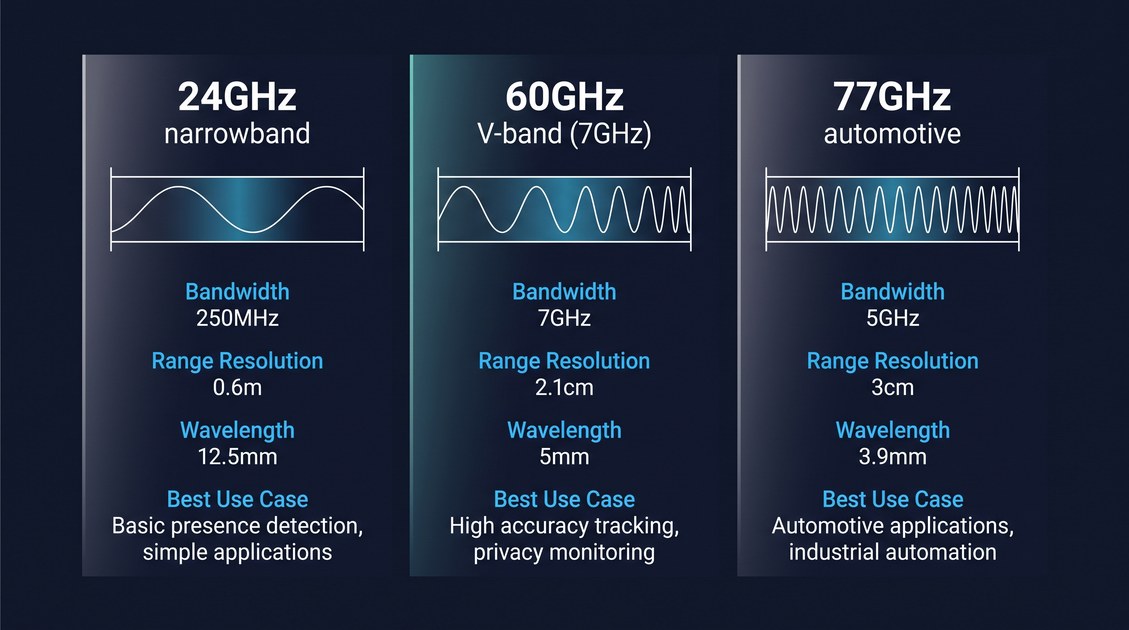
mmWave radar applications span a wide range of industries and use cases, with the dominant applications being human presence detection (using 60 GHz radar in hotel rooms, offices, healthcare facilities, and residential smart homes), automotive radar (using 77 GHz radar for adaptive cruise control, collision avoidance, and other advanced driver assistance systems), industrial sensing (using 24 GHz and 77 GHz radar for level sensing, conveyor monitoring, and robotic collision avoidance), healthcare monitoring (using 60 GHz radar for fall detection and patient monitoring), and public space monitoring (using 77 GHz radar for crowd monitoring and parking management). The 60 GHz band (57–64 GHz) is the default frequency for indoor presence detection, providing 7 GHz of bandwidth that enables 2.1 cm range resolution and micro-Doppler detection of human breathing at 0.2–0.5 Hz from ranges of 6–8 meters. The 77 GHz band (76–81 GHz) is the default for automotive radar and long-range industrial applications, and the 24 GHz band (24.0–24.25 GHz) is used for cost-sensitive motion-only applications.
This guide provides a comprehensive overview of mmWave radar applications across all major industries, covering the use cases, the deployment patterns, and the technical requirements for each application. Whether you are an engineer designing a radar system, a procurement specialist sourcing sensors, or a system integrator looking for new applications, this guide will help you understand the opportunities and the requirements.
mmWave Radar Applications: Human Presence Detection
Human presence detection is the dominant application for mmWave radar in 2026, with the 60 GHz band being the default frequency.
mmWave Radar Applications: Hotel Room Presence Detection
Hotel rooms are the canonical application for 60 GHz mmWave radar. A ceiling-mounted 60 GHz radar sensor can reliably detect whether a guest is in the room throughout their stay, including when they are sleeping, and feeds the occupancy data to the building management system for housekeeping coordination and the HVAC system for energy management.
mmWave Radar Applications: Office and Conference Room Sensing
Offices use 60 GHz mmWave radar for per-room HVAC and lighting control, conference room availability detection, and space utilization analytics. The radar sensor's ability to detect stationary occupants is essential for office applications where workers may be at their desks for hours without significant movement.
mmWave Radar Applications: Healthcare and Patient Room Sensing
Healthcare facilities use 60 GHz mmWave radar for fall detection, bed-exit alerting, and occupancy-based environmental control. The privacy profile of mmWave radar (no images, non-invasive) makes it suitable for deployment in private spaces where camera-based sensing would be inappropriate.
mmWave Radar Applications: Residential Smart Home Sensing
Residential smart homes use 60 GHz mmWave radar for occupancy-based lighting, HVAC control, and security monitoring. The "light turned off while reading" problem that plagues PIR-based motion sensors is solved by a 60 GHz radar sensor that can detect the stationary occupant.
mmWave Radar Applications: Restroom Occupancy
Restrooms are a difficult deployment for any sensor, but 60 GHz mmWave radar is well-suited because it can detect stationary occupants (a person using a stall) without producing images. The radar sensor can drive ventilation and lighting control while respecting the privacy of the users.
mmWave Radar Applications: Automotive Radar
The 77 GHz band is the primary frequency for automotive radar, used for advanced driver assistance systems (ADAS).
mmWave Radar Applications: Adaptive Cruise Control
A long-range 77 GHz radar sensor can detect vehicles ahead and maintain a safe following distance, automatically adjusting the vehicle's speed to the speed of the vehicle ahead. This is one of the most widely deployed automotive radar applications, with adoption in most new vehicles sold in developed markets.
mmWave Radar Applications: Collision Avoidance
A 77 GHz radar sensor can detect imminent collisions and trigger automatic emergency braking, helping to prevent or mitigate accidents. This application is becoming mandatory in many markets (including the European Union and the United States) as part of the new vehicle safety standards.
mmWave Radar Applications: Blind Spot Detection
A short-range 77 GHz radar sensor can detect vehicles in the driver's blind spot and alert the driver, helping to prevent lane-change accidents. This application is widely deployed in mid-range and luxury vehicles.
mmWave Radar Applications: Parking Assistance
A short-range 77 GHz radar sensor can detect obstacles when parking, helping the driver to park safely. This application is widely deployed in mid-range and luxury vehicles.
mmWave Radar Applications: Driver Monitoring
An in-cabin 60 GHz radar sensor can detect the driver's presence, posture, and breathing, enabling driver monitoring for drowsiness detection, child presence detection (to prevent hot car deaths), and seat belt reminders.
mmWave Radar Applications: Industrial Sensing
mmWave radar is used in a wide range of industrial applications.
mmWave Radar Applications: Level Sensing
A mmWave radar sensor can measure the level of liquids, powders, and granular materials in tanks, hoppers, and silos. The sensor is non-contact (it measures the level from the top of the tank through the air), which is advantageous for corrosive, abrasive, or hazardous materials. The 77 GHz band is commonly used for level sensing because of its long range and fine resolution.
mmWave Radar Applications: Conveyor Monitoring
A mmWave radar sensor can detect the presence of objects on a conveyor in dusty or dirty environments where photoelectric sensors would fail. The 24 GHz and 60 GHz bands are commonly used for conveyor monitoring.
mmWave Radar Applications: Robotic Collision Avoidance
A mmWave radar sensor can detect the presence of objects in a robot's workspace, enabling collision avoidance and object handling. The 60 GHz band is commonly used for robotic collision avoidance because of its compact form factor and fine resolution.
mmWave Radar Applications: Worker Safety
A mmWave radar sensor can detect the presence of workers in hazardous areas, enabling safety interlocks that shut down machinery when a worker enters a dangerous zone. The 60 GHz band is commonly used for worker safety because of its reliable detection of stationary humans.
mmWave Radar Applications: Healthcare Monitoring
mmWave radar is used in healthcare monitoring beyond the fall detection and patient monitoring applications described above.
mmWave Radar Applications: Vital Signs Measurement
A 60 GHz radar sensor can measure the heart rate and respiration rate of a human by analyzing the micro-Doppler signature of the chest wall. This non-contact vital signs measurement is useful for patient monitoring and for telehealth applications.
mmWave Radar Applications: Sleep Monitoring
A 60 GHz radar sensor can monitor the sleep pattern of a person by analyzing their breathing and movement during the night. This is useful for sleep disorder diagnosis and for general health monitoring.
mmWave Radar Applications: Gait Analysis
A 60 GHz radar sensor can analyze the gait of a person by measuring their walking pattern, which is useful for detecting mobility issues, for monitoring rehabilitation after an injury, and for early detection of neurological conditions.
mmWave Radar Applications: Public Spaces and Smart City
mmWave radar is used in public spaces and smart city applications.
mmWave Radar Applications: Crowd Monitoring
A 77 GHz radar sensor in a public space (airport terminal, train station, convention center) can monitor crowd density and provide data for crowd management, security, and space planning. The 77 GHz band is preferred for crowd monitoring because of its long range and multi-target tracking capability.
mmWave Radar Applications: Parking Management
A mmWave radar sensor in a parking garage or an outdoor parking lot can detect the presence of vehicles in individual parking spaces, enabling real-time parking availability information for drivers. The 60 GHz and 77 GHz bands are both used for parking management.
mmWave Radar Applications: Traffic Monitoring
A 77 GHz radar sensor on a road or highway can monitor traffic flow, providing data for traffic management and for autonomous vehicle infrastructure. The 77 GHz band is preferred for traffic monitoring because of its long range.
mmWave Radar Applications: Security Perimeter Monitoring
A 77 GHz radar sensor can monitor a security perimeter, detecting intruders in all lighting conditions (including complete darkness) and through fog, rain, and snow. The 77 GHz band is preferred for security perimeter monitoring because of its long range and environmental tolerance.
mmWave Radar Applications: Retail Analytics
mmWave radar is used in retail analytics applications.
mmWave Radar Applications: Footfall Counting
A 60 GHz radar sensor at the entrance of a retail store can count the number of people entering and leaving, providing data for footfall analytics. The 60 GHz band is preferred for footfall counting because of its reliable detection of stationary humans and its privacy profile (no images).
mmWave Radar Applications: Dwell Time Measurement
A 60 GHz radar sensor in a retail aisle can measure the dwell time of shoppers, providing data for merchandise optimization and for evaluating the effectiveness of displays and promotions.
mmWave Radar Applications: Queue Management
A 60 GHz radar sensor at a checkout or a service counter can detect the length of the queue, enabling staff allocation to reduce wait times.
mmWave Radar Applications: Selection Criteria by Application
The right mmWave radar for a specific application depends on the application requirements.
Frequency Band
- 24 GHz: for cost-sensitive motion-only applications
- 60 GHz: for indoor presence detection (hotel, office, healthcare, residential)
- 77 GHz: for long-range applications (automotive, warehouse, large venues)
Form Factor
- Ceiling puck (70 mm diameter): for most indoor applications
- Wall-mount: for corridors and entryways
- Automotive-grade module: for automotive applications
- Industrial-grade module: for industrial applications
Connectivity
- Zigbee: for hotel and residential deployments
- WiFi: for office deployments
- Matter: for residential smart home deployments
- Automotive CAN bus: for automotive applications
- BACnet: for building management system integration
- Ethernet or Modbus: for industrial applications
mmWave Radar Applications: Future Trends
The mmWave radar applications market is expanding rapidly, with several trends driving new applications:
- Single-chip integration: enabling smaller form factors and lower costs
- On-device machine learning: enabling new capabilities (activity recognition, gait analysis, vital signs measurement)
- Multi-sensor fusion: combining mmWave radar with other sensing modalities for more comprehensive sensing
- Matter adoption: enabling new residential smart home applications
- 5G and 6G: the next generation of wireless networks will drive new mmWave applications
- Autonomous vehicles: the growth of autonomous vehicles will drive demand for automotive radar
- Smart city: the growth of smart city initiatives will drive demand for public space monitoring
mmWave Radar Applications: Final Recommendation
mmWave radar applications span a wide range of industries and use cases, with the dominant applications being human presence detection, automotive radar, industrial sensing, healthcare monitoring, and public space monitoring. The 60 GHz band is the default for indoor presence detection, and the 77 GHz band is the default for automotive radar and long-range industrial applications.
For a procurement team or an engineer looking to deploy mmWave radar, the right approach is to start with a clear definition of the application requirements, then select the appropriate frequency band, form factor, and connectivity, then evaluate the available sensors against those requirements, and then execute a pilot before committing to a full deployment. The recommended products for most indoor presence detection applications are the ceiling-presence-sensor-zigbee, ceiling-presence-sensor-wifi, and ceiling-presence-sensor-matter from vendors with strong product portfolios and proven deployment track records.
With the right mmWave radar, correctly installed and integrated, the application can deliver significant value, from improved energy efficiency and better occupant experience to enhanced safety and security. The mmWave radar applications market is expanding rapidly, and the technology is becoming the default choice for an increasingly wide range of sensing tasks.
Part of this article content is generated by AI and optimized for professional accuracy and readability.
Not sure which sensor fits your project?
Talk to our mmWave application engineers for a free consultation.
Find the right presence sensor for your hotel project
Compare the 3 protocols, check hotel-specific case studies, and download the installation guide
Related products
2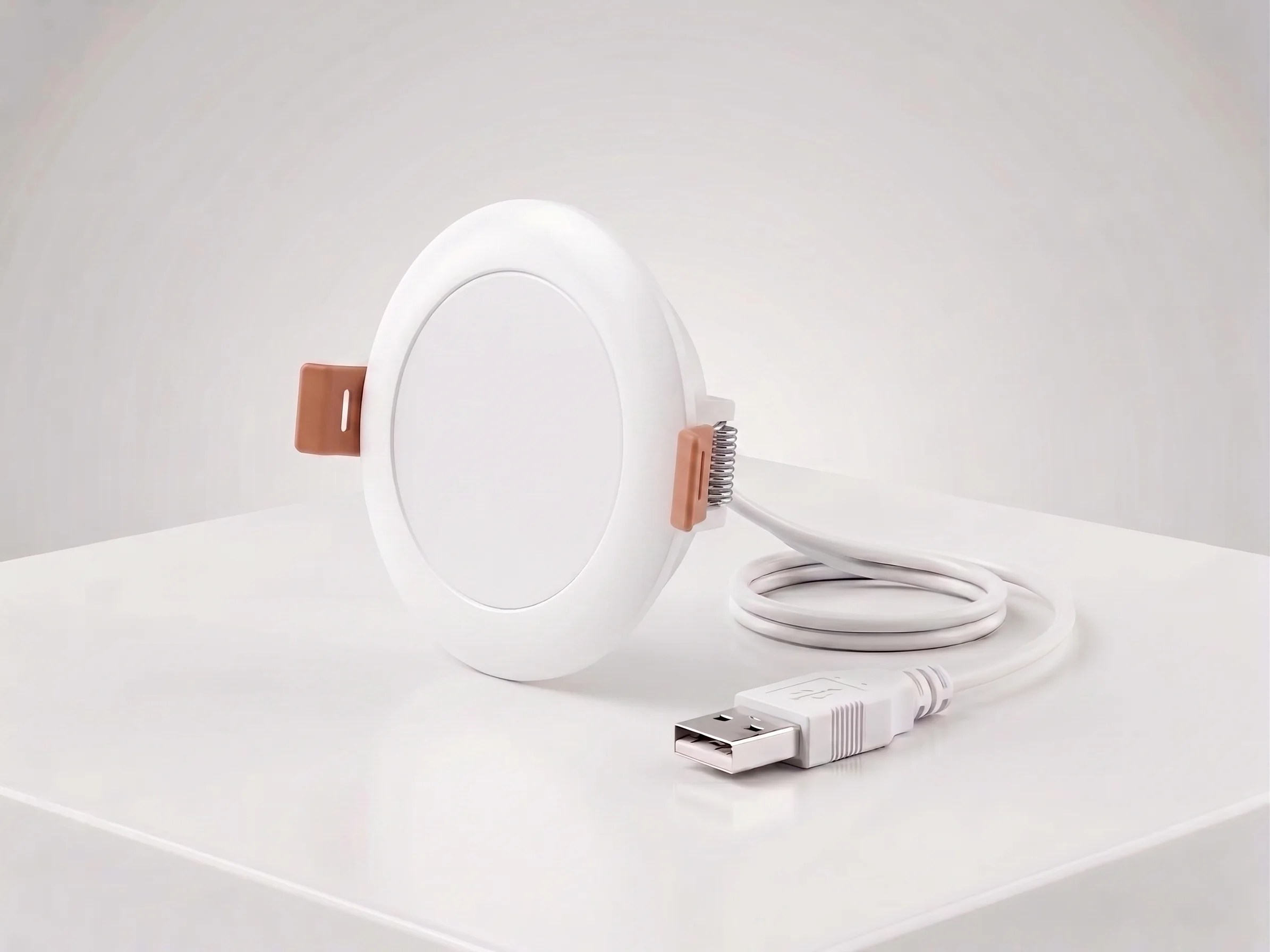
Ceiling Mount mmWave Human Presence Sensor — Zigbee
24GHz wideband mmWave ceiling presence sensor with 10m motion detection, 2.5m micro-motion, and breathing detection. 120° field, DC5V, Zigbee 3.0. For hotel room occupancy and commercial automation.
This page already points to it as the next recommended reference.
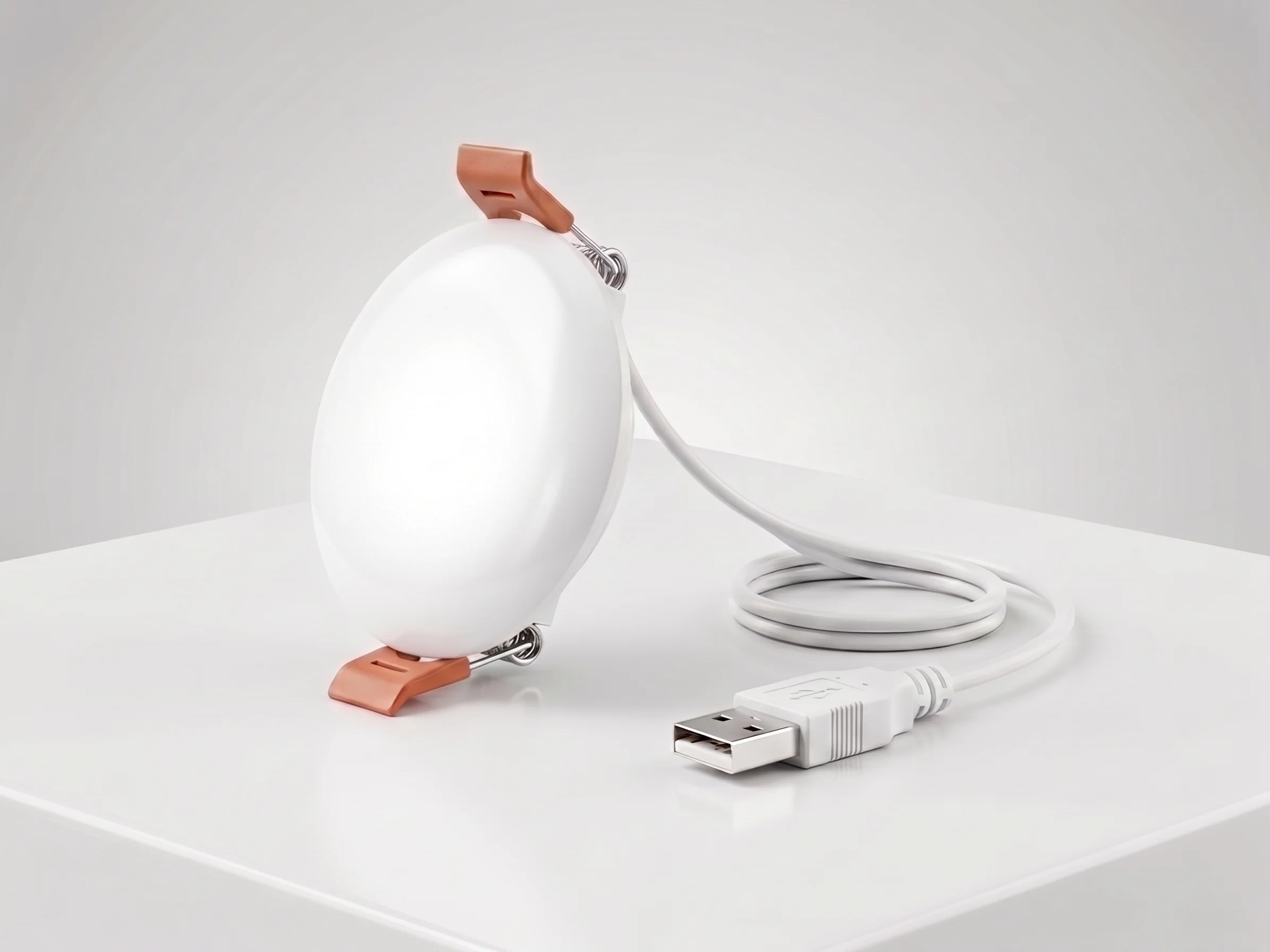
Ceiling Mount mmWave Human Presence Sensor — WiFi
24GHz wideband mmWave ceiling presence sensor with 10m motion detection, 2.5m micro-motion, and breathing detection. 120° field, DC5V, WiFi 2.4GHz. No gateway required for retrofit hotel and apartment projects.
This page already points to it as the next recommended reference.
Related solutions
1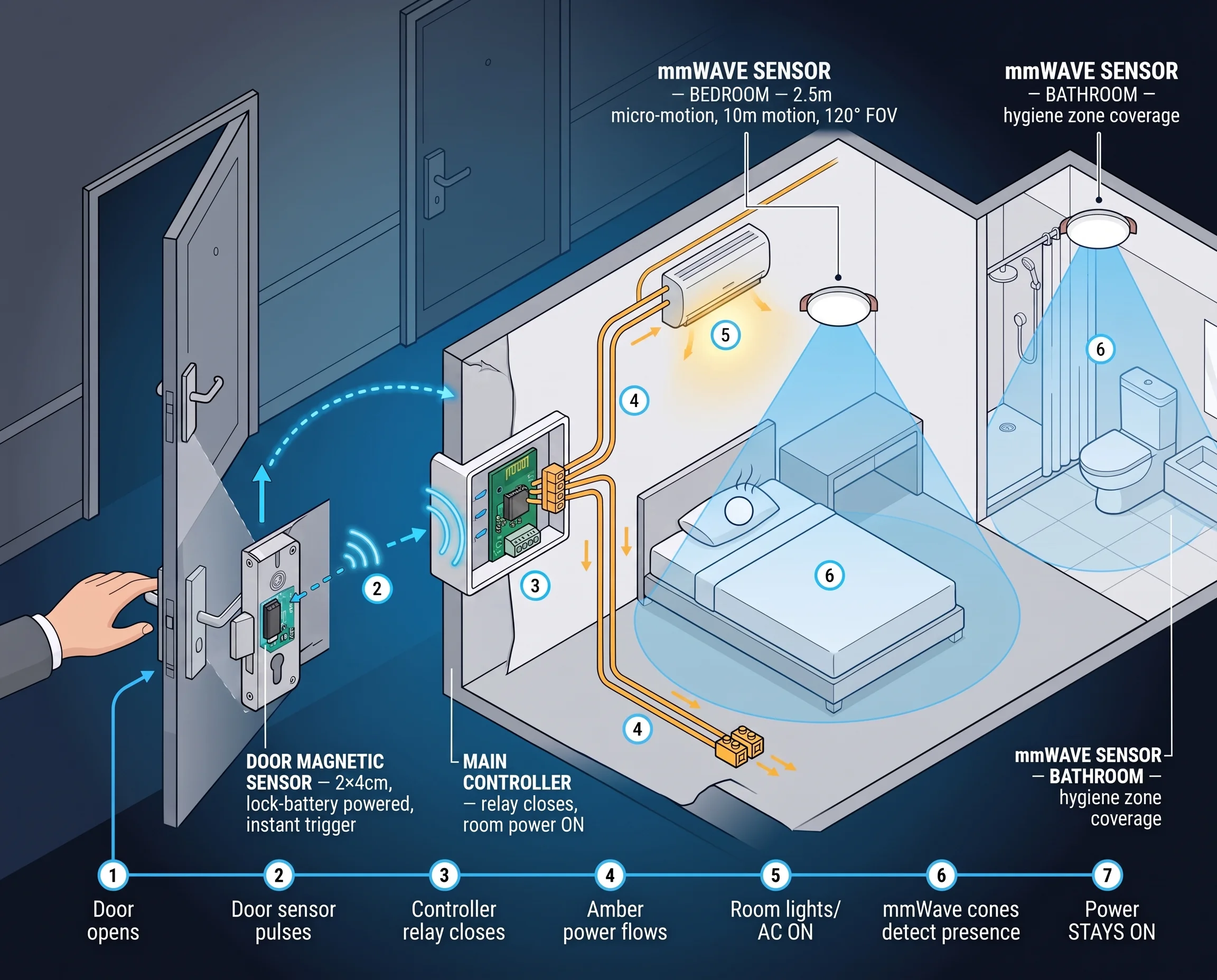
Hotel Room Occupancy & Motion Sensor Solution
mmWave radar presence sensors for hotel room occupancy, housekeeping scheduling, and HVAC energy saving. Detect true occupancy — even when the guest is asleep — with our ceiling-mount hotel room motion sensor.
It supports the same product context: Ceiling Mount mmWave Human Presence Sensor — Zigbee, Ceiling Mount mmWave Human Presence Sensor — WiFi.
Related blog posts
3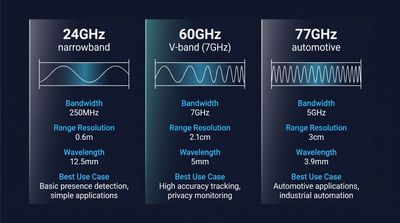
60GHz vs 24GHz vs 77GHz mmWave Sensors: Choosing the Right Frequency for Commercial Presence Detection
Compare 60GHz, 24GHz, and 77GHz mmWave sensors for commercial presence detection. Technical specs, detection range, privacy, and OEM sourcing guidance.
It supports the same product context: Ceiling Mount mmWave Human Presence Sensor — Zigbee, Ceiling Mount mmWave Human Presence Sensor — WiFi.
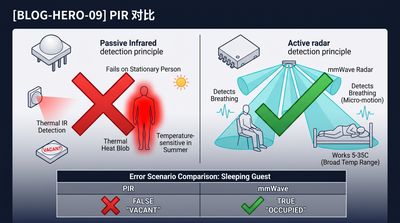
What Is an Electronic Presence Sensor? Technology, Accuracy, and How It Differs From a Motion Sensor
Learn what an electronic presence sensor is, how it detects stationary humans, and how it differs from a PIR motion sensor. Covers mmWave, accuracy, and use cases.
It supports the same product context: Ceiling Mount mmWave Human Presence Sensor — Zigbee, Ceiling Mount mmWave Human Presence Sensor — WiFi.
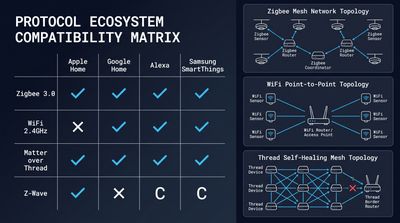
How to Integrate mmWave Presence Sensors With Home Assistant (Local Control Guide)
Step-by-step local control setup guide for mmWave devices, covering MQTT/Matter config, automation scripts, calibration and OEM ceiling presence sensor integration tips.
It supports the same product context: Ceiling Mount mmWave Human Presence Sensor — WiFi, Ceiling Mount mmWave Human Presence Sensor — Zigbee.
Specify your hotel project with our engineers
Send your room count, ceiling type, and protocol preference. We will return a sample plan and quote within 24 business hours.
- Move from general guidance into a product or application discussion.
- Use RFQ when pricing, drawings, MOQ, or launch timing needs structure.
- Keep a direct contact path visible for fast clarifications and handoff.