24GHz mmWave Radar Sensor Manufacturer: How to Choose the Right Supplier
A guide to 24GHz mmWave radar sensor manufacturers. Covers supplier evaluation, chipset vendors, pricing, and how to select the right 24 GHz manufacturer.
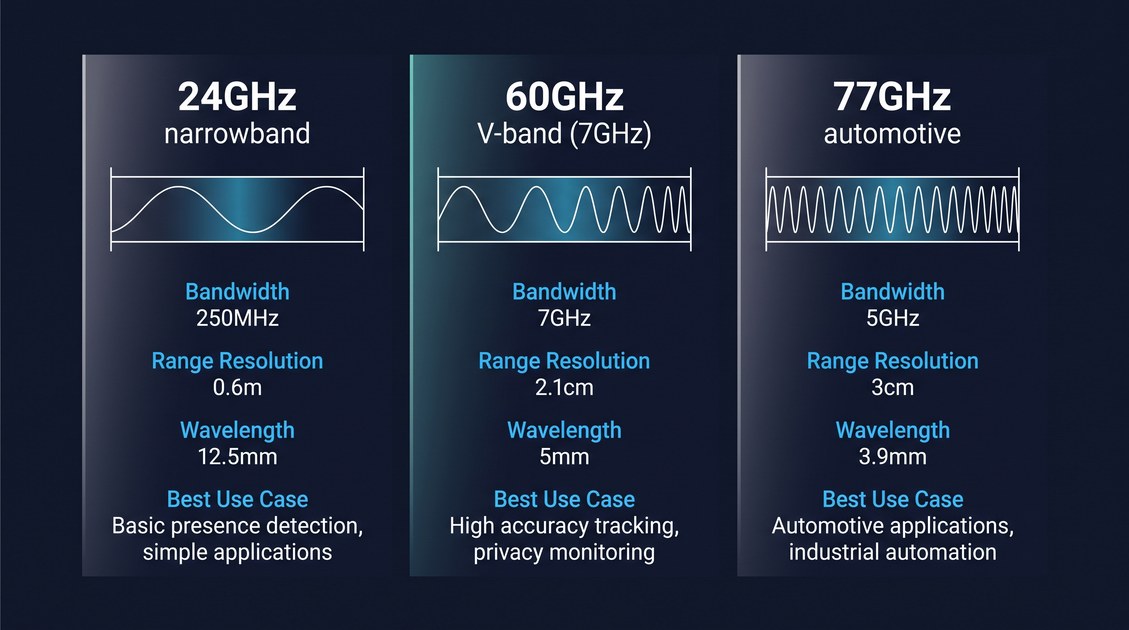
A 24GHz mmWave radar sensor manufacturer is a company that designs and produces millimeter-wave radar devices operating in the 24 GHz industrial-scientific-medical (ISM) band (24.0–24.25 GHz narrowband or 24.05–24.25 GHz UWB), with products ranging from bare silicon chipsets ($2–8 per chipset at 10,000-unit volume) to integrated modules ($3–12 per module at 10,000-unit volume) to finished sensor products ($10–50 per unit at 1,000-unit volume). The 24 GHz mmWave radar sensor manufacturer market is the most mature segment of the mmWave industry, with products used in automatic door openers, security motion sensors, stairwell lighting control, basic occupancy-based lighting control, and some industrial sensing applications. The 24 GHz band is the lowest-cost mmWave option, with the narrowband ISM allocation providing 250 MHz of bandwidth (suitable for motion detection but not for fine range resolution or micro-motion detection) and the UWB allocation providing up to 5 GHz of bandwidth (suitable for fine range resolution, but being phased out for new automotive designs in Europe).
The 24GHz mmWave radar sensor manufacturer market is served by both established international vendors (Texas Instruments, Infineon) and Asian fabless vendors (Calterah, SGR, and others). This guide provides a comprehensive overview of the 24GHz mmWave radar sensor manufacturer landscape, covering the leading manufacturers, the product categories, the pricing structure, and the selection criteria for choosing the right manufacturer for a specific application.
24GHz mmWave Radar Sensor Manufacturer: Leading Manufacturers
The 24GHz mmWave radar sensor manufacturer market is served by several leading manufacturers, each with different strengths and target markets.
Texas Instruments
Texas Instruments (TI) is a leading 24GHz mmWave radar sensor manufacturer, with a product line that includes the IWR1443 and IWR1642 (24 GHz FMCW transceivers). TI's 24 GHz products are widely used in industrial sensing, security, and basic occupancy detection applications.
Pricing for TI's 24 GHz chipsets at 10,000-unit volume is typically $3–6 per chipset. TI maintains regional stocking through major distributors (Mouser, Digi-Key, Arrow) and provides extensive technical documentation and reference designs.
The advantages of TI as a 24GHz mmWave radar sensor manufacturer include the mature software ecosystem, the comprehensive reference designs, the global technical support, and the strong brand recognition. The disadvantages include the higher chipset cost compared to some Asian vendors.
Infineon
Infineon is another leading 24GHz mmWave radar sensor manufacturer, with the XENSIV 24 GHz product line (BGT24 series). Infineon has a strong position in the 24 GHz market, with products used in automotive, industrial, and commercial sensing applications.
Pricing for Infineon's 24 GHz chipsets at 10,000-unit volume is typically $3–6 per chipset. Infineon provides a software development kit and reference designs, and has a strong presence in the European market.
The advantages of Infineon include the automotive heritage, the strong European presence, and the competitive pricing. The disadvantages include a less mature software ecosystem compared to TI for some applications.
Calterah and SGR (Asian Manufacturers)
Calterah and SGR are Chinese fabless 24GHz mmWave radar sensor manufacturers that offer 24 GHz FMCW transceivers at competitive prices. These manufacturers have a strong position in the Asian commercial market and are gaining market share globally.
Pricing for Asian 24GHz mmWave radar sensor manufacturers' chipsets at 10,000-unit volume is typically $1.5–4 per chipset, significantly lower than TI or Infineon. The disadvantages include less mature software ecosystems, more limited global technical support, and potential concerns about long-term supply stability.
Other 24 GHz Manufacturers
Other 24GHz mmWave radar sensor manufacturers include:
- STMicroelectronics: offers 24 GHz radar products for automotive and industrial applications
- NXP: offers 24 GHz radar products, primarily for automotive
- Several Chinese module vendors: offer integrated 24 GHz modules at competitive prices
| Manufacturer | 10K unit price | Software ecosystem | Best for |
|---|---|---|---|
| Texas Instruments | $3–6 | Excellent | OEM custom designs |
| Infineon | $3–6 | Good | European market, automotive |
| Calterah | $1.5–4 | Fair | Cost-sensitive OEM |
| SGR | $1.5–4 | Fair | Cost-sensitive OEM |
| STMicroelectronics | $3–6 | Good | Automotive, industrial |
24GHz mmWave Radar Sensor Manufacturer: Product Categories
The 24GHz mmWave radar sensor manufacturer market offers three main product categories.
24 GHz Chipsets
A 24 GHz chipset is the bare silicon transceiver that OEMs integrate into their own PCB designs. The chipset typically includes the RF transceiver, the ADC, and a basic processor for FMCW chirp generation and FFT processing. Pricing at 10,000-unit volume: $1.5–6 per chipset, depending on the manufacturer and the features.
The 24 GHz chipset is the right choice for OEMs with RF design capability who want to build a custom product with full control over the form factor, the features, and the integration.
24 GHz Modules
A 24 GHz module is an integrated device that includes the chipset, the antenna array, the RF front-end, and the baseband processor on a single PCB. The module typically has a documented interface (SPI, I2C, GPIO) and reference firmware. Pricing at 10,000-unit volume: $3–12 per module, depending on the manufacturer and the features.
The 24 GHz module is the right choice for system integrators and OEMs who want to add 24 GHz radar sensing to their products without doing the full RF design.
24 GHz Finished Products
A 24 GHz finished product is a complete, certified device that is ready for deployment. The product typically includes the module, the microcontroller, the connectivity (Zigbee, WiFi, dry contact), the housing, and the certified firmware. Pricing at 1,000-unit volume: $10–50 per unit.
The 24 GHz finished product is the right choice for end-user deployments (hotel chains, office operators, healthcare facilities) that need ready-to-install devices.
24GHz mmWave Radar Sensor Manufacturer: Pricing Structure
The pricing for 24 GHz mmWave radar sensors varies by product category and by volume.
24 GHz Chipset Pricing
- 1,000-unit lot: $3–8 per chipset
- 10,000-unit lot: $1.5–6 per chipset
- 100,000-unit lot: $1–4 per chipset
24 GHz Module Pricing
- 1,000-unit lot: $5–15 per module
- 10,000-unit lot: $3–12 per module
- 100,000-unit lot: $1.5–8 per module
24 GHz Finished Product Pricing
- 1,000-unit lot: $15–50 per unit
- 10,000-unit lot: $10–40 per unit
- 100,000-unit lot: $8–30 per unit
24GHz mmWave Radar Sensor Manufacturer: Selection Criteria
Selecting the right 24GHz mmWave radar sensor manufacturer requires evaluating several criteria.
Technical Capability
The manufacturer's products should meet the application requirements. Key technical criteria include:
- Frequency and bandwidth: 24 GHz narrowband (250 MHz) or 24 GHz UWB (5 GHz)
- Detection range: 5–15 m for a 24 GHz sensor
- Field of view: ±60° to ±120° depending on the antenna design
- Power consumption: 0.2–1.0 W active for a 24 GHz sensor
- Integration interface: SPI, I2C, GPIO, or a higher-level protocol
Manufacturing Quality
The manufacturer should have robust quality systems in place. Key quality criteria include:
- Certifications: ISO 9001 for quality management, IATF 16949 for automotive
- Yield rate: above 95%
- Field failure rate: below 0.5% per year
- Warranty period: 12–24 months
Supply Chain Resilience
The manufacturer should be able to meet volume commitments and mitigate disruptions. Key supply chain criteria include:
- Lead time: 4–8 weeks at 10K volume for 24 GHz
- Capacity headroom: 60–80% preferred
- Geographic risk: manufacturing in multiple countries preferred
Commercial Terms
The manufacturer should offer fair and flexible commercial terms. Key commercial criteria include:
- Pricing transparency: clear volume-based pricing
- Payment terms: net 30 to net 90 days
- Warranty: 12–24 months
- MOQ: reasonable for the procurement team's volume requirements
24GHz mmWave Radar Sensor Manufacturer: Applications
The 24 GHz mmWave radar sensor is used in a range of applications.
Automatic Door Openers
Automatic door openers are one of the oldest and most common applications for 24 GHz mmWave radar sensors. A 24 GHz CW Doppler sensor mounted above the door detects approaching people and triggers the door to open. The 24 GHz sensor is preferred for this application because it can detect motion through glass and is insensitive to ambient temperature.
Security Motion Sensing
Security motion sensors use 24 GHz mmWave radar sensors (often combined with PIR sensors in a "dual-technology" configuration) to detect intruders. The 24 GHz sensor is preferred because it can detect motion through barriers and is less prone to false triggers from pets, sunlight, and HVAC airflow.
Stairwell and Corridor Lighting Control
Stairwell and corridor lighting control is a common application for 24 GHz mmWave radar sensors. A 24 GHz sensor mounted in the ceiling detects motion and turns on the lights, and turns off the lights after a preset period of no motion.
Basic Occupancy-Based Lighting Control
Basic occupancy-based lighting control in offices, restrooms, and other commercial spaces is another common application. A 24 GHz sensor detects motion and controls the lighting accordingly. For applications where the occupant may be stationary for extended periods, a 60 GHz mmWave sensor is preferred over a 24 GHz sensor.
24GHz mmWave Radar Sensor Manufacturer: Limitations of 24 GHz
The 24 GHz band has several limitations compared to the 60 GHz band.
Limited Bandwidth
The narrowband ISM allocation at 24 GHz provides only 250 MHz of bandwidth, which is sufficient for motion detection but not for fine range resolution or micro-motion detection. The 24 GHz UWB allocation provides up to 5 GHz of bandwidth, but the UWB allocation is being phased out for new automotive designs in Europe and is increasingly restricted for other applications.
Limited Micro-Motion Sensitivity
A 24 GHz narrowband sensor cannot reliably detect the micro-motion of human breathing (the 250 MHz of bandwidth provides only 0.6 m range resolution, which is too coarse for micro-motion detection). For applications that require stationary-occupant detection, a 60 GHz sensor with 7 GHz of bandwidth is required.
Cross-Wall Leakage
A 24 GHz sensor, with its 12.5 mm wavelength, can in some cases detect motion through a single drywall partition, which is a privacy concern for some deployments. For privacy-sensitive deployments, a 60 GHz sensor (which does not penetrate drywall) is preferred.
24GHz mmWave Radar Sensor Manufacturer: When to Choose 24 GHz vs 60 GHz
The choice between 24 GHz and 60 GHz depends on the application requirements.
Choose 24 GHz When
- The application requires motion detection only (no stationary-occupant detection)
- The deployment is cost-sensitive
- The deployment requires motion through barriers (glass, thin walls)
- The deployment is in a market where 24 GHz UWB is still available
Choose 60 GHz When
- The application requires stationary-occupant detection (hotel rooms, offices, healthcare, residential)
- The deployment is privacy-sensitive (the 60 GHz signal does not penetrate drywall)
- The deployment requires fine range resolution (2.1 cm at 60 GHz vs 0.6 m at 24 GHz)
- The deployment requires micro-motion detection (breathing)
24GHz mmWave Radar Sensor Manufacturer: Final Recommendation
The 24GHz mmWave radar sensor manufacturer market is the most mature segment of the mmWave industry, with a range of manufacturers offering chipsets, modules, and finished products at competitive prices. The 24 GHz band is the right choice for cost-sensitive motion-only applications (automatic door openers, security motion sensing, stairwell lighting control, basic occupancy-based lighting control), but it is not suitable for applications that require stationary-occupant detection, for which the 60 GHz band is the default choice.
For a procurement team evaluating 24GHz mmWave radar sensor manufacturers, the right approach is to start with a clear definition of the application requirements, then identify a shortlist of qualified manufacturers (Texas Instruments, Infineon, Calterah, SGR), then evaluate each manufacturer across four dimensions (technical capability, manufacturing quality, supply chain resilience, and commercial terms), and then select the manufacturer that scores best across all dimensions.
The negotiation should focus on the price volume curve, the payment terms, the warranty, and for high-volume orders, a multi-year supply agreement with scheduled price reductions. With this structured approach, a procurement team can secure competitive pricing and reliable supply from a 24GHz mmWave radar sensor manufacturer.
Not sure which sensor fits your project?
Talk to our mmWave application engineers for a free consultation.
Find the right presence sensor for your hotel project
Compare the 3 protocols, check hotel-specific case studies, and download the installation guide
Related products
2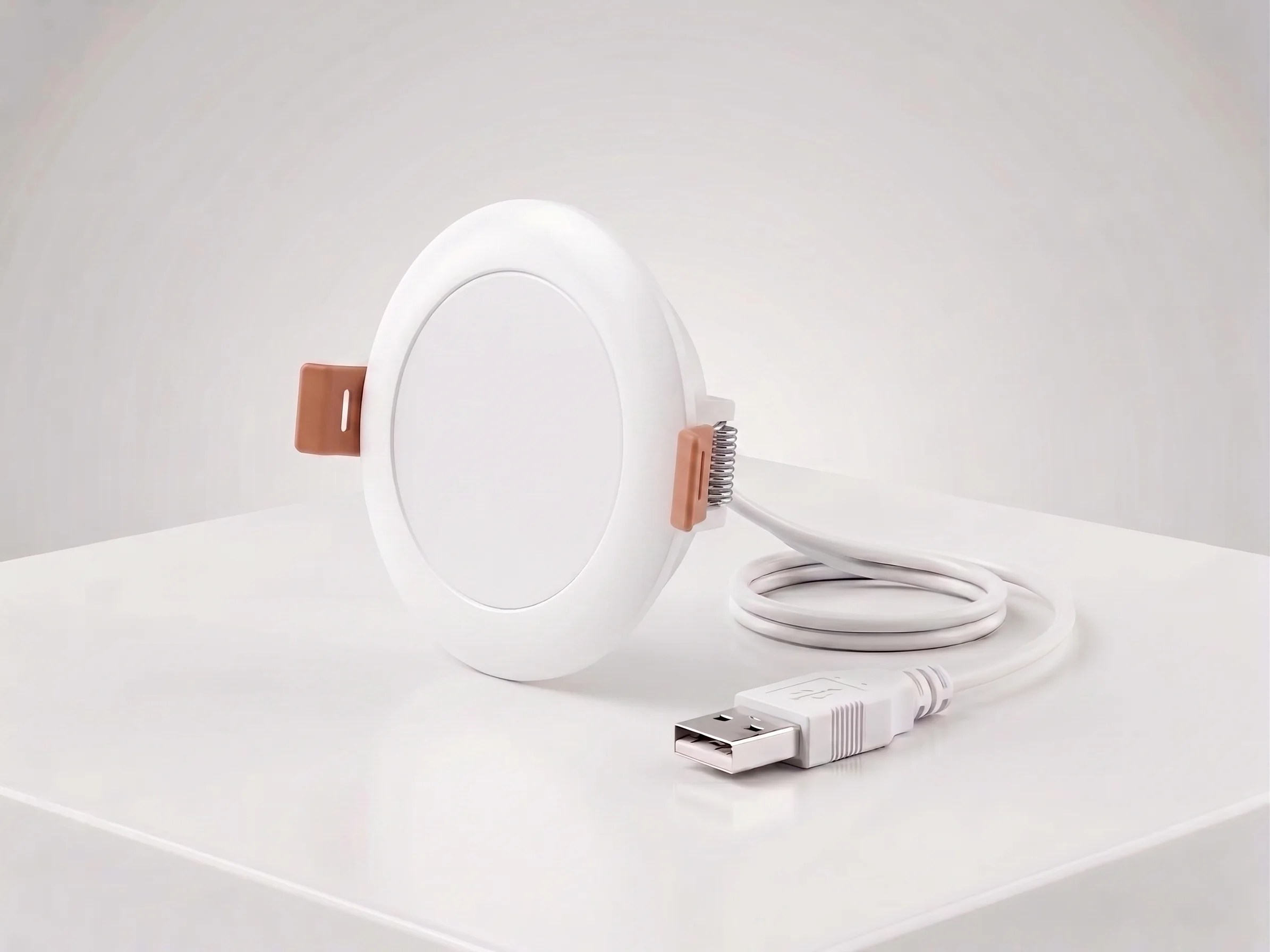
Ceiling Mount mmWave Human Presence Sensor — Zigbee
24GHz wideband mmWave ceiling presence sensor with 10m motion detection, 2.5m micro-motion, and breathing detection. 120° field, DC5V, Zigbee 3.0. For hotel room occupancy and commercial automation.
This page already points to it as the next recommended reference.
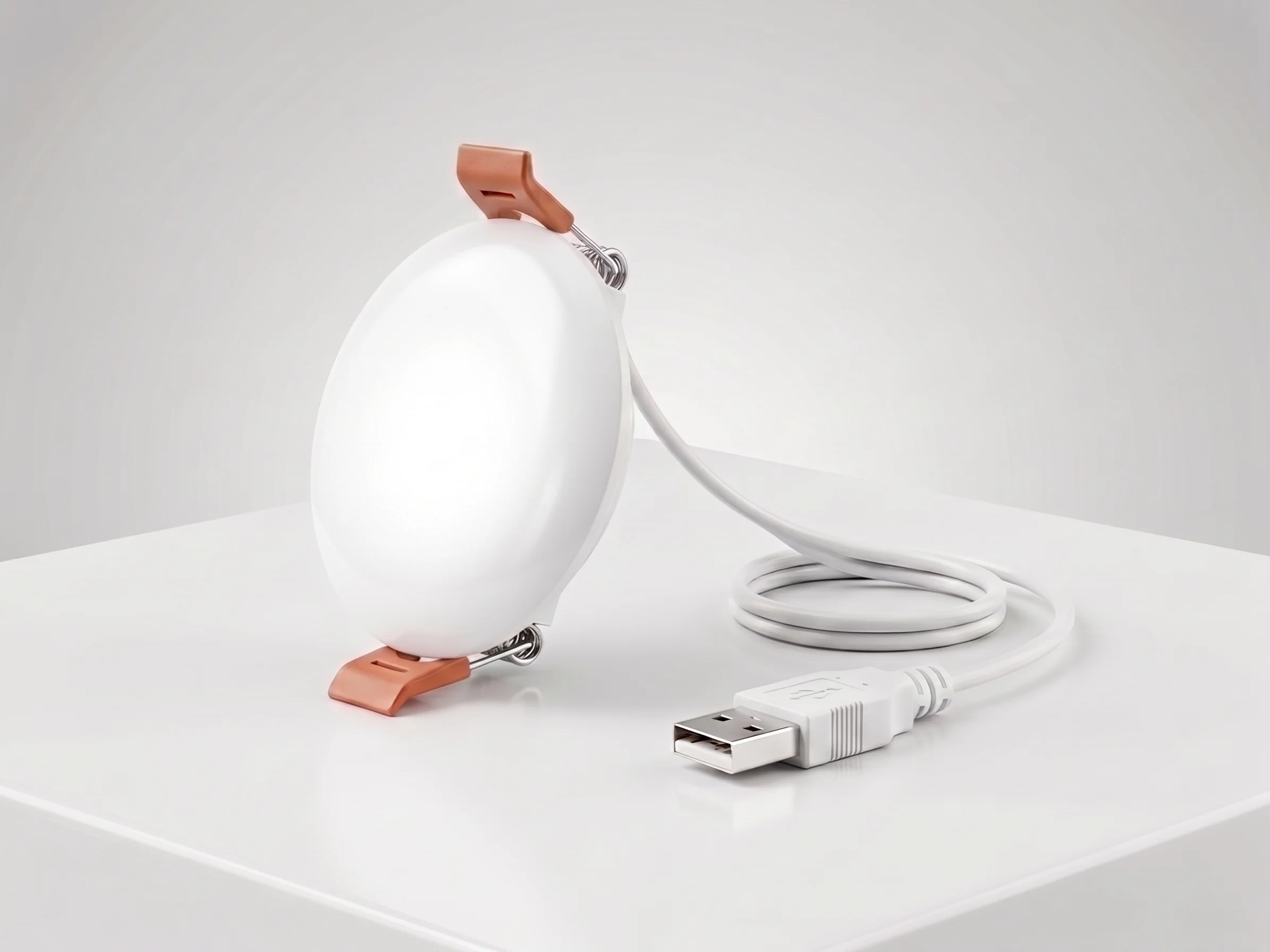
Ceiling Mount mmWave Human Presence Sensor — WiFi
24GHz wideband mmWave ceiling presence sensor with 10m motion detection, 2.5m micro-motion, and breathing detection. 120° field, DC5V, WiFi 2.4GHz. No gateway required for retrofit hotel and apartment projects.
This page already points to it as the next recommended reference.
Related solutions
1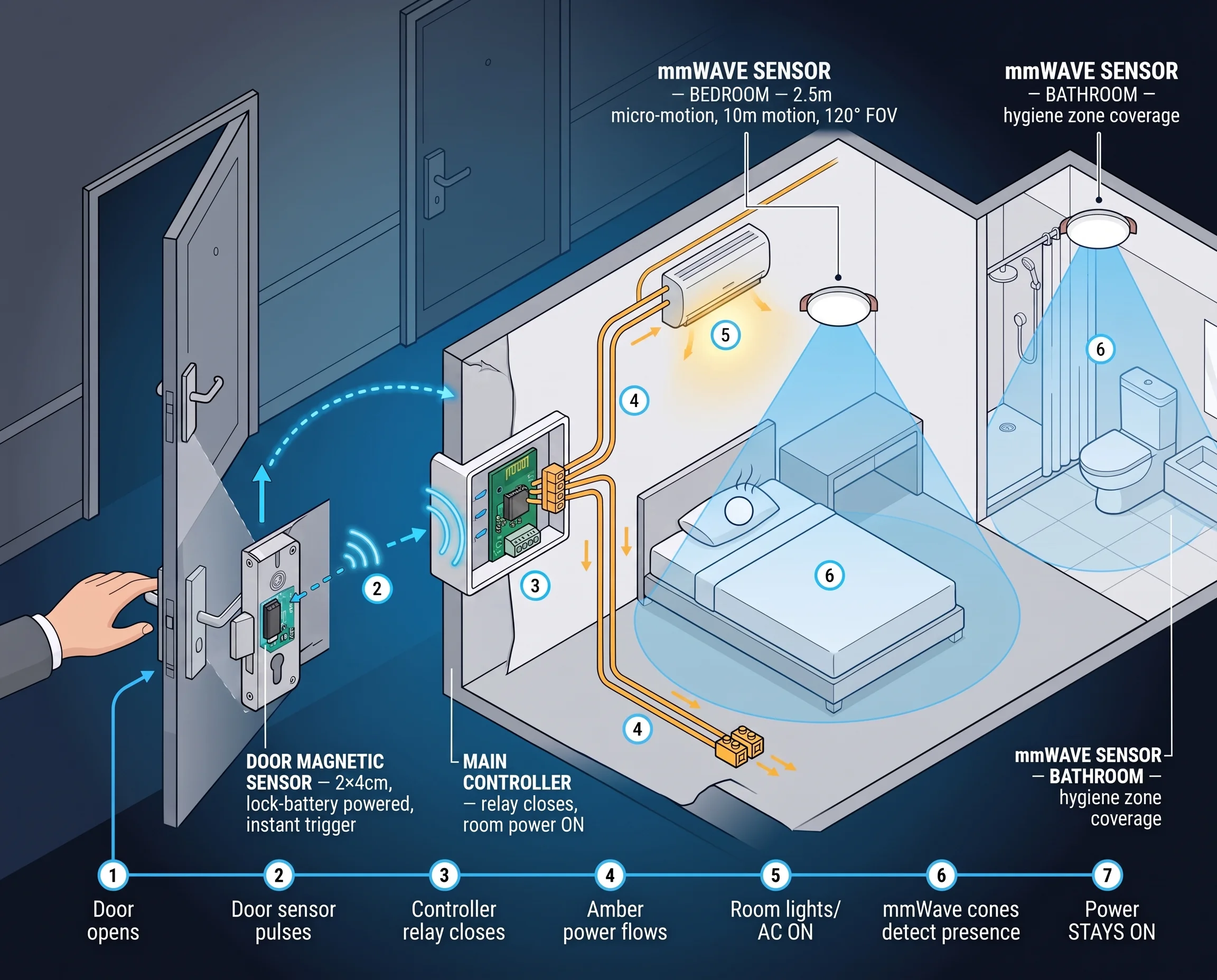
Hotel Room Occupancy & Motion Sensor Solution
mmWave radar presence sensors for hotel room occupancy, housekeeping scheduling, and HVAC energy saving. Detect true occupancy — even when the guest is asleep — with our ceiling-mount hotel room motion sensor.
It supports the same product context: Ceiling Mount mmWave Human Presence Sensor — Zigbee, Ceiling Mount mmWave Human Presence Sensor — WiFi.
Related blog posts
3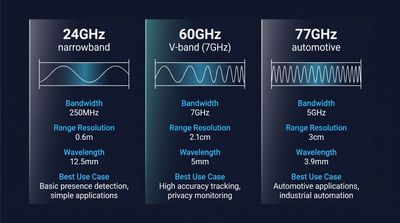
60GHz vs 24GHz vs 77GHz mmWave Sensors: Choosing the Right Frequency for Commercial Presence Detection
Compare 60GHz, 24GHz, and 77GHz mmWave sensors for commercial presence detection. Technical specs, detection range, privacy, and OEM sourcing guidance.
It supports the same product context: Ceiling Mount mmWave Human Presence Sensor — Zigbee, Ceiling Mount mmWave Human Presence Sensor — WiFi.
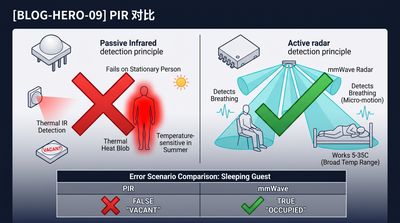
What Is an Electronic Presence Sensor? Technology, Accuracy, and How It Differs From a Motion Sensor
Learn what an electronic presence sensor is, how it detects stationary humans, and how it differs from a PIR motion sensor. Covers mmWave, accuracy, and use cases.
It supports the same product context: Ceiling Mount mmWave Human Presence Sensor — Zigbee, Ceiling Mount mmWave Human Presence Sensor — WiFi.
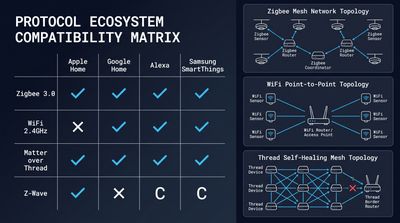
How to Integrate mmWave Presence Sensors With Home Assistant (Local Control Guide)
Step-by-step local control setup guide for mmWave devices, covering MQTT/Matter config, automation scripts, calibration and OEM ceiling presence sensor integration tips.
It supports the same product context: Ceiling Mount mmWave Human Presence Sensor — WiFi, Ceiling Mount mmWave Human Presence Sensor — Zigbee.
Specify your hotel project with our engineers
Send your room count, ceiling type, and protocol preference. We will return a sample plan and quote within 24 business hours.
- Move from general guidance into a product or application discussion.
- Use RFQ when pricing, drawings, MOQ, or launch timing needs structure.
- Keep a direct contact path visible for fast clarifications and handoff.